غير مصنف

كيف يتم إعادة تدوير الكابلات؟

كيف يمكنك إعادة تدوير الكابلات

Why Cable Recycling Matters in Modern Industry

Global copper demand continues to rise driven by electrification, electric vehicles, renewable energy infrastructure, data centers, and 5G networks. Primary mining faces declining ore grades, higher energy intensity, and geopolitical supply risks. Recycling scrap cables offers a high-purity secondary source that requires dramatically less energy.

Recycling copper from scrap typically saves 80–90% of the energy and 85–95% of greenhouse gas emissions compared with primary production from ore. One ton of recycled copper can avoid the need to process approximately 15 tons of ore while delivering metal that meets or exceeds the quality requirements of many downstream applications.

Scrap cables represent one of the cleanest and most valuable copper-bearing streams because the conductor is usually high-purity electrolytic copper. When processed correctly, the recovered metal commands premium pricing as Bare Bright (ISRI Barley) or high-grade nodules.

Cable Classification and Expected Copper Recovery Rates

Not all cables are equal. Recovery percentage (copper content by weight) and processing difficulty vary significantly:

Cable CategoryTypical Copper Recovery %Common ExamplesProcessing Notes
High-grade power / heavy industrial55–70%+Large single-core, multi-core power, EV charging cables, busbar feedersHighest value; often worth stripping or high-yield granulation
Medium-grade installation40–55%Twin & Earth (T&E), THHN, Romex, domestic flexStandard dry granulation performs well
Low-grade / fine wire15–35%Data, telecom, signal, alarm, CAT5/6, appliance cordsRequires fine granulation + electrostatic stage for high recovery
Armored / SWAVariable (armor reduces % )Steel-wire armored power cablesMagnetic separation essential before granulation
Automotive harness30–50%Vehicle wiring loomsMixed gauges; pre-sorting improves results

ISRI Specifications (key commercial grades):

  • Barley: No.1 Bare Bright copper wire — uncoated, unalloyed, bright, free of insulation and oxidation. Highest price.
  • Druid: Insulated copper wire containing No.1 (Barley-grade) conductor, sold on recovery basis.
  • Droid: Insulated copper wire containing No.2 conductor, sold on recovery basis.

Accurate pre-sorting and sampling (weighing a representative cut sample before and after stripping) is essential for correct valuation and process optimization.

Complete Industrial Recycling Process – Engineering Breakdown

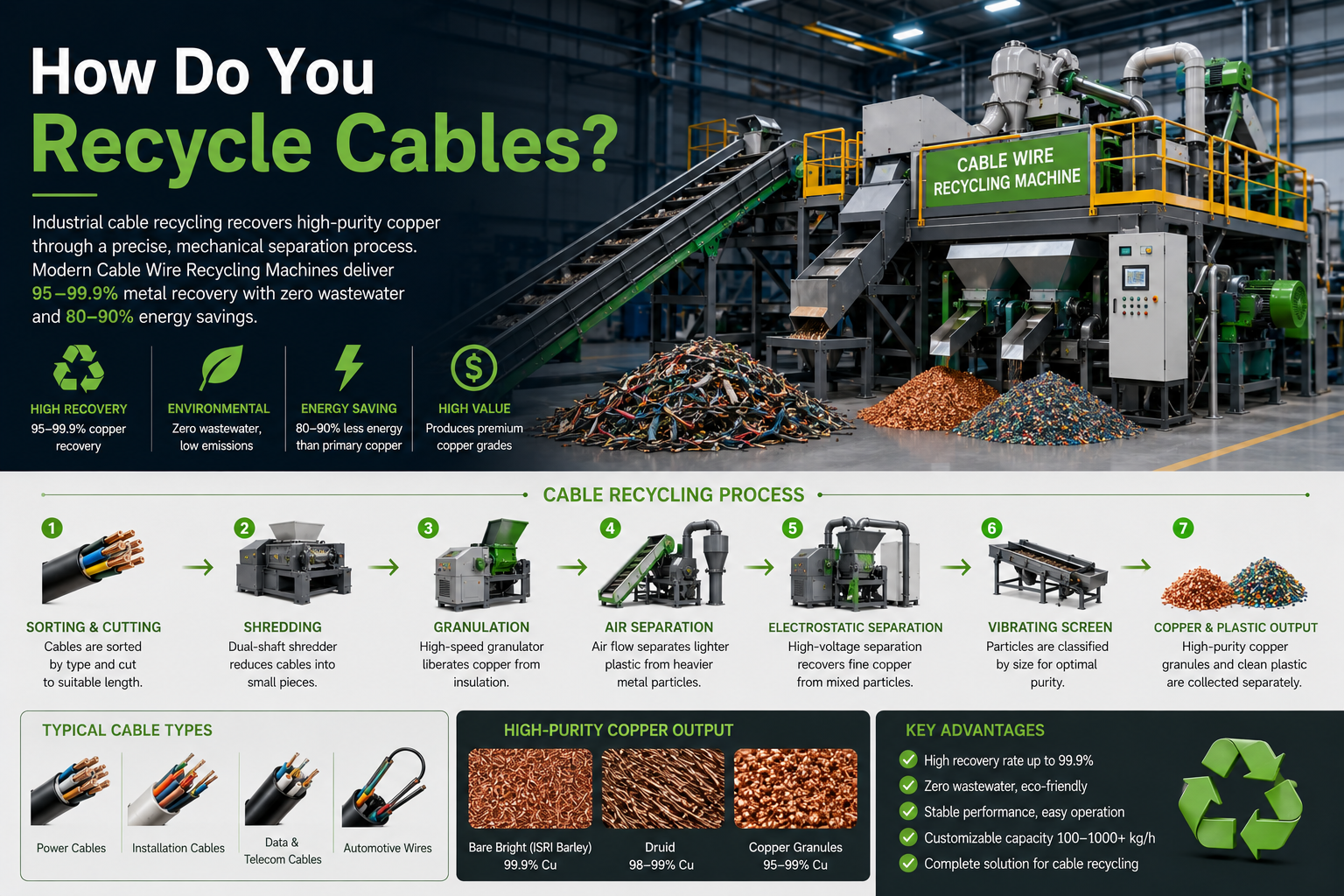
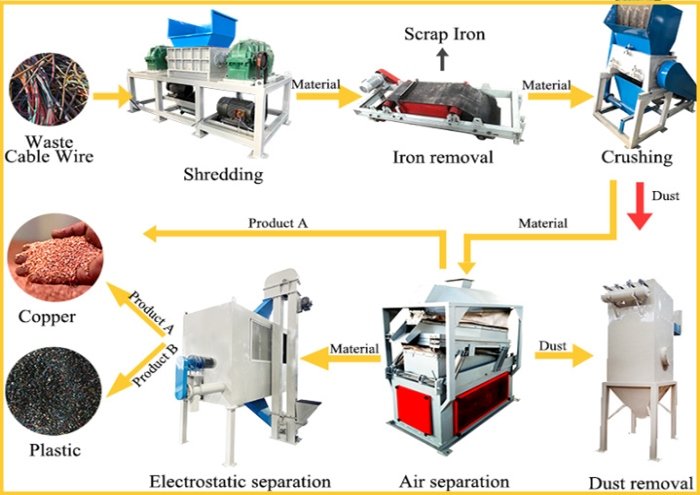
A modern Cable Wire Recycling Machine line is a continuous, multi-stage physical separation system. The dominant technology today is dry processing because of zero wastewater, lower operating cost, and strong environmental compliance.

Stage 1: Reception, Sorting & Pre-Processing

Incoming material is weighed, inspected, and sorted by metal type (Cu vs Al), gauge range, and presence of armor or connectors. Thick or armored cables are cut with hydraulic shears or processed through a primary scrap cable stripper to remove the outer jacket. This reduces load on the shredder and improves downstream liberation.

Stage 2: Primary Size Reduction – Shredding

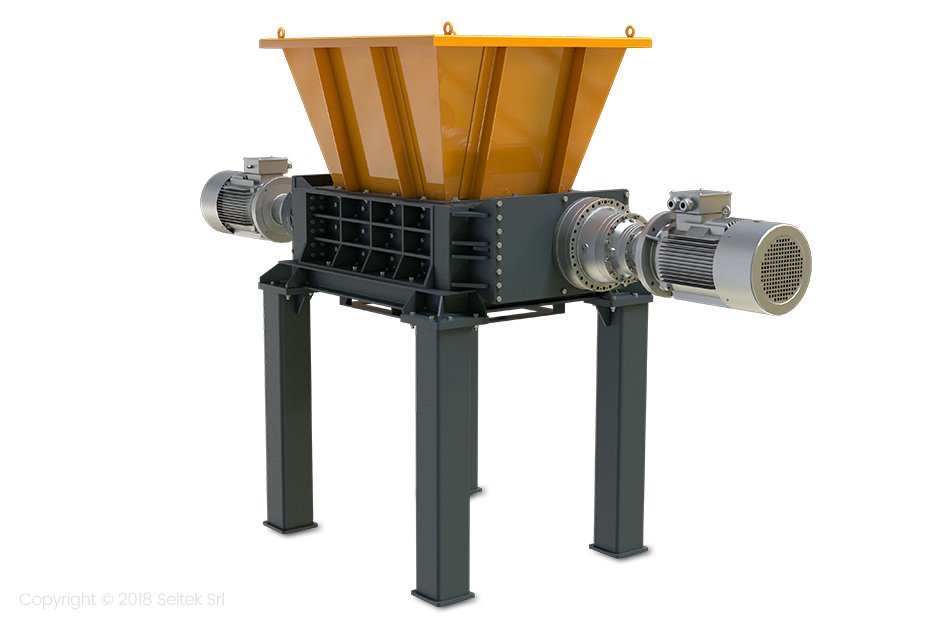
Dual-shaft (or four-shaft) shredders with interlocking hardened blades reduce long cables to 30–80 mm fragments. Dual-shaft designs provide high torque at low speed, handle tough or contaminated material, and minimize fines generation. Optional overband or drum magnets remove ferrous armor and plugs at this stage, protecting the granulator and raising final purity.

Stage 3: Fine Granulation

The shredded material enters a high-speed granulator fitted with a rotor carrying precision knives (commonly D2 or SKD-11 tool steel, hardness HRC 58+). The material is reduced to uniform granules of 2–8 mm (typically 3–5 mm for optimal separation). This step fully liberates metal from insulation. Blade life is normally 6–12 months depending on feed cleanliness and daily throughput; knives are resharpenable.

Stage 4: Multi-Stage Separation

  • Air classification / Zigzag or vibrating air table: Density difference is exploited. Copper (≈8.96 g/cm³) falls while plastic (0.9–1.4 g/cm³) is lifted by controlled airflow.
  • Magnetic separation: Removes residual ferrous particles.
  • Electrostatic separation: High-voltage corona discharge (typically 20–40 kV) charges particles differently. Metal and non-metal trajectories diverge. This stage is critical for recovering fine “hair wire” that air separation alone may lose.
  • Vibrating screens classify particle sizes and improve separation efficiency.

Modern dry lines routinely achieve copper recovery rates of 95–99.9% and metal purity of 99–99.9% when properly configured and calibrated.

Stage 5: Dust Control, Conveying & Packaging

Pulse-jet baghouse or cartridge filters capture dust (often >99.9% efficiency on PM2.5). Plastic granules are frequently conveyed pneumatically to storage. Clean copper granules and plastic fractions are collected in bins or big bags ready for sale.

Dry vs Wet Cable Recycling Systems – Technical Comparison

المعلمةDry ProcessWet Process
Water consumptionZeroContinuous circulation required
Wastewater / sludgeNoneRequires treatment system
Copper purity99–99.9% (with electrostatic)99.5–99.9%
Fine wire recoveryExcellent with electrostatic stageSlightly higher on ultra-fine fractions
Energy consumptionأدنىHigher (pumps + drying)
Operating costأدنىHigher (water, chemicals, sludge disposal)
Environmental complianceStronger (no liquid discharge)More complex permitting
FootprintCompactLarger (water handling + drying)
Output conditionDry, immediately saleableWet; requires drying
Market preference (new plants)>90% of new installationsSpecialty / fine-wire focused

Dry systems dominate new investments due to regulatory trends, lower total cost of ownership, and equivalent or near-equivalent purity when electrostatic technology is included.

Typical Machine Specifications (Reference Range)

Capacity ClassThroughputInstalled Power (approx.)Typical PuritySuitable For
Compact / Entry100–200 kg/h25–40 kW99–99.5%Start-ups, small yards
Mid-range300–600 kg/h40–80 kW99.5–99.9%Regional recyclers
Industrial800–1500+ kg/h90–200+ kW99.5–99.9%Large plants, manufacturers

Actual performance depends on feed composition, pre-sorting quality, and correct calibration of air velocity, vibration frequency, and electrostatic voltage.

Economic & Operational Considerations

Revenue is driven primarily by copper purity and recovery rate. Moving from 95% to 99%+ recovery on high-volume lines can add substantial annual revenue. Plastic fractions also generate income when clean and color-sorted.

Key operating costs include electricity, blade replacement, labor (modern lines often require only 1–2 operators), and maintenance. Proper pre-sorting and magnet protection dramatically extend blade life and reduce downtime.

Selection Criteria for a Reliable Cable Wire Recycling Machine

When evaluating equipment, prioritize:

  • Proven recovery rate and purity on your specific cable mix (request test reports)
  • Blade material and resharpening capability
  • Completeness of the separation train (air + magnetic + electrostatic)
  • Dust collection performance and noise levels
  • PLC automation level and remote diagnostics
  • Modular design for future capacity expansion
  • After-sales support, spare parts availability, and process engineering assistance
  • Compliance with local environmental and safety standards

Customized configurations are standard for professional suppliers. Feedstock analysis, layout design, and process guarantees should form part of the technical package.

Best Practices for Maximum Performance

  • Maintain consistent feed rate; avoid overloading the granulator.
  • Keep magnets clean and correctly positioned.
  • Calibrate air tables and electrostatic separators regularly against known samples.
  • Implement a preventive maintenance schedule for knives, screens, and bearings.
  • Train operators on purity sampling and process adjustment.
  • Segregate high-value and low-value streams at source whenever practical.

Conclusion – Turning Scrap into Reliable High-Value Resources

Professional cable recycling with modern Cable Wire Recycling Machines converts a complex waste stream into two clean, marketable products: high-purity copper granules and recyclable plastic. When engineered correctly, the process delivers recovery rates above 99%, strong environmental performance, and attractive returns.

As a long-term technical partner in the cable and recycling industry, we focus on reliable equipment design, process optimization, and sustained support rather than one-off sales. Our solutions emphasize stable purity, low operating cost, and the ability to handle real-world mixed feedstocks.

استفسر الآن for a detailed technical proposal, capacity calculation based on your material mix, layout drawings, and current equipment configurations. We will provide data-backed recommendations tailored to your throughput targets and purity requirements.

اترك تعليقاً

لن يتم نشر عنوان بريدك الإلكتروني. الحقول الإلزامية مشار إليها بـ *