غير مصنف

ما هي آلة الدرفلة على البارد لقضبان النحاس؟

ماكينة التدحرج على البارد لقضبان النحاس

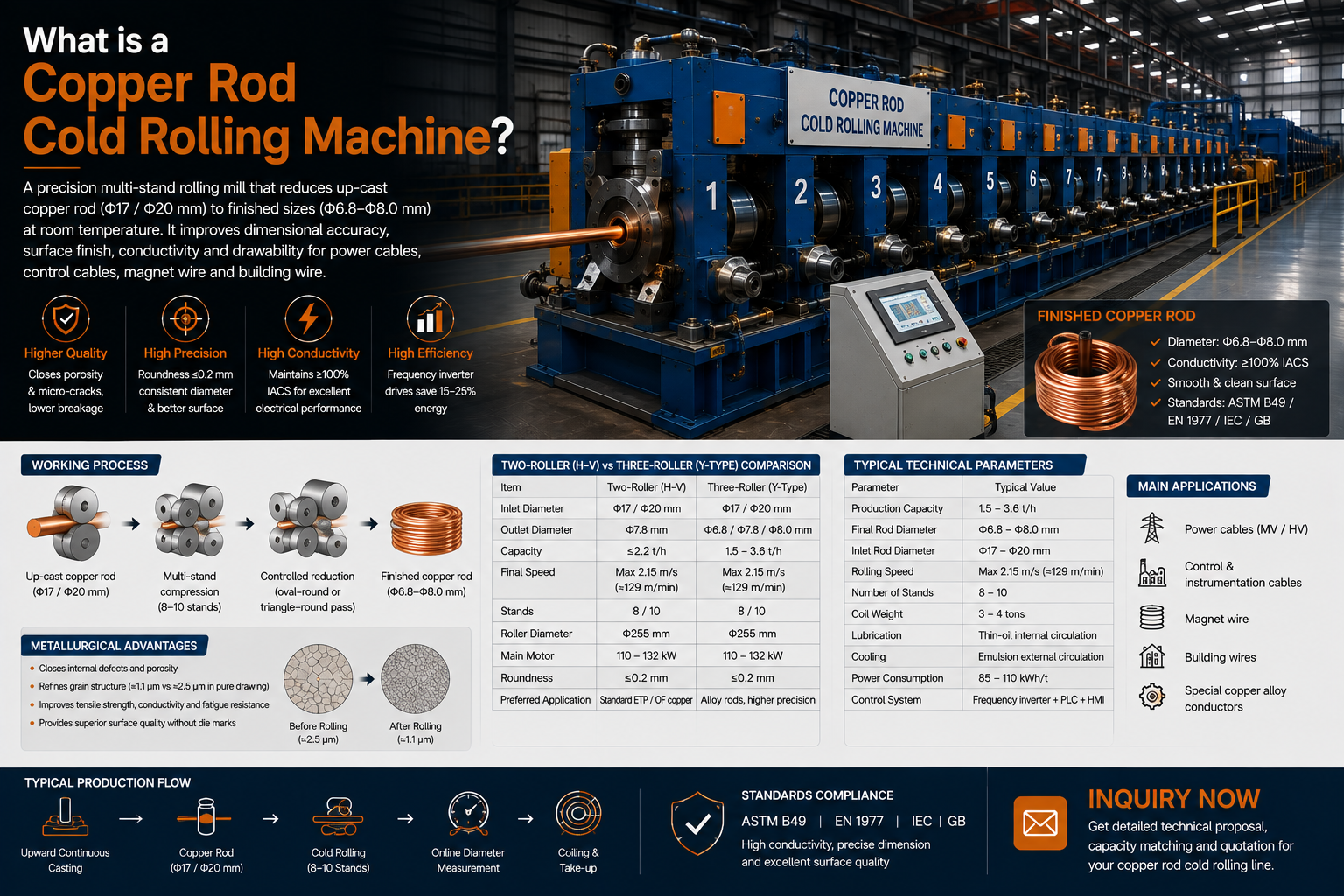
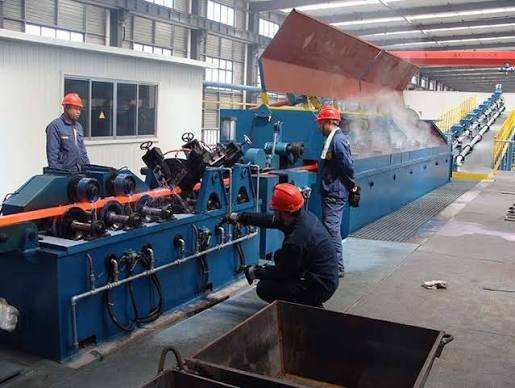
A آلة الدرفلة الباردة لقضبان النحاس is a precision multi-stand rolling mill that reduces the diameter of up-cast oxygen-free or low-oxygen copper rod (typically Φ17 mm or Φ20 mm) to finished sizes of Φ6.8–Φ8.0 mm at room temperature through successive compressive deformation. The process operates below the recrystallization temperature of copper, producing a denser grain structure, higher dimensional accuracy, improved surface finish, and enhanced drawability for subsequent wire drawing used in power cables, control cables, magnet wire, and building wire.

Two main configurations are used in modern cable conductor production: two-roller (horizontal-vertical alternating) mills and three-roller (Y-type) mills. Both close internal porosity and micro-cracks inherent in continuous up-casting, refine grain size (typically to ~1.1 μm versus ~2.5 μm in pure drawing under comparable strain), and deliver roundness of ≤0.2 mm while maintaining conductivity ≥100–101 % IACS after proper processing.

How Does Copper Rod Cold Rolling Work and What Metallurgical Advantages Does It Provide?

Cold rolling applies pure compressive force between precision rollers rather than tensile drawing. The rod passes through a series of 8–10 stands with oval-round or triangle-round pass schedules. Each stand reduces cross-section by a controlled ratio (typically 1.15–1.4 per pass), producing total elongation while work-hardening the material in a controlled manner.

Key metallurgical results include:

  • Closure of casting defects (porosity, blowholes, micro-cracks), reducing downstream wire breakage by 15–30 %.
  • Finer, more uniform grain structure that improves both tensile strength and electrical conductivity.
  • Superior surface quality free of die marks common in drawing.
  • Higher density and better fatigue resistance for fine-wire and magnet-wire applications.

Emulsion cooling and thin-oil lubrication systems keep roll temperature stable and prevent surface oxidation or contamination.

What Are the Main Types of Copper Rod Cold Rolling Machines and Their Technical Comparison?

Selection depends on required output diameter accuracy, production volume, and alloy type (pure copper or Cu-Mg, Cu-Ag, Cu-Sn alloys).

إعدادInlet DiameterOutlet Diameterالسعة (طن/ساعة)Final Speed (m/s)StandsMain MotorRoundnessPreferred Application
Two-roller (H-V)Φ17 / Φ20 mmΦ7.8 مم≤2.2Max 2.158 / 10110–132 kW≤0.2 mmStandard ETP / OF copper for power & building cable
Three-roller (Y-type)Φ17 / Φ20 mmΦ6.8 / Φ7.8 / Φ8.0 mm1.5–3.6Max 2.158 / 10110–132 kW≤0.2 mmAlloy rods, higher precision, lower ovality

Three-roller Y-type mills provide a more uniform three-dimensional stress state, eliminating torsion and improving roundness for high-end magnet wire and specialty conductors. Two-roller mills remain cost-effective for high-volume standard cable rod.

Technical Parameters and Performance Data

Typical industrial specifications for continuous cold rolling lines integrated with up-casting systems:

المعلمةTwo-Roller ExampleThree-Roller Example
Inlet rod diameterΦ17 مم / Φ20 ممΦ17 مم / Φ20 مم
Outlet rod diameterΦ7.8 ممΦ6.8 / Φ7.8 / Φ8.0 mm
Production capacity≤2.2 t/h1.5–3.6 t/h
Final rolling speedMax 2.15 m/s (≈129 m/min)Max 2.15 m/s
Number of stands8 or 108 or 10
Roller diameterΦ255 ممΦ255 مم
Coil weight3–4 tons3–4 tons
Control systemمحول تردد + وحدة تحكم منطقية قابلة للبرمجة + واجهة مستخدم رسوميةمحول تردد + وحدة تحكم منطقية قابلة للبرمجة + واجهة مستخدم رسومية
LubricationThin-oil internal circulationThin-oil internal circulation
CoolingEmulsion external circulationEmulsion external circulation
Typical power consumption85–110 kWh/t85–110 kWh/t

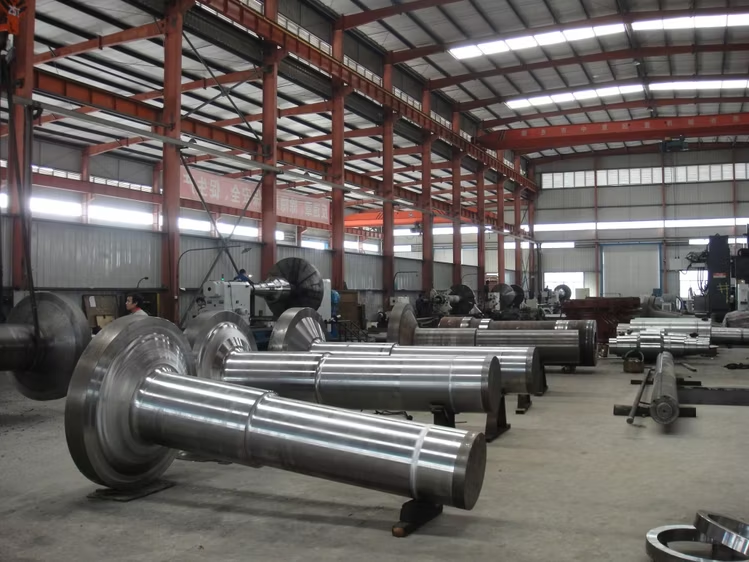
Roll materials are commonly Cr12MoV or H13 tool steels for extended service life. Frequency-converter drives deliver 15–25 % energy savings versus fixed-speed systems and enable soft-start operation that reduces mechanical stress.

Selection Guidelines and Application in Cable Manufacturing

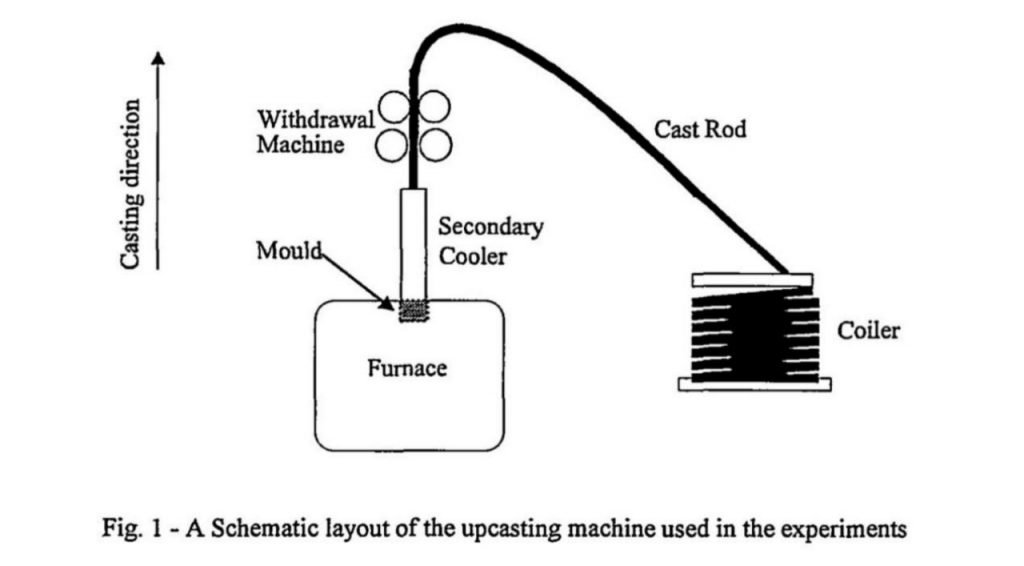
For power-cable and control-cable producers, the cold rolling machine is normally placed immediately after the up-casting line. Selection criteria include:

  • Matching inlet diameter to the up-caster output (most commonly Φ17 mm or Φ20 mm).
  • Required final diameter for downstream multi-wire drawing (Φ8 mm is standard for many medium-voltage and building-wire lines).
  • Alloy capability when producing copper-magnesium or copper-silver rods for high-strength or high-conductivity applications.
  • Integration with online laser diameter measurement, automatic coiling, and SCADA/MES systems for process traceability.

The resulting rod meets the dimensional, mechanical, and electrical requirements of ASTM B49, EN 1977, and corresponding IEC/GB standards for electrical conductor rod (conductivity ≥100 % IACS for ETP grades, higher for oxygen-free grades).

Standards, Quality Control and Failure Prevention

Finished rod must satisfy chemical composition, tensile strength, elongation, and conductivity limits defined in ASTM B49 and EN 1977. Critical process controls include emulsion concentration and temperature, roll gap accuracy, and tension management between stands.

أنماط الفشل الشائعة وكيفية الوقاية منها:

  • Excessive ovality → correct roll alignment and pass schedule.
  • Surface scratches or residual oxide → maintain proper emulsion filtration and descaling.
  • Premature roll wear → use high-quality tool-steel rolls and separated lubrication circuits.
  • Wire breakage in subsequent drawing → ensure complete closure of casting porosity through adequate total reduction and proper cooling.

Key Technical Points Summary

Copper rod cold rolling machines convert up-cast rod into high-quality intermediate product for cable conductors by applying multi-stand compressive deformation at ambient temperature. The process refines microstructure, eliminates internal defects, improves surface quality, and delivers consistent roundness and conductivity required by modern power, control, and magnet-wire applications. Two-roller and three-roller configurations offer capacity ranges of 1.5–3.6 t/h with energy consumption typically 85–110 kWh/t. Proper selection and process control directly determine downstream drawing performance and final cable reliability.

For engineered copper rod cold rolling solutions matched to your up-casting capacity, target diameter, alloy range, and cable production requirements, استفسر الآن.

اترك تعليقاً

لن يتم نشر عنوان بريدك الإلكتروني. الحقول الإلزامية مشار إليها بـ *