غير مصنف

What Is a Triple Layer Co-Extrusion Dry Cure CCV Line?

What is Triple Layer Co-Extrusion Dry Cure CCV Line-doingcable

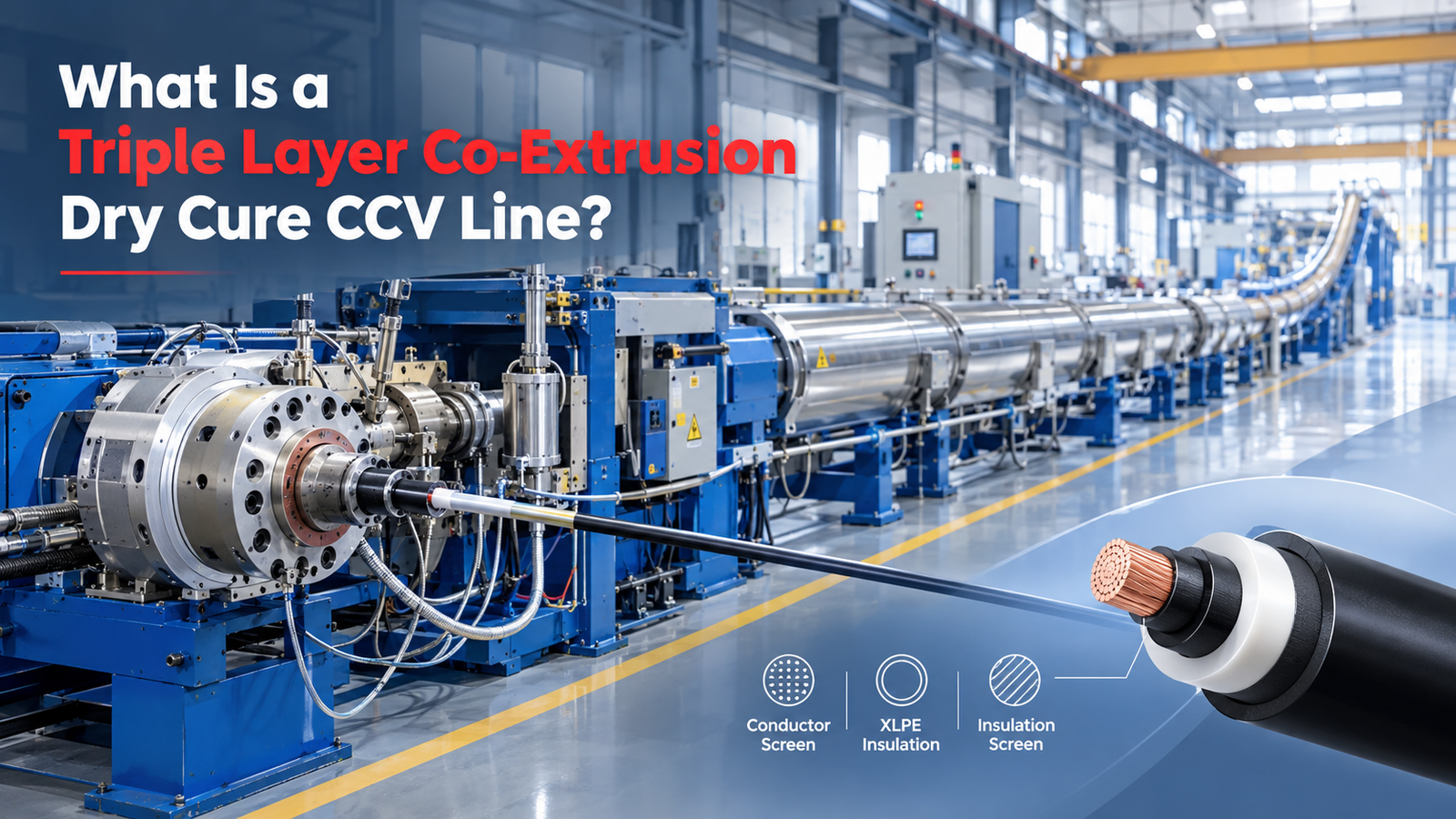
A خط معالجة جافة ثلاثي الطبقات بتقنية البثق المشترك CCV is a continuous catenary vulcanization system that simultaneously extrudes the conductor screen, XLPE insulation and insulation screen through a single triple crosshead, then cross-links the peroxide-cured XLPE inside a pressurized nitrogen-filled heated tube.

It is the global standard process for medium-voltage (6–35 kV) and high-voltage (up to 110–132 kV, extendable higher) XLPE power cables. Dry nitrogen cure eliminates the residual moisture associated with steam curing and thereby reduces water-tree risk. True triple co-extrusion eliminates interface contamination between the three layers.

Typical configurations cover Cu 25–1000 mm² / Al 35–1000 mm², insulation thickness 3.4–15 mm (higher for EHV), line speeds 0–30 m/min, and half-catenary or vertical layouts. Finished cores must meet IEC 60502-2 or IEC 60840 after degassing and subsequent screening/sheathing.

What Is a Triple Layer Co-Extrusion Dry Cure CCV Line?

A خط معالجة جافة ثلاثي الطبقات بتقنية البثق المشترك CCV produces the insulated core of XLPE power cables by extruding three layers in one pass and continuously cross-linking the insulation under pressurized dry nitrogen in a catenary tube.

CCV = Continuous Catenary Vulcanization. The cable hangs under gravity in a natural catenary curve inside a long stainless-steel tube. Dry cure means the vulcanizing medium is high-purity nitrogen (normally ≥99.5 %) rather than saturated steam. The combination of true triple co-extrusion and dry nitrogen cure became the industry standard for peroxide-cured XLPE after water-tree failures were linked to residual moisture from steam curing.

How does the triple-layer dry-cure CCV process actually work?

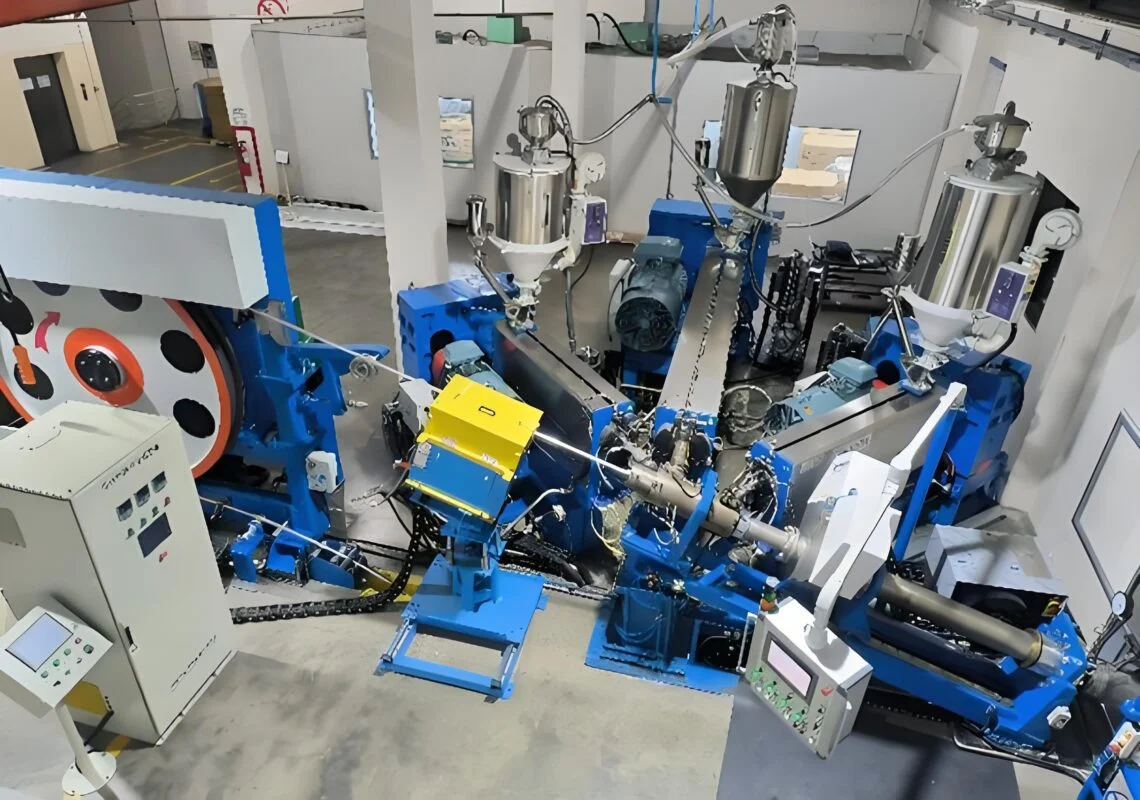
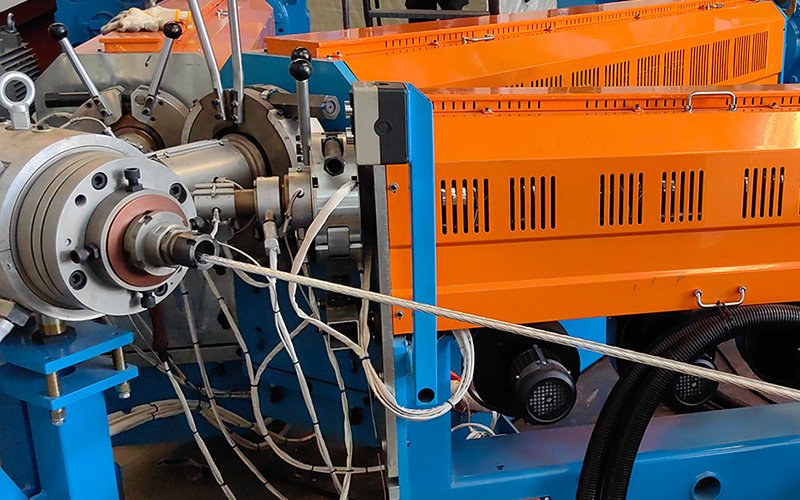
The conductor is paid off, optionally preheated, and enters a precision triple crosshead. Three dedicated extruders simultaneously apply the inner semi-conductive screen, XLPE insulation and outer semi-conductive screen. The coated core immediately enters the heated catenary tube where radiant heat and pressurized nitrogen raise the insulation temperature so that the organic peroxide decomposes and forms cross-links.

Typical process sequence and control points:

  1. Pay-off, dancer or accumulator, optional conductor preheater (improves heat transfer into the insulation and reduces droop).
  2. Triple co-extrusion through a dedicated three-layer crosshead (common sizes Φ65/150/90 for MV, Φ80/175/100 for higher output/HV).
  3. Entry heat treatment zone (sometimes used to control viscosity near the conductor).
  4. Heating section of the CCV tube (multiple independent zones, tube wall temperatures typically 300–450 °C, design often 400–450 °C).
  5. Transition / pre-cooling zone (still under nitrogen pressure).
  6. Pressurized water-cooling section.
  7. Exit seal, haul-off, inline X-ray or laser measurement of diameter and eccentricity, take-up.

Nitrogen pressure is normally maintained at approximately 1.0–1.6 MPa (design pressure of tubes commonly 1.6 MPa, supply pressure 2.0–2.5 MPa). The pressure keeps cross-linking by-products (including methane) in solution and suppresses void formation. Residence time in the heating section is set by line speed and tube length so that cross-link density reaches the required level (normally verified by hot-set test) throughout the insulation wall.

How do dry-cure CCV, steam CCV and moisture-cure processes compare?

Dry-cure nitrogen CCV is preferred for XLPE MV/HV. Steam CCV remains common for rubber. Moisture-cure (silane) is used mainly for low-voltage XLPE.

ProcessمتوسطTypical voltageMoisture riskLayer structureNotes
Dry-cure CCV (N₂)Pressurized nitrogen + radiant heat6–132 kV (extendable)Very lowTrue triple co-extrusionStandard for peroxide XLPE
Steam CCVSaturated steamRubber / some EPRHigh (water-tree risk)Single or dualStill used for elastomers
Moisture-cure (Sioplas)Water after extrusionMainly LVControlledUsually single/dualNot for MV/HV peroxide
VCV / MDCVNitrogen or oilEHV / thick wallsمنخفضTripleVertical or special geometry for thick insulation

Dry-cure–dry-cool variants (nitrogen also used for cooling) further reduce residual moisture for HV/EHV cables.

What are the detailed technical parameters of typical MV and HV CCV lines?

المعلمة6–35 kV MV (6-section)6–35 kV MV (9-section)10–110 kV HV
Voltage class6–35 kV XLPE6–35 kV XLPE10–110 kV XLPE
ConductorCu 25–630 / Al 35–800 mm²نفسCu 25–1000 / Al 35–1000 mm²
Max cable Ø~70 mm~70 mm~80 mm
Max weight~10 kg/m~10 kg/m~14.5 kg/m
Conductor screen0.5–2.0 mm0.5–2.0 mm0.5–2.0 mm
Insulation3.4–12 mm3.4–12 mm3.4–15 mm
Insulation screen0.5–2.0 mm0.5–2.0 mm0.5–2.0 mm
Line speed0–30 m/min0–30 m/min0–25 / 0–30 m/min
Heating section≈41 m (6 tubes)≈54 m (9 tubes)≈54 m (9 tubes)
Pre-cooling12 m (2 tubes)12 m12 m
Cooling section≈54 m (9 tubes)≈90 m (15 tubes)≈84 m (14 tubes)
ExtrudersΦ65 / 150 / 90Φ80 / 175 / 100 (optional)Φ80 / 175 / 100
Installed power~750 kVA~1050 kVA~1000 kVA
Nitrogen2.0–2.5 MPa supply, ≥99.5 %نفسنفس
Tube materialSS 304SS 304SS 304
Design pressure1.6 MPa1.6 MPa1.6 MPa

Higher-output or EHV packages use longer heating sections, larger extruders, steeper catenary angles or vertical U-shape geometry, and advanced sag-control systems.

Which standards, compounds and process controls are mandatory?

Finished cables must comply with IEC 60502-2 (6–30 kV) or IEC 60840 (30–150 kV). Key verification items include insulation thickness, concentricity, partial-discharge performance, hot-set cross-linking degree (IEC 60811), and long-term electrical tests.

Process controls that must be specified and monitored:

  • Triple-layer thickness and eccentricity (closed-loop X-ray or laser measurement).
  • Nitrogen purity (≥99.5 %) and stable pressure.
  • Multi-zone tube temperature profile.
  • Conductor preheat temperature.
  • Compound dryness and peroxide activity.
  • Residence time matched to insulation thickness and compound.
  • Post-extrusion degassing time (by-products, especially methane, must be reduced before metallic screening and sheathing; several days is typical).

Insulation screen is normally strippable below 35 kV and bonded (non-strippable) above 35 kV. Conductor screen is always cross-linkable semi-conductive compound. XLPE compounds are peroxide-based; moisture-cure silane compounds are not used on these lines.

What are the principal failure modes and how are they prevented?

Failure modeTypical causePrevention
Insulation droop / eccentricityThick insulation on small conductor, low viscosity near conductorEntry heat treatment, steeper catenary, higher-viscosity XLPE, active sag control
Voids / micro-voidsInsufficient N₂ pressure, rapid coolingMaintain design pressure, controlled cooling profile
Interface contaminationTandem instead of true triple extrusionSingle triple crosshead co-extrusion
Incomplete cross-linkingShort residence time, low temperature, aged compoundMatch speed to tube length; hot-set verification
Water-tree precursorsResidual moisture (steam cure or wet compound)Dry nitrogen cure + properly dried compounds
High residual methaneShort transition zone, rapid cool-downOptimized transition zone length and temperature profile
Start-up scrapLong transitionAutomated ramp, recipe systems, inline measurement

Key takeaways

  • A Triple Layer Co-Extrusion Dry Cure CCV Line extrudes conductor screen + XLPE + insulation screen in one pass and cross-links under pressurized nitrogen in a catenary tube.
  • It is the standard process for 6–35 kV and many 110 kV XLPE power cables; dry cure avoids the moisture that causes water-treeing.
  • Typical MV lines use Φ65/150/90 extruders, half-catenary heating sections of 41–54 m, speeds to 30 m/min, and nitrogen at ~1.0–2.5 MPa.
  • Finished cable must satisfy IEC 60502-2 or IEC 60840 plus hot-set verification of cross-link density.
  • Critical controls are concentricity, nitrogen pressure/purity, multi-zone temperature profile, residence time and sag management.

اترك تعليقاً

لن يتم نشر عنوان بريدك الإلكتروني. الحقول الإلزامية مشار إليها بـ *