آلات ومعدات الكابلات, الصب والدرفلة المستمرة, خط نحاسي CCR, إنتاج قضبان النحاس, قاعدة معارف المنتج, الأدلة الفنية والمعرفة

ما هي عملية الصب المستمر للنحاس؟

ما هي عملية الصب المستمر للنحاس؟

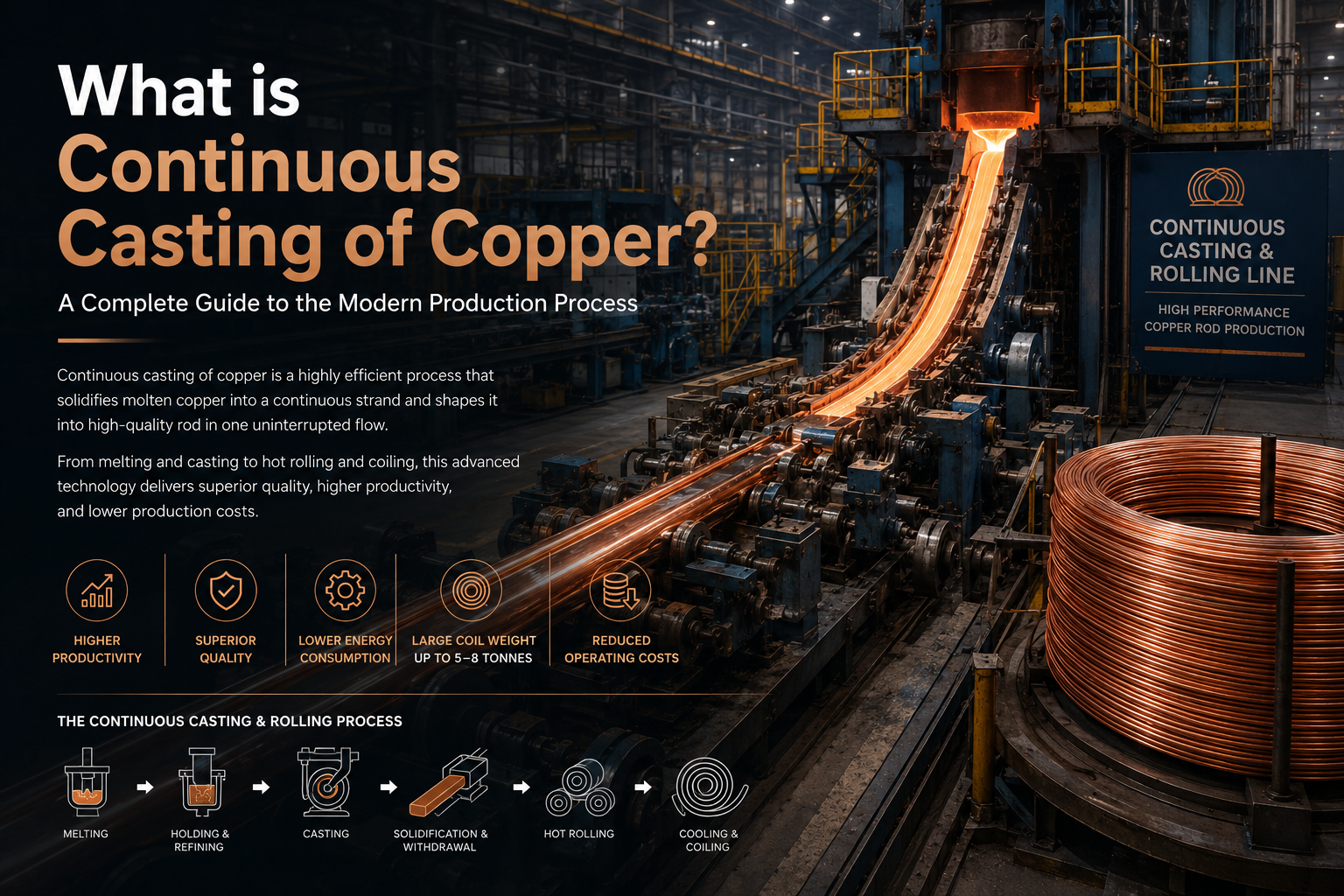
Continuous casting of copper is a highly efficient metallurgical process that produces long, continuous lengths of copper rod, bar, or billet directly from molten metal. Unlike traditional batch casting — where copper is poured into individual molds to form ingots or wire bars that must later be reheated and rolled — continuous casting solidifies the metal in a moving mold and withdraws it as an unbroken strand.

This technology has become the dominant method for producing high-quality copper rod used in the wire and cable industry. It delivers superior consistency, higher productivity, and significant cost advantages while meeting the strict quality demands of modern electrical conductors.

ما هي عملية الصب المستمر للنحاس؟

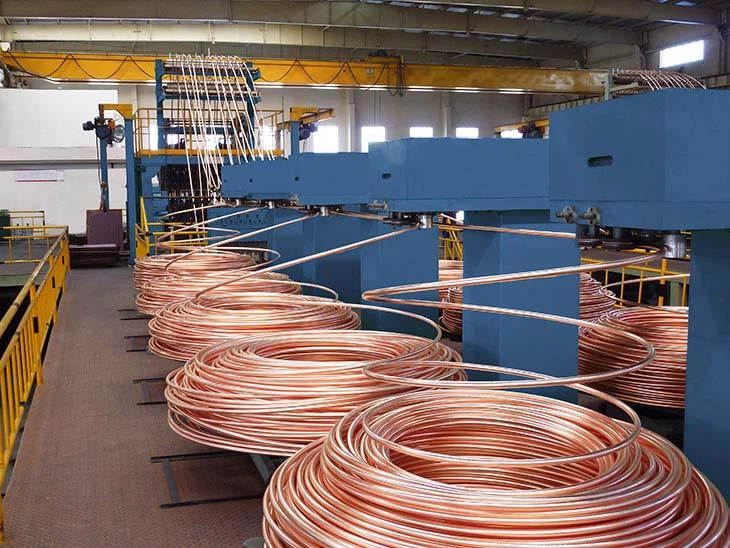
Modern continuous casting and rolling (CCR) lines are the backbone of high-volume copper rod production for wire and cable manufacturing.

The Continuous Casting Process: Step by Step

The process typically combines melting, casting, and hot rolling in a single integrated flow (especially in CCR systems). Here is how it works in practice:

  1. Melting High-purity copper cathode or selected scrap is melted in a shaft furnace or induction furnace. Temperature is carefully controlled, usually around 1100–1150°C.
  2. Holding and Refining The molten copper moves to a holding furnace where temperature, oxygen content, and impurities are precisely managed. For standard Electrolytic Tough Pitch (ETP) copper, oxygen levels are typically maintained between 120–300 ppm.
  3. Casting Molten copper is fed continuously into a water-cooled casting machine. In the most common wheel-and-belt systems, copper solidifies in a trapezoidal groove on a rotating wheel sealed by a steel belt. Twin-belt casters use two moving steel belts to form the mold.
  4. Solidification and Withdrawal As the metal solidifies, it is continuously withdrawn from the mold at a controlled speed, forming a solid cast bar or rod.
  5. Hot Rolling (in CCR lines) The hot cast bar immediately enters a multi-stand rolling mill, reducing its cross-section to the final rod diameter — most commonly 8 mm for wire drawing feedstock.
  6. Cooling, Coiling, and Finishing The rod is cooled, coiled into large bundles (often 5–8 tonnes), and may undergo surface treatment or pickling before packaging.

This uninterrupted flow eliminates the reheating step required in traditional methods and produces rod with excellent uniformity.

Main Types of Continuous Casting for Copper

1. Continuous Casting and Rolling (CCR) – Wheel-and-Belt Systems The most widely used technology for wire rod production. Leading systems include:

  • Continuus-Properzi
  • Southwire SCR
  • Contirod (Hazelett twin-belt)

These lines are ideal for high-volume production of ETP copper rod used in power cables, building wire, and general conductors.

2. Upward Continuous Casting (Upcast)

Molten copper is drawn upward through graphite crystallizers. This method produces oxygen-free copper (OFC) rod with very low oxygen content (<10 ppm). It is preferred for high-end applications requiring superior conductivity and ductility, such as specialty cables and high-frequency conductors.

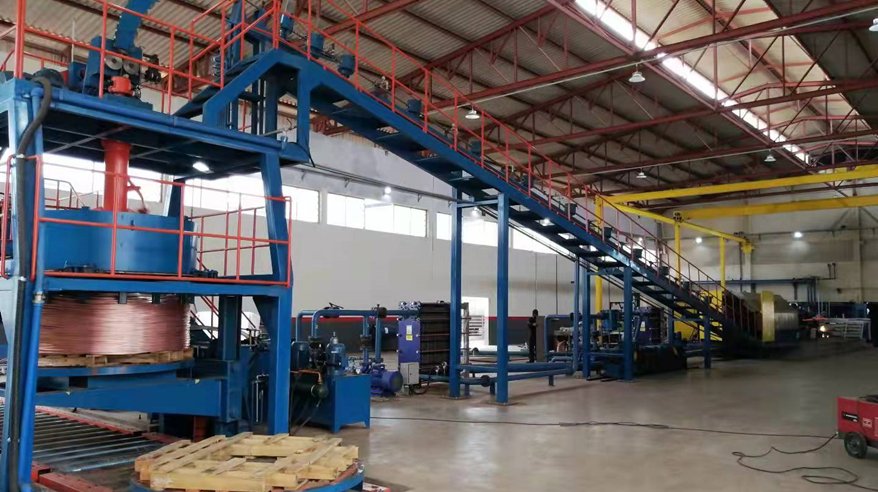
Continuous Casting of Copper

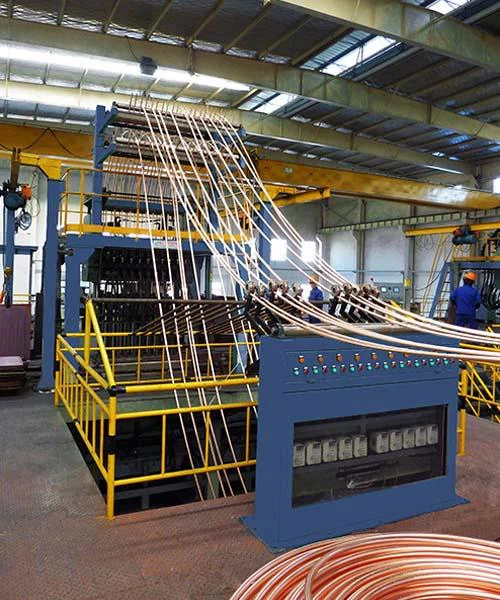
Upward continuous casting lines are widely used to produce high-purity oxygen-free copper rod.

3. Horizontal Continuous Casting

Used for producing copper billets, tubes, profiles, and smaller-diameter rods. It offers flexibility for alloy production and specialized shapes.

Key Advantages of Continuous Casting

Continuous casting has largely replaced traditional ingot casting + hot rolling for copper rod because of its clear technical and economic benefits:

  • Superior product consistency — Uniform grain structure and minimal segregation
  • Large coil weights (up to 5–8 tonnes) with no welds, reducing breaks during subsequent wire drawing
  • Higher productivity and lower energy consumption (no reheating of ingots)
  • Better surface quality and fewer internal defects
  • Reduced operating costs and simplified logistics
  • Improved downstream performance — Fewer wire breaks in rod breakdown and multi-head drawing lines

These advantages directly translate into higher efficiency and reliability for cable manufacturers.

Continuous Casting of Copper vs. Aluminum: Key Differences

Many cable manufacturers produce both copper and aluminum conductors. While both materials commonly use Continuous Casting and Rolling (CCR) technology, there are important technical and practical differences that affect process design, equipment selection, and final application performance.

AspectCopper Continuous CastingAluminum Continuous Casting
Melting Point~1085°C (higher energy input required)~660°C (lower energy consumption)
Typical Rod Diameter8 mm (standard for wire drawing)9.5 mm or 12 mm (common for EC aluminum rod)
Oxygen ControlCritical (ETP vs Oxygen-Free grades)Less critical; mainly focuses on hydrogen and inclusions
Density & Coil WeightHigher density; coils are heavierLower density; easier handling and logistics
الموصليةExcellent (IACS 100%+ for high-purity grades)Good but significantly lower than copper (~61% IACS)
التطبيقات الرئيسيةPower cables, building wire, data cables, specialty conductorsOverhead conductors (ACSR/AAC), some building wire, busbars
Rolling ForcesHigher due to material strengthLower rolling forces required
Downstream DrawingRequires robust rod breakdown lines; more sensitive to surface qualitySofter material but work-hardens differently; different die and lubricant requirements
Cost ProfileHigher raw material cost but superior performanceLower cost per ton; preferred for cost-sensitive large-scale transmission
Common CCR TechnologiesProperzi, Southwire SCR, ContirodSame core technologies (Properzi, Southwire, etc.) often adapted

Key Takeaways from the Comparison:

  • Copper CCR excels in applications where high electrical conductivity, compact size, and long-term reliability are critical. The process demands tighter control over oxygen and surface quality because even minor defects can cause breaks during fine wire drawing.
  • Aluminum CCR offers significant advantages in weight, cost, and energy efficiency during production. It is the preferred choice for overhead power lines where weight reduction directly impacts tower design and installation costs.
  • Both processes benefit from integrated casting + hot rolling, large coil weights, and high productivity. However, downstream equipment (rod breakdown machines, drawing lines, and stranding equipment) must be specifically optimized for each material’s mechanical properties.
  • Manufacturers producing both copper and aluminum conductors often seek flexible or modular equipment solutions that can handle the different requirements of each metal efficiently.

Understanding these differences helps cable producers select the right feedstock and pair it with properly matched production equipment for optimal results.

Why Continuous Casting Matters for Wire and Cable Production

High-quality continuously cast copper rod (especially 8 mm CCR rod) serves as the primary raw material for rod breakdown machines and subsequent wire drawing processes. Consistent rod quality ensures:

  • Better electrical conductivity in final cables
  • Fewer production interruptions
  • Improved surface finish and mechanical properties
  • Higher overall equipment effectiveness (OEE) on drawing and stranding lines

Manufacturers who start with premium continuously cast rod and pair it with advanced, reliable drawing and stranding equipment achieve the best results in both productivity and final cable performance.

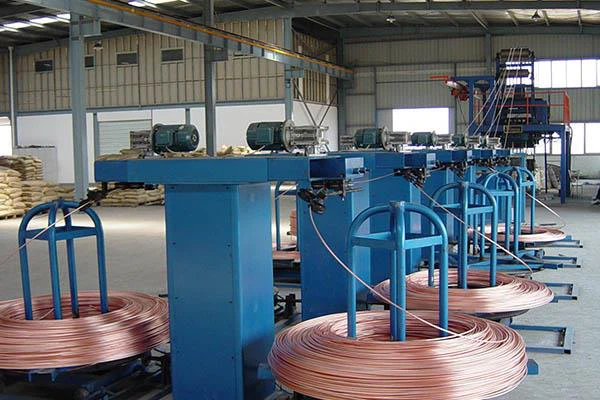
Continuous Casting of Copper

In-line hot rolling immediately follows casting in CCR lines, producing uniform 8 mm copper rod ready for wire drawing.

خاتمة

Continuous casting of copper represents one of the most important advancements in non-ferrous metallurgy. It enables the efficient, high-quality production of copper rod that forms the foundation of modern wire and cable manufacturing.

Whether using wheel-and-belt CCR systems for standard ETP rod or upward casting for oxygen-free copper, the process delivers the consistency, efficiency, and scalability required by today’s demanding applications in power transmission, data centers, renewables, and industrial cabling.

For cable equipment manufacturers and producers seeking to optimize their entire value chain — from rod production through final cable assembly — investing in reliable, technically advanced equipment remains essential.

استفسر الآن to discuss advanced rod breakdown lines, multi-head drawing systems, or complete production solutions that maximize the benefits of high-quality continuously cast copper rod.

Continuous Casting of Copper

الأسئلة الشائعة (FAQs)

What is the difference between continuous casting and traditional copper casting?

Traditional methods cast copper into individual ingots or wire bars that must be reheated and rolled. Continuous casting produces an unbroken strand directly, eliminating reheating and delivering more uniform quality with higher efficiency.

What diameter of copper rod is most commonly produced by continuous casting for wire drawing?

8 mm diameter rod is the industry standard feedstock for rod breakdown and wire drawing lines in cable manufacturing.

What is the difference between CCR and Upward Casting?

CCR (wheel-and-belt) systems are mainly used for high-volume ETP copper rod. Upward casting produces oxygen-free copper (OFC) with lower oxygen content, suitable for premium applications.

Why is continuous cast copper rod preferred for cable production?

It offers excellent uniformity, large coil weights without welds, superior surface quality, and fewer breaks during high-speed wire drawing — all of which improve productivity and final cable reliability.

اترك تعليقاً

لن يتم نشر عنوان بريدك الإلكتروني. الحقول الإلزامية مشار إليها بـ *