غير مصنف

كيف تعمل آلة البثق المستمر لأسلاك النحاس؟

كيف تعمل آلة البثق المستمر لأسلاك النحاس؟

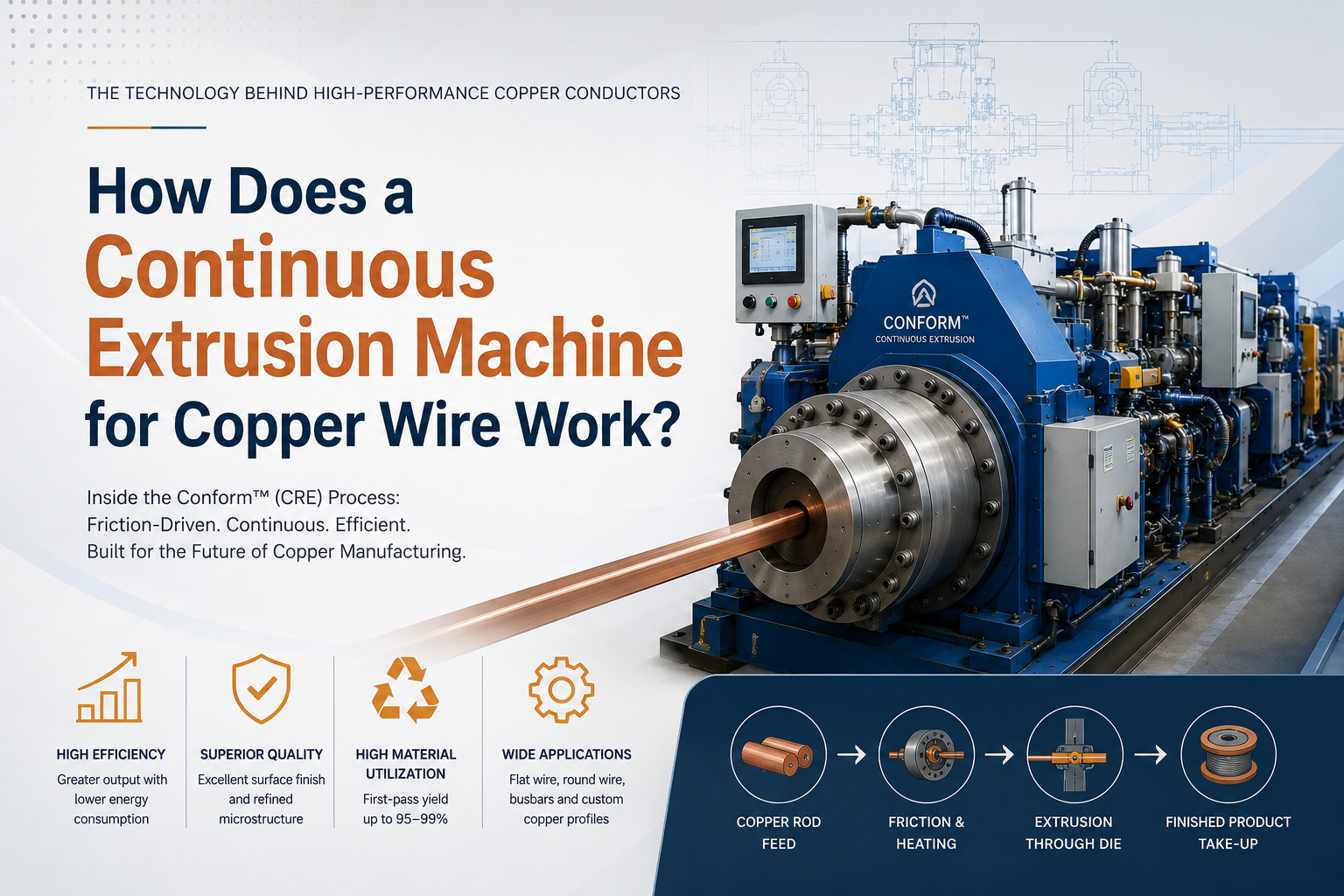
In modern cable and conductor manufacturing, continuous extrusion technology (also known as the Conform™ process أو Continuous Rotary Extrusion – CRE) has revolutionized the production of copper flat wire, round wire, small busbars, and specialized profiles.

Unlike conventional batch extrusion that requires pre-heated billets and multiple discontinuous steps, a continuous extrusion machine transforms copper rod feedstock directly into finished products in one seamless, high-speed operation. This results in superior productivity, dramatically lower energy consumption, near-zero scrap, and excellent metallurgical quality.

This comprehensive guide explains exactly how a continuous extrusion machine for copper wire works, based on the established Conform process used by leading global manufacturers.

The Core Working Principle: Friction-Driven Continuous Rotary Extrusion

The Conform process is a solid-state, friction-based metal forming technology. It relies on the rotating extrusion wheel to generate both the driving force and the necessary heat through friction — eliminating the need for external billet heating in most copper applications.

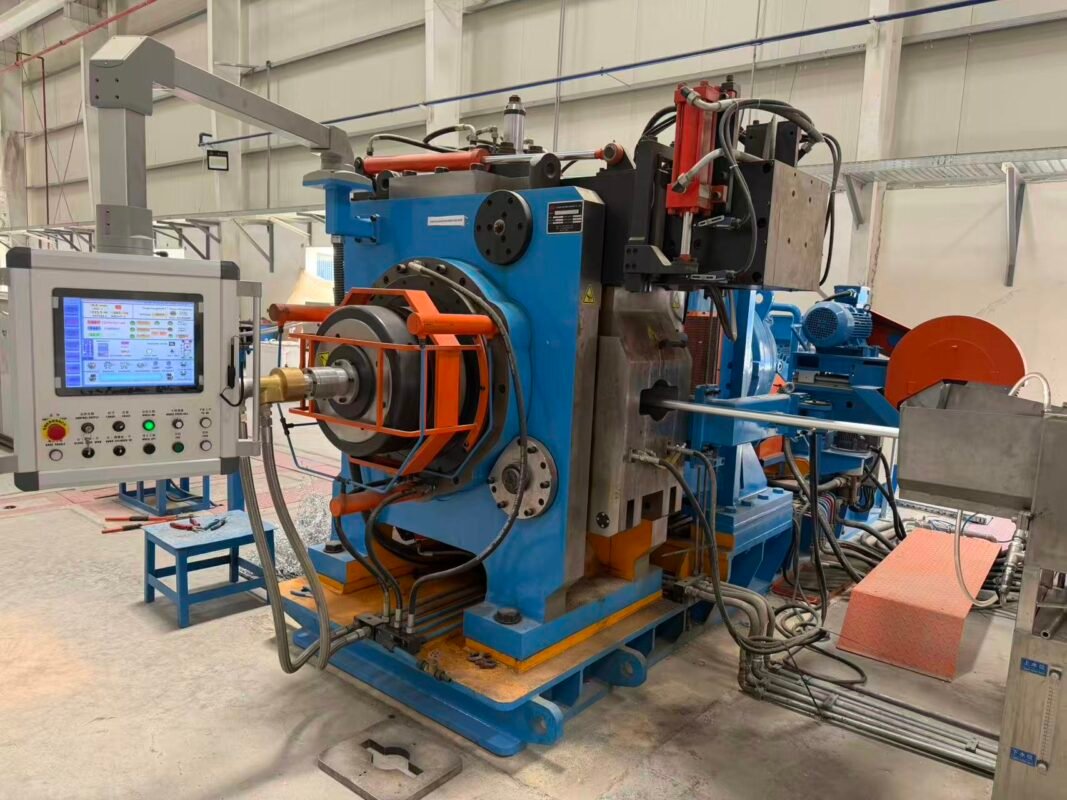
continuous extrusion machine

Detailed Step-by-Step Process

  1. Feedstock Preparation and Entry Oxygen-free copper rod (typically Ø12.5 mm for TLJ300H models) is paid off from a large coil and fed into a precision coining roll that forces it into the circumferential groove of the rotating extrusion wheel.
  2. Gripping and Frictional Drive The large contact area between the copper rod and the grooved wheel creates powerful frictional grip. As the wheel rotates (controlled by a high-power AC motor, e.g., 110 kW on TLJ300H), the rod is continuously drawn forward along the groove.
  3. Frictional Heating and Plasticization Intense friction between the moving rod, the wheel groove, and the stationary shoe generates significant heat. For copper, temperatures can reach 400–500°C or higher without any external heaters. This brings the material into a highly plastic state suitable for extrusion.
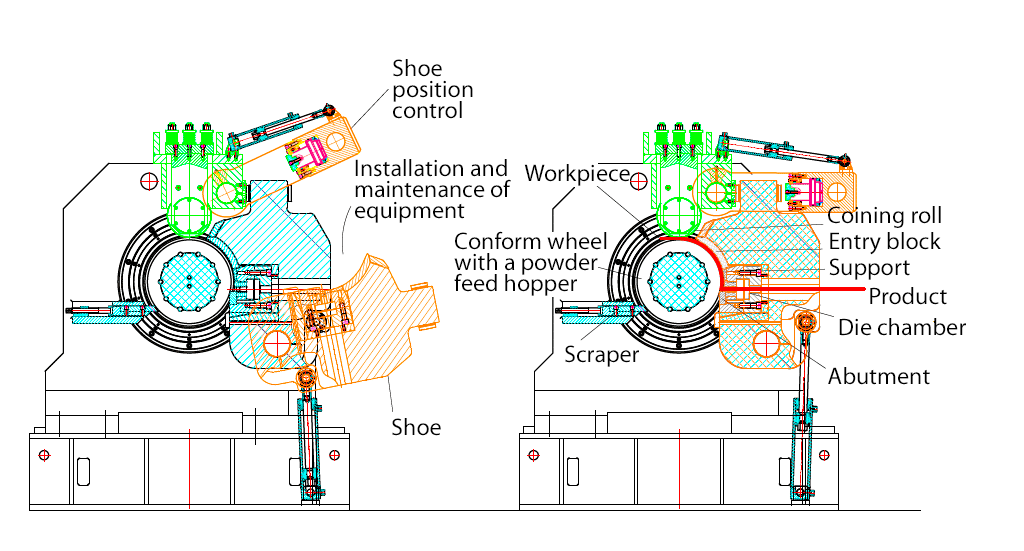
  4. Upsetting at the Abutment The groove is enclosed by a stationary shoe assembly. At the end of the arc, a fixed abutment (block) protrudes into the groove and stops the forward movement of the material. This creates high pressure and forces the plasticized copper to “upset” (pile up) in front of the abutment.
  5. Radial Extrusion Through the Die The accumulated material is forced radially outward into the die chamber located in the shoe. Under extreme pressure, it flows through a precisely engineered die orifice, forming the desired continuous profile (flat wire, round wire, or busbar).
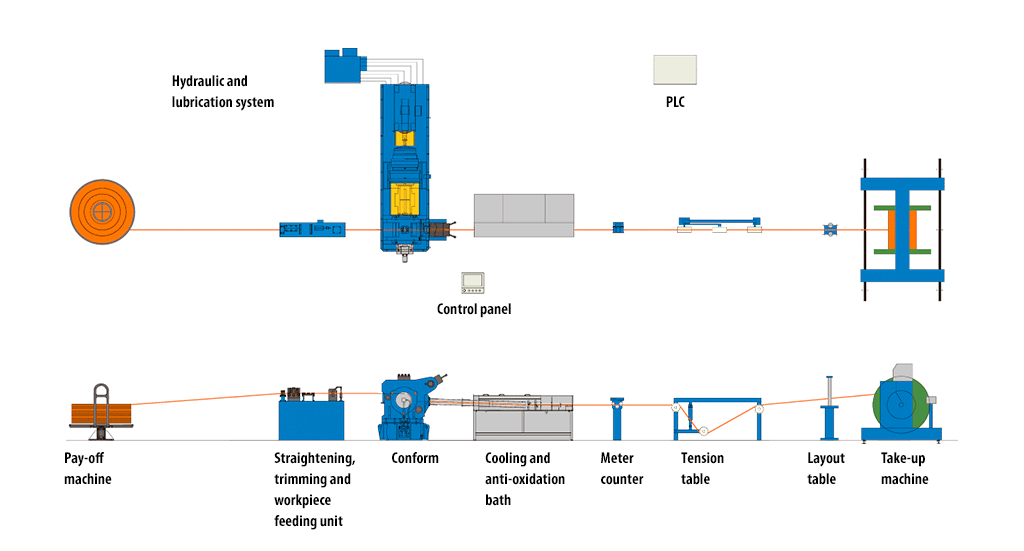
  6. Product Exit, Cooling, and Take-up The extruded copper product exits continuously, is cooled in a water or air bath to prevent oxidation, dried, measured, and wound onto reels or cut to length.

The entire cycle is continuous — the machine runs 24/7 as long as feedstock is supplied, producing theoretically unlimited product lengths.

Process Diagram (Conform Wheel, Shoe, Abutment & Die Chamber)

Complete Continuous Extrusion Line Layout

Key Components of a Continuous Extrusion Machine

  • Extrusion Wheel (Heart of the Machine): Grooved wheel (nominal diameter 300 mm on TLJ300H) driven by main motor. High-speed models reach optimized RPM for copper (typically 20 RPM max).
  • Shoe Assembly: Stationary enclosure containing the abutment and die chamber. Precision-machined for tight tolerances.
  • Abutment & Die Chamber: Redirects material flow and forms the final shape.
  • Coining Roll / Entry System: Ensures smooth, consistent rod insertion.
  • Hydraulic & Lubrication Systems: Maintain pressure and minimize tooling wear.
  • Advanced Cooling & Anti-Oxidation Systems: Critical for copper to maintain surface quality.
  • PLC + Industrial Cloud Control: Real-time monitoring of speed, temperature, pressure, and remote diagnostics.

Technical Advantages Over Traditional Extrusion

Continuous extrusion offers measurable benefits for copper wire production:

  • Single-Step Forming — Rod → finished profile in one continuous pass (no intermediate drawing or annealing required in many cases).
  • High Material Utilization — First-pass yield up to 95–99%; extremely low scrap compared to conventional methods.
  • Energy Efficiency — Friction provides most of the heat; energy consumption is significantly lower than billet heating + extrusion.
  • Superior Product Quality — Dense microstructure, refined grain size (often <25 μm), excellent surface finish, and fully recrystallized (annealed) state.
  • High Productivity — Models like TLJ300H achieve up to 800 kg/h for copper flat wire.
  • Flexible Product Range — Flat wire (5–200 mm²), round wire (min Ø2.6 mm), small busbars, and custom profiles.

Typical Applications in the Cable Industry

  • Copper flat wire for transformer windings and power cables
  • Copper busbars for switchgear and electrical panels
  • Round copper wire as base material for further drawing
  • Specialty copper conductors for automotive, renewable energy, and industrial applications

خاتمة

A continuous extrusion machine for copper wire operates on the elegant principle of friction-driven rotary extrusion. By combining mechanical gripping, frictional heating, and precise die forming, it delivers continuous, high-quality copper products with unmatched efficiency and economy.

This technology represents a major leap forward in conductor manufacturing — offering lower costs, higher output, better quality, and greater sustainability.

Looking to Upgrade Your Copper Wire Production?

We supply proven TLJ300H / TLJ350H series continuous extrusion lines engineered for stable, high-speed copper flat wire and busbar production.

استفسر الآن — Contact our technical team for detailed specifications, line layout, and customized production solutions.

اترك تعليقاً

لن يتم نشر عنوان بريدك الإلكتروني. الحقول الإلزامية مشار إليها بـ *