غير مصنف

What Are the Different Types of Cable Stranding Machines?

What Are the Different Types of Cable Stranding Machines-doingcable

A cable plant does not buy “a strander.” It buys a geometry: concentric Class 2, compacted sector, ACSR, flexible Class 5/6 bunch, or insulated-core lay-up. The machine type is selected by back-twist requirement, bobbin mass, fill factor and line speed — not by catalogue name.

Wrong selection shows up as birdcaging, residual torsion, DC resistance above IEC 60228 Table limits, or a line that cannot hold lay at the speed the capstan can pull.

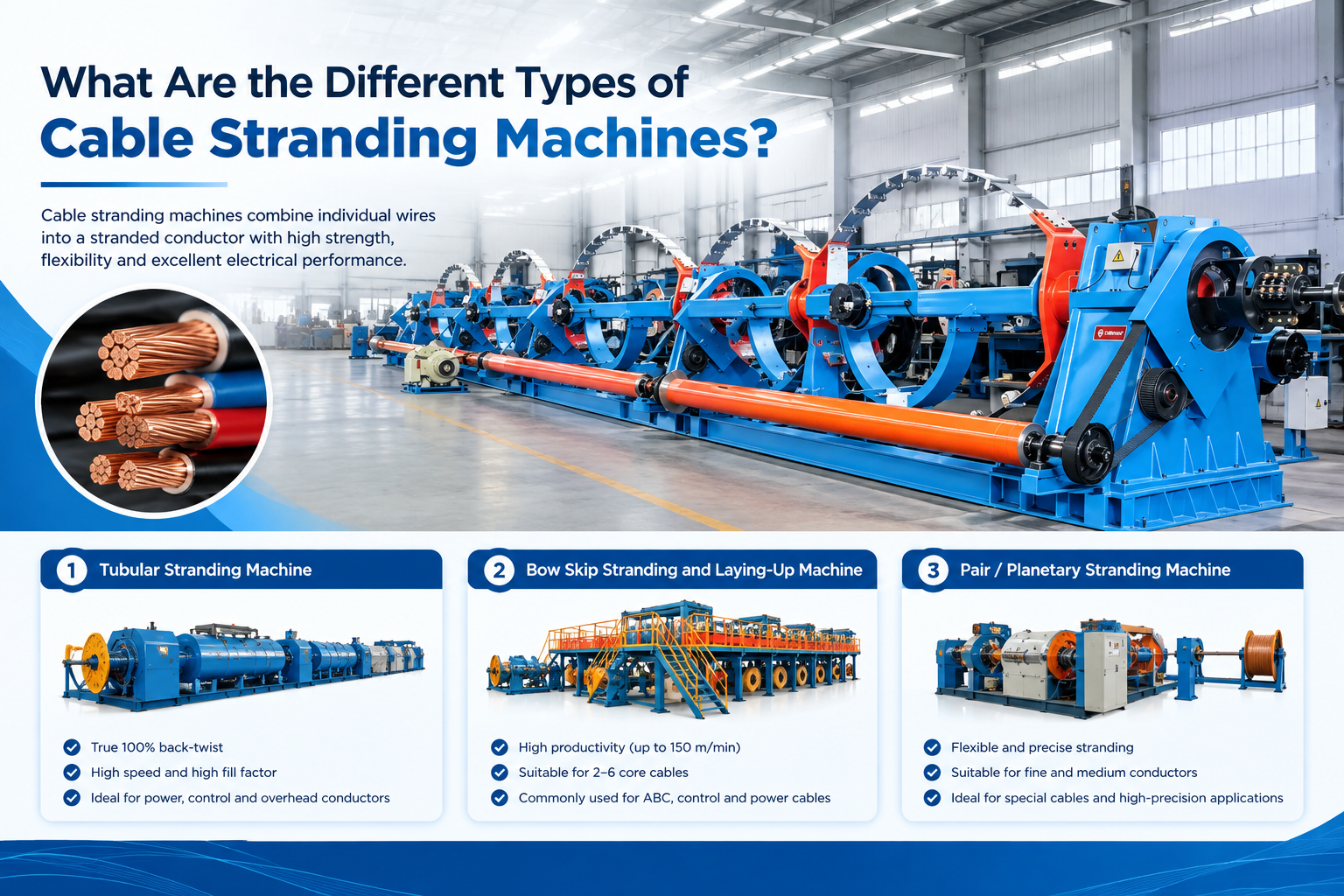
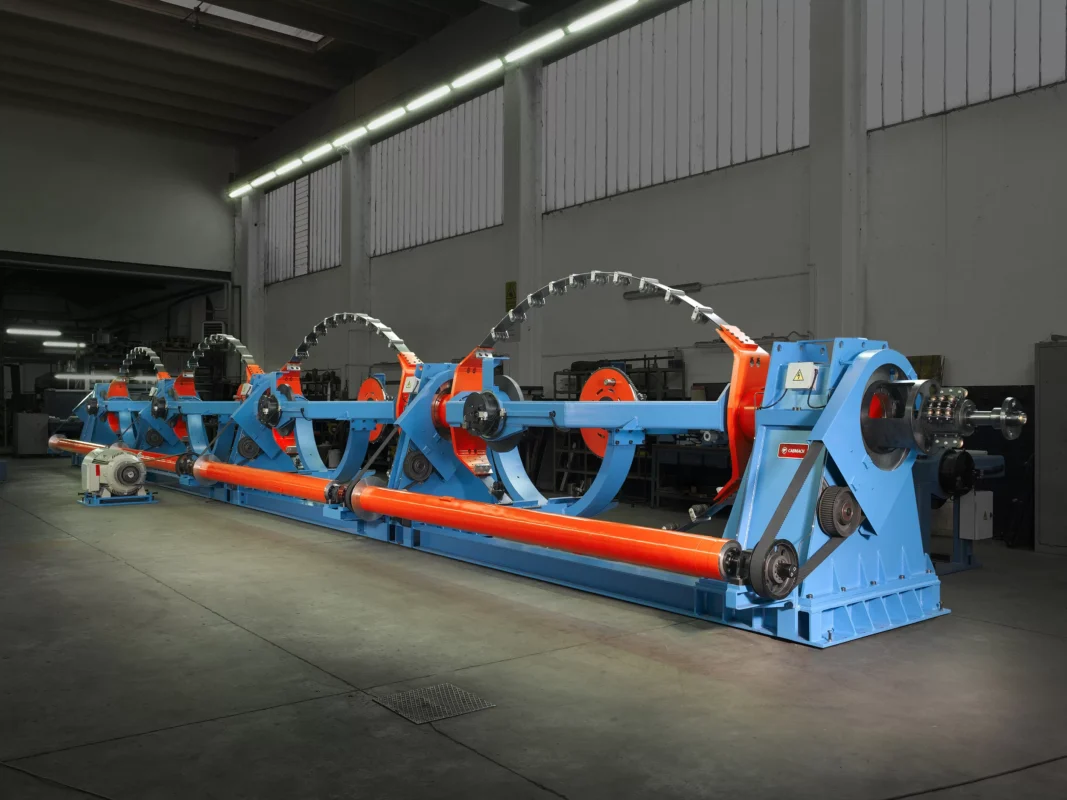
The types used in current power, control and flexible-cable plants are tubular, rigid-frame, planetary, skip/bow, single-twist, double-twist buncher, concentric high-speed and drum-twister laying-up lines.

What is a آلة جدل الكابلات and what does it actually produce?

A cable stranding machine twists multiple wires or insulated cores into one conductor or cable core under controlled lay length, tension and closing-die geometry.

It is the process step between drawn/annealed wire and insulation or armoring. For bare conductors the output is judged against IEC 60228:2023 (EN IEC 60228:2024) conductor class, wire count and 20 °C DC resistance; for overhead bare metal it is judged against IEC 61089 and ASTM B8 / B231 / B232 / B399.

Three geometric results matter on the shop floor:

  1. Concentric strand — fixed layer counts (1+6, 1+6+12, 1+6+12+18). Positions are locked. Used for Class 2 power conductors.
  2. Compacted / sector strand — same layer logic plus dies or rollers that raise fill factor and cut overall diameter before XLPE extrusion.
  3. Bunched strand — random positions, high flexibility, Class 5/6 automotive and building wire. Geometry is not concentric.

If the finished cable needs a true circular Class 2 core for MV XLPE, a buncher is the wrong machine even if it is faster.

How do tubular, rigid, planetary and skip stranders differ in back-twist?

Back-twist is the single design fact that separates the four rotating-cage families.

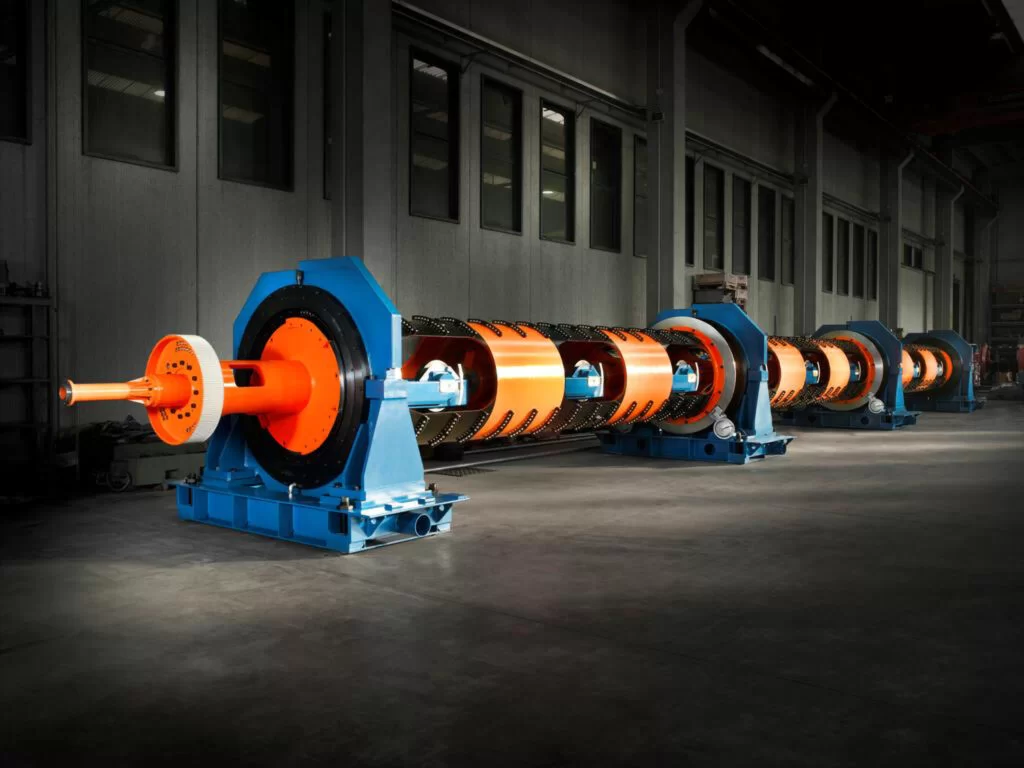
  • Tubular strander: bobbins sit inside a rotating steel tube and keep their orientation. The construction gives true 100% back-twist. Individual wires receive almost no extra torsion. Typical rotor 400–1,200 rpm, line 80–230 m/min on Cu 0.8–5.0 mm / Al 1.2–6.0 mm. Best for 7- and 19-wire Class 2, steel strand and compact small-to-medium conductors.
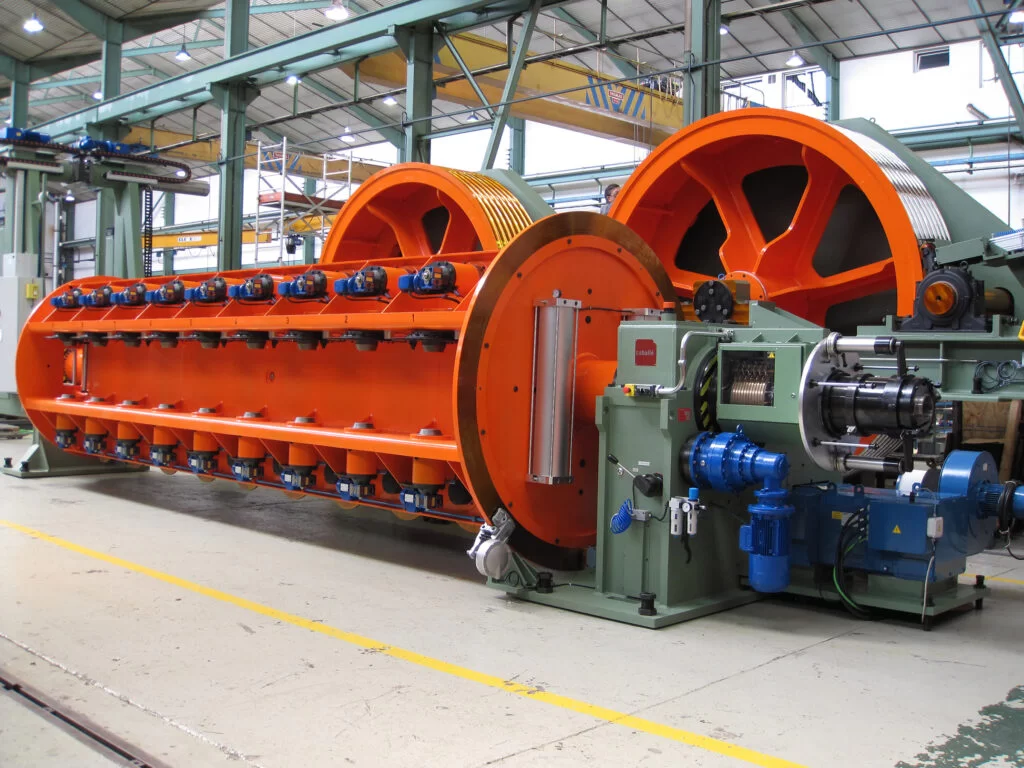
  • Rigid-frame (rigid-cage) strander: cages rotate as a rigid unit; bobbins do not counter-rotate. Back-twist is 0%. Residual torsion is managed with pre-formers and compacting. Cage speed is lower (typically 80–300 rpm on large PND630 cages) but bobbin payload and layer count are high: 6+12+18+24+30 for 61- and 91-wire, ACSR and sector cores.
  • Planetary strander: cradles orbit and can be geared for 0–100% back-twist. Wire path to the closing die is short, so bending stress is low. Used for OPGW, optical elements, control cores and constructions that cannot tolerate residual twist. Speed sits between tubular and rigid, commonly 50–120 m/min.
  • Skip / bow strander: payoffs are stationary; a lightweight bow carries the wire around them. Large, heavy reels can stay on the floor. Partial back-twist, medium speed, common on 1+3 / 1+4 PVC control and some laying-up jobs. Carbon-fiber bows are used when RPM must rise without raising rotating mass.
المعلمةTubularPlanetaryRigid frameSkip / bow
Back-twistTrue 100%Variable 0–100%Usually 0%Partial
Typical rotor / cage400–1,200 rpm200–600 rpm80–300 rpm150–600 rpm (bow)
Typical line speed80–230 m/min50–120 m/min20–80 m/min20–80 m/min
Best conductor1.5–95 mm² Class 2, steel ropeFine–medium, OPGW, insulated35–1,200 mm², ACSR, sectorInsulated cores, 1+3/1+4
Compactionجيدجيد جداًExcellent with dies/rollersمحدود
BobbinPN400–630 inside tubePN400–800 in cradlesPND500–800 shaftlessLarge stationary
Failure if misappliedLimited max mm²Gear wear, lower km/hBirdcage on hard wire without pre-formLay scatter on fine bare Cu

Which stranding machine is used for Class 2 power conductors?

Class 2 circular and compacted conductors in IEC 60228:2023 are produced on tubular stranders for 7- and 19-wire sizes, and on rigid-frame or concentric stranders for 37-, 61- and 91-wire and shaped cores.

IEC 60228 Class 2 requires a minimum number of wires by nominal mm², equal nominal wire diameter in a conductor, and a maximum DC resistance at 20 °C. Compacted circular copper starts from 1.5 mm²; compacted or shaped aluminum starts from 10 mm²; shaped conductors start from 25 mm².

Practical split used by MV/HV plants:

  • Up to ~35–70 mm², 7/19 wire: tubular 1+6 or 1+12, PN500/PN630, compacting die at the closing point. Rotor speed pays back the floor space.
  • 95–630 mm², 37/61 wire, Milliken segments later: rigid 12+18+24 or 18+24+30 with dual capstan Ø2000–3150 mm and sector-forming heads in front of each cage.
  • ACSR / AAC / AAAC overhead: rigid or concentric line set to ASTM B232 / B399 / IEC 61089 layer directions (typically opposite successive layers).

A double-twist buncher can make a flexible conductor of the same mm², but that conductor is Class 5/6 geometry. It will not pass a Class 2 concentric inspection or a compacting-diameter window specified for XLPE insulation wall.

When should a plant use a double-twist buncher instead of a concentric strander?

Use a double-twist buncher when the conductor must be flexible (IEC 60228 Class 5 or 6) and the wires may sit in random positions. Use a concentric/tubular/rigid line when layer geometry and diameter must be locked.

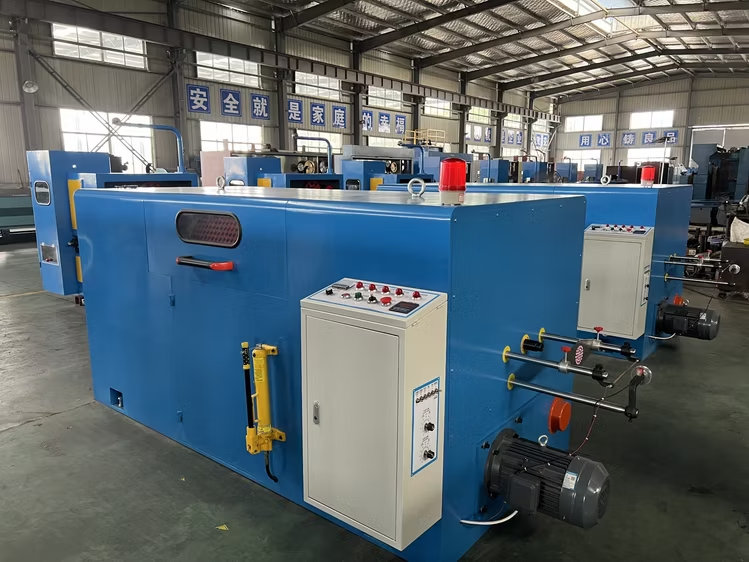
A double-twist bow applies two twists per revolution, so linear output is roughly twice a single-twist machine at the same bow RPM. Typical window: individual wire 0.05–1.20 mm, finished 0.05–16 mm², line up to about 200–300 m/min on fine Cu, take-up 500–1250 mm. Automotive ISO 6722, UL building wire and IEC flexible cords are the volume products.

A single-twist machine applies one twist per revolution. It is slower on fine wire, but it accepts larger take-up reels and is the correct tool when you are laying insulated cores, not bunching bare fine wire — control cable, instrument pairs, some MV cores before taping.

Do not specify a buncher for:

  • compacted circular Class 2 intended for 6/10 kV or 8.7/15 kV XLPE
  • ACSR steel core + aluminum layers
  • any construction that a customer drawing shows as 1+6+12

Those products fail on diameter, fill factor or layer direction, not on “twist quality.”

What are skip stranders, drum twisters and concentric stranders used for?

Skip/bow, drum-twister and concentric machines cover jobs the four main cages cannot do efficiently: heavy stationary reels, finished multi-core cables, and very high-speed large-section concentric layers.

Skip / bow strander. Stationary payoffs, rotating bow. Typical 1+3, 1+4, 1+6 for PVC control and rubber mining cable. Advantage is reel mass: a 1250 mm core reel does not have to spin inside a tube. Limit is bare-wire tension uniformity at high RPM; bows fatigue if balance is poor.

Drum twister. The take-up drum itself rotates to put lay into large insulated cores. Used with caterpillar haul-off, filling, and one or two taping heads for MV/HV three-core and multi-core laying-up. Line speed is low (often 8–30 m/min) because the product is already insulated and heavy. This is a cable machine, not a bare-conductor machine.

Concentric (high-speed rigid-concentric) strander. Non-back-twist, short rotating length, line speeds reported up to ~100 m/min on large Cu/Al — faster than a long rigid cage of the same wire count. Built for circular and sector compacting in one pass. Chosen when a plant’s bottleneck is 240–800 mm² output, not 19-wire tubular work.

How should a cable factory select the machine from conductor drawing to FAT?

Selection starts from the conductor drawing and the standard clause, then from bobbin logistics, then from speed. Motor kW is the last number, not the first.

Step 1 — Name the class and geometry.
Class 2 circular / Class 2 compacted / Class 2 sector / Class 5 bunch / ACSR / insulated lay-up. Write the standard: IEC 60228:2023, ASTM B8, IEC 61089, IEC 60502-2. If the drawing shows 19 wires of equal diameter, you are in tubular or small rigid territory. If it shows 61 wires plus compacting, you are in rigid/concentric territory.

Step 2 — Fix single-wire diameter and bobbin.
Cu 0.8–5.0 mm on PN400–630 almost always tubular. Cu/Al 1.8–5.0 mm on PND630 × 36 ends is rigid. Fine 0.10–0.50 mm on 500–800 mm bunchers is double-twist.

Step 3 — Decide back-twist.
Hard-drawn steel, OPGW aluminum-clad steel, and many control cores need 100% back-twist (tubular or planetary). Soft annealed Cu Class 2 compacted on rigid cages is routinely run at 0% back-twist with pre-formers.

Step 4 — Lay length and capstan.
Lay = line speed / (cage rpm). If the customer specifies lay ±1% and you also need 150 m/min, the cage must be able to hold RPM with a closed-loop encoder. Gearbox-only pitch boxes still work; servo electronic lay is what export plants now put in the FAT protocol.

Step 5 — Compacting and sector.
If finished diameter must drop 8–12% for XLPE wall savings, specify compacting dies or two-roll / three-roll compactors per cage, plus a sector box if the core is 120° Milliken or 3-sector LV.

Typical tubular parameters we confirm in an inquiry

ItemTypical range
إعداد1+6, 1+12, 1+18 (6/12/18/24B)
Payoff bobbinPN400 / 500 / 630
Cu wire0.8–5.0 mm
Al wire1.2–6.0 mm
Rotor400–1,500 rpm by bobbin size
Line speed50–230 m/min
Lay accuracy≤ ±1% with encoder
TensionMagnetic-particle / hysteresis, ±2%
Take-upPN1250–PN2000
Standards targetedIEC 60228 Class 2, ASTM B8, IEC 61089

Typical rigid-frame parameters

ItemTypical range
Cages6 / 12 / 18 / 24 / 30 / 36
BobbinPND500 / 630 / 800 shaftless pintle
Cu / Al / AA1.5–4.5 / 1.8–5.0 / 1.5–4.5 mm
Cage speed220 rpm (6B) down to ~100 rpm (36B)
Pitch example (12B)~44–590 mm
Line speed~7–53 m/min on heavy 630 lines; higher on compact concentric designs
CapstanDual wheel Ø2000 / 2500 / 3150 mm
OptionsSector heads, pre-former, taping, auto loading

These are engineering windows, not a single SKU. A 19-wire 35 mm² copper line and a 61-wire 400 mm² aluminum line should not share one machine specification.

Which standards and factory tests decide whether the strand is acceptable?

The machine is accepted only if the conductor it makes is accepted. FAT should run the customer’s real mm², not an empty rotation test.

Product standards

  • IEC 60228:2023 / EN IEC 60228:2024 — class, wire number, 20 °C resistance, compacted/shaped rules.
  • IEC 60502-1 / -2 — the insulated cable that will use that conductor.
  • ASTM B8 (Cu concentric), B231 (AAC), B232 (ACSR), B399 (AAAC).
  • IEC 61089 — round-wire concentric overhead conductors.
  • GB/T 3956 — Chinese conductor class aligned to IEC 60228 for many export contracts.

Factory tests on the strand, not only on the machine

  • DC resistance at 20 °C vs Table value; temperature correction per IEC 60228 Annex B.
  • Overall diameter and compactness vs drawing (go/no-go ring + laser).
  • Lay length, left/right direction, layer direction on multi-layer ACSR.
  • Birdcage / corkscrew after a 3–5 m cut and after a reverse-bend.
  • Wire-break stop, guard-door interlock, emergency brake time of the cage.
  • For compacted cores: residual elongation and surface scoring from dies.

If resistance fails, check wire Ø undersize, oil film, or over-compacting that has necked the wires. If the cage is mechanically perfect and resistance still fails, the input wire is out of drawing tolerance — the strander cannot invent cross-section.

What failure modes appear when the wrong strander is specified?

Most strand defects are selection or tension problems, not “operator skill.”

  1. Birdcaging after cut. Residual torsion from a 0% back-twist rigid cage on hard-drawn high-tensile wire with no pre-former. Fix: pre-form head, or move the construction to tubular/planetary 100% back-twist.
  2. High DC resistance. Over-compacted wires, wrong input Ø, or a bunched core sold as Class 2. Measure input wire first.
  3. Lay scatter ±5%. Mechanical pitch box worn, or capstan slip on a dual-wheel that has lost wrap angle. Encoder lay control is the durable fix.
  4. One wire long, eleven short. Payoff brake drift. Magnetic-particle brakes need periodic current calibration; open-loop felt pads do not hold ±2% at 800 rpm.
  5. Surface scratch then XLPE peel. Closing-die diameter too small or die not rotating. Compacting dies are consumables; put them on the spare-parts list in the same PO.
  6. Cage vibration above 1,000 rpm (tubular). Rotor unbalance after a crashed bobbin, or bearing oil-feed blocked. Do not raise RPM to chase output until the balance report is clean.
  7. Buncher used for 19-wire power. Diameter out of IEC Annex C guidance, poor circularity, insulation eccentricity after extrusion. The defect is specification, not the buncher.

2024–2026 plant practice is consistent: servo tension and electronic lay on export machines; rigid + compacting for MV/HV copper and aluminum; tubular kept for 7/19-wire and steel; double-twist isolated to Class 5/6. Mixing those three flows on one line creates scrap, not flexibility.

Key takeaways

  • Name the conductor class first. Class 2 concentric, Class 2 compacted/sector, Class 5/6 bunch and insulated lay-up are four different machines.
  • Tubular = 100% back-twist + high RPM + 7/19-wire and steel. Rigid = 0% back-twist + high payload + 37/61/91 and ACSR. Planetary = adjustable back-twist + low wire stress. Skip = large stationary reels. Double-twist = flexible bunch only. Drum twister = finished multi-core cable.
  • IEC 60228:2023 / EN IEC 60228:2024 resistance and wire-count tables are the acceptance document. Machine RPM is not.
  • Compacting dies, pre-formers and calibrated payoff brakes prevent the defects that show up after extrusion, when correction is expensive.
  • Quote from a drawing: material, mm², wire Ø, bobbin, lay, annual km, standard. That is enough to size cages, capstan and take-up.

For a configuration sheet matched to your conductor list — tubular, rigid-frame, planetary, skip or double-twist — send the drawing and target output.

استفسر الآن

اترك تعليقاً

لن يتم نشر عنوان بريدك الإلكتروني. الحقول الإلزامية مشار إليها بـ *