غير مصنف

ما الفرق بين الصب المباشر والصب المستمر؟

الصب المباشر والصب المستمر في صناعة الكابلات

In the wire and cable industry, the metallurgical process used to produce copper and aluminum rods or billets directly determines conductor performance, drawing efficiency, long-term reliability, and total cost of ownership for utilities, EPC contractors, and OEMs. Selecting the optimal casting method is a strategic decision that impacts everything from electrical conductivity and mechanical integrity to supply chain stability and project lifecycle costs.

As a technology-driven, customer-centric cable solutions provider with deep upstream metallurgy expertise, we combine decades of practical experience with data-backed insights to help B2B partners choose and source materials that deliver جودة موثوقة, consistent performance, and true long-term value.

Clarifying Terminology with Industrial Precision

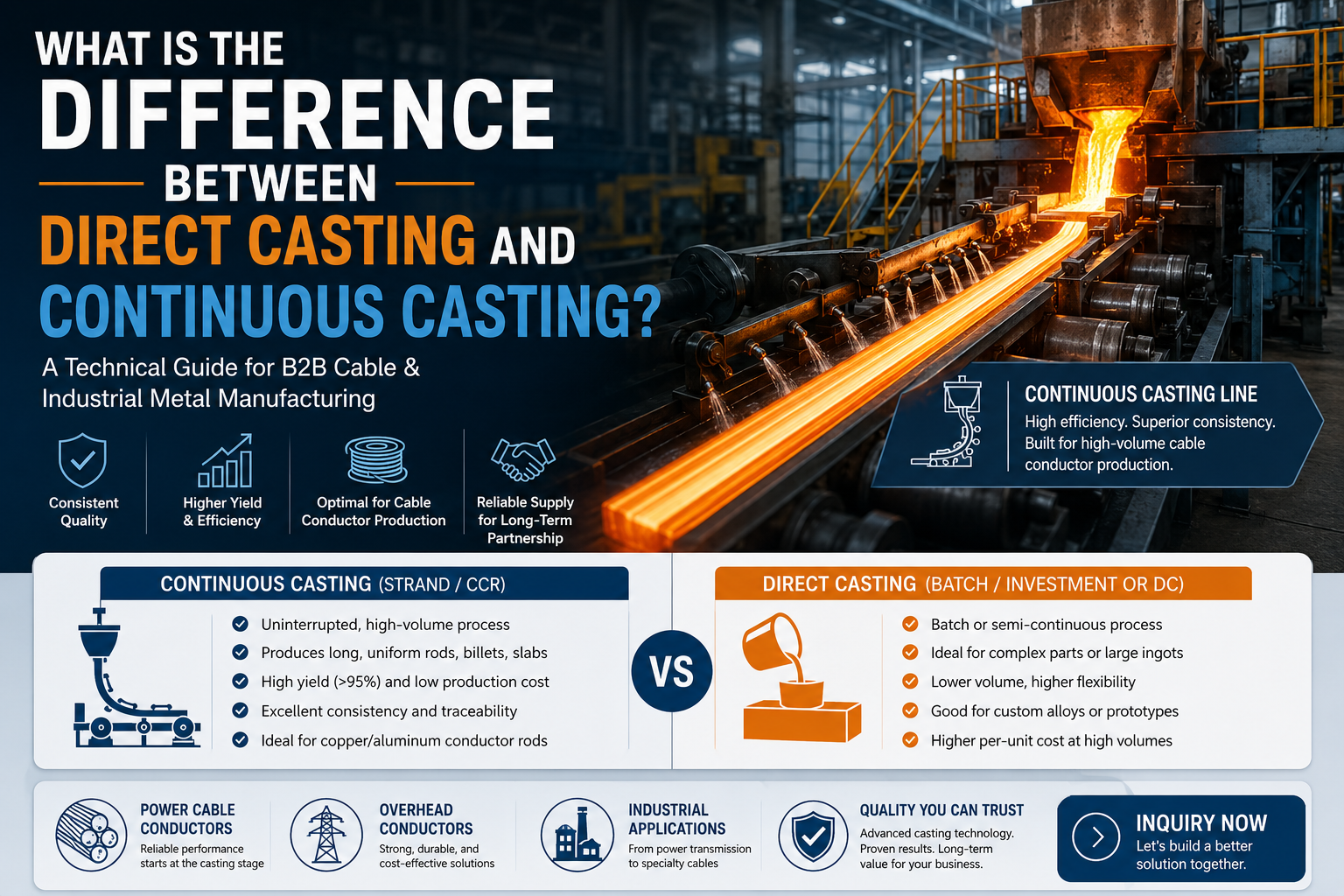
الصب المستمر (strand casting or CCR – Continuous Casting & Rolling): An uninterrupted process in which molten metal is poured into an open-ended, water-cooled mold. The solidifying strand is continuously withdrawn, cooled, and cut or rolled into uniform long products (rods, billets, slabs). This is the dominant modern method for high-volume standardized production.

Direct Casting encompasses two distinct industrial approaches:

  • Batch / Traditional or Investment Casting: Molten metal is poured into a single closed mold cavity (often lost-wax ceramic shells or sand molds). After solidification, the mold is removed. Best suited for complex geometries, prototypes, or lower-volume custom parts.
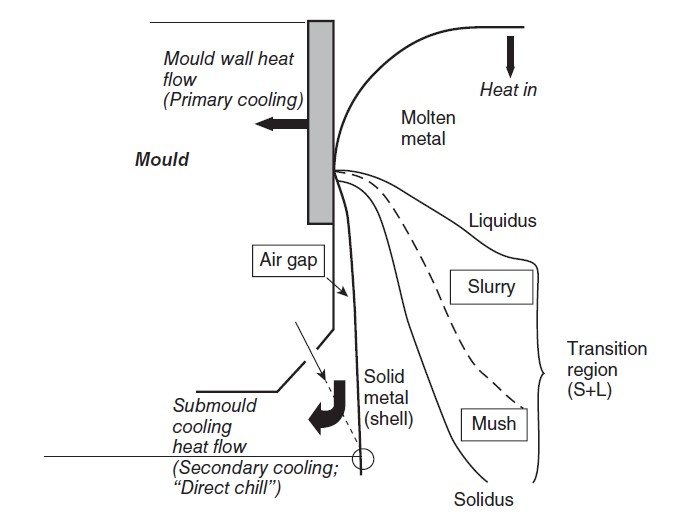
  • Direct Chill (DC) Casting: A semi-continuous process widely used for aluminum (and some copper) ingots/billets. Metal solidifies partially in a short water-cooled mold; the ingot is withdrawn while direct water jets provide intense secondary cooling. It produces large, high-integrity individual ingots later rolled into wire rod stock.

These distinctions matter significantly when specifying raw materials for power cables, control cables, building wires, or specialty conductors.

Continuous Casting: Process, Parameters & Advantages

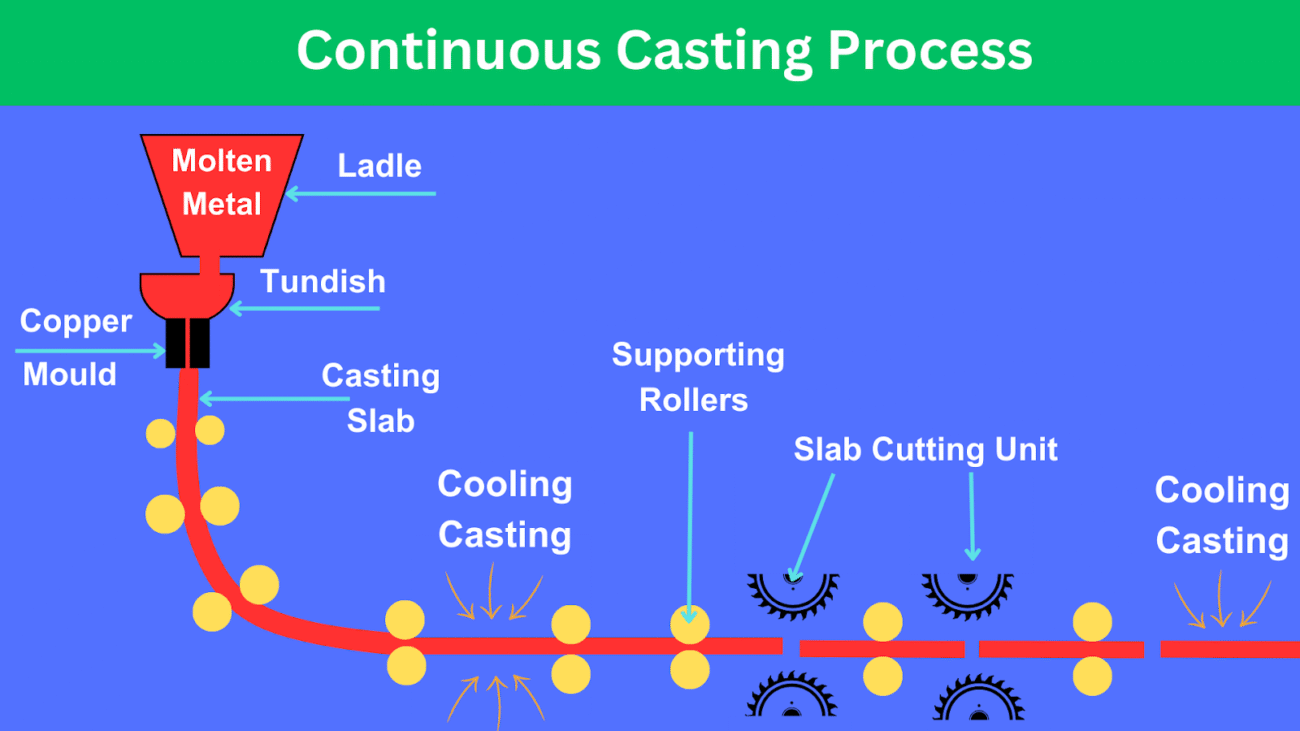
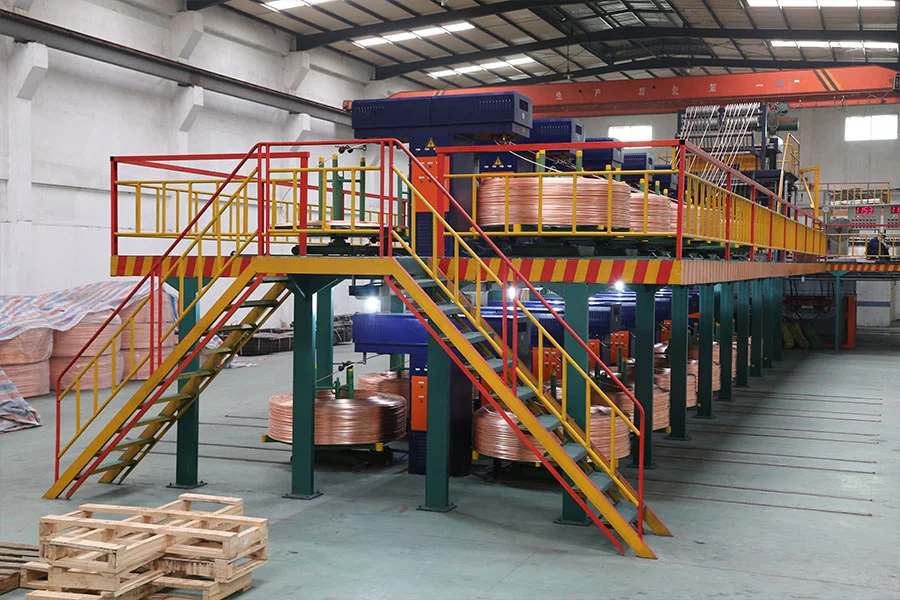
Molten metal flows from the ladle through a tundish (for flow control and inclusion removal) into a water-cooled copper mold where primary solidification occurs. A thin solid shell forms while the core remains molten. The strand is withdrawn by rolls, supported through the spray chamber for secondary cooling, straightened if required, and cut or directly rolled (in CCR lines).

Modern copper CCR lines integrate melting/refining, casting, and multi-stand rolling in one continuous flow, producing 8 mm or 12.5 mm rods ready for wire drawing.

Key technical parameters:

  • Mold oscillation and flux lubrication prevent sticking and ensure surface quality.
  • Casting speeds: up to 4 m/min for billets; CCR copper lines achieve high throughput with precise temperature and oxygen control.
  • Secondary water cooling removes the majority of heat.
  • Automation (PLC/SCADA) maintains metal level, flow, and cooling uniformity.

Global adoption & quantitative benefits:

  • Continuous casting accounts for approximately 95% of global steel production (and over 97% in many developed markets).
  • Yield improvements of 10–15% versus traditional ingot casting by eliminating “top and tail” losses (typically 10–20% in ingot routes).
  • Significant energy savings through elimination of ingot reheating and reduced overall processing steps.
  • Higher productivity and lower manpower requirements.

For copper cable rod (ETP grade via CCR): High-purity cathode feedstock yields rods with ≥99.90% Cu and controlled oxygen (typically 120–350 ppm). This controlled oxygen improves castability and drawability while delivering electrical conductivity of ≥100% IACS — the benchmark for efficient power transmission with minimal losses.

الأنسب لـ: High-volume production of uniform rods, billets, and slabs — the backbone of modern cable conductor manufacturing.

Pros (data-driven):

  • Exceptional consistency and traceability — critical for cable qualification and long-term infrastructure projects.
  • Reduced segregation and porosity; finer, more uniform microstructure.
  • Superior surface quality and drawability → fewer breaks during fine wire production.
  • Lowest cost per ton at scale; excellent supply security for large projects.
  • High automation enables tight process control and quality documentation.

Cons:

  • High capital intensity and best economics at sustained high volumes.
  • Less flexible for highly complex or very low-volume custom shapes.

Direct Casting: Batch/Investment & Direct Chill (DC) Methods

Batch / Investment Casting pours metal into a precise negative mold. After cooling, the mold is broken away. Modern variants use vacuum or inert atmospheres and magnetic stirring for alloy homogeneity. Ideal for intricate components or small-batch specialty parts.

Direct Chill (DC) Casting (primary method for aluminum wrought products): Molten metal enters a short water-cooled mold (7.5–15 cm deep). Only ~20% of heat is removed through the mold wall; the remaining ~80% is extracted by direct water sprays on the emerging ingot surface. Withdrawal speeds are typically 5–15 cm/min. The result is large ingots (up to 10 m) with reduced internal stress compared to static ingot casting.

الأنسب لـ:

  • Complex or detailed geometries (investment).
  • Large aluminum ingots/billets subsequently rolled into wire rod for cables (DC dominant).
  • Medium-volume or custom alloy production where fine grain structure and mechanical properties are prioritized.

Pros:

  • Excellent capability for intricate or thick-walled parts.
  • Lower setup cost for smaller runs or prototypes.
  • DC aluminum ingots often deliver fine, uniform grain structure beneficial for wire rod drawing and mechanical performance in certain cable applications.
  • Good flexibility for specialized alloys.

Cons:

  • Lower throughput and higher per-unit handling/labor costs due to batch nature.
  • Greater potential for inter-batch variation.
  • Often requires more secondary processing (rolling, machining).
  • Higher cost at very high volumes compared to continuous routes.

Head-to-Head Technical Comparison

CriterionContinuous Casting (incl. CCR)Direct Casting (Batch/Investment or DC)
Process TypeUninterrupted strand / integrated rollingBatch or semi-continuous (individual ingots)
Global Adoption (Steel)~95% of world productionLargely replaced for bulk steel
Typical Yield>95% (10–15% gain vs ingot)70–92% depending on method
Energy EfficiencySignificantly lower (no ingot reheating)Higher due to batch reheating & handling
Shape & Volume FitStandardized long profiles, high volumeComplex/custom or large individual ingots
Microstructure & QualityHighly uniform; low segregationGood to excellent; DC often fine grain for Al wire rod
Copper Rod (Cable)ETP: 120–350 ppm O₂, ≥100% IACS, excellent drawabilityLess common; OFC variants possible in specialized lines
Aluminum Wire RodGrowing (strip/continuous); good uniformityDC preferred in many sources for mechanical properties
Secondary ProcessingOften minimal (direct to rod)Frequently requires rolling/extrusion
Cost at ScaleLowest per ton for large runsHigher per unit at high volume
Traceability & ConsistencyExcellent (continuous monitoring)Good but more batch-dependent

Metallurgical Impact on Final Cable Performance

Continuous casting (especially CCR copper) produces rods with homogeneous microstructure, controlled oxygen, and minimal inclusions. This translates directly to:

  • Superior electrical conductivity (≥100% IACS) → lower I²R losses and energy efficiency for end users.
  • Excellent drawability to fine and superfine wires with minimal breakage.
  • Consistent mechanical properties (tensile strength/elongation balance) → reliable stranding, installation, and long-term mechanical integrity.
  • Reduced risk of defects that could cause hot spots or insulation stress over decades of service.

DC-cast aluminum provides fine grain structure advantageous for wire rod applications requiring high strength and ductility after drawing. Both modern methods, when properly controlled, far outperform legacy ingot casting in quality and consistency.

Choosing the Right Method for Your Project

Key decision factors include annual volume, required geometry/complexity, metal type (copper vs aluminum), target conductivity/mechanical specs, lead time, and total cost of ownership (including downstream drawing and cable qualification).

Our practical recommendation:

  • High-volume standardized copper or aluminum conductor rod → Continuous casting / CCR for optimal quality, cost, and supply reliability.
  • Complex components, prototypes, or specialized alloys → Direct (investment or tailored DC) routes.
  • Hybrid or custom requirements → We provide technical consultation to match the optimal upstream process to your exact cable specifications.

Why Partner with an Experienced Cable & Metallurgy Specialist?

We deliver more than cables — we deliver حلول تقنية and long-term partnership. Our team advises on casting route selection, material specifications, and traceability from melt to finished conductor. This ensures your cables meet the highest standards of reliability and performance while optimizing cost and supply security for multi-year infrastructure or OEM programs.

Ready to optimize your conductor material strategy with data-driven casting expertise?

استفسر الآن — Contact our technical specialists for a detailed consultation, sample evaluation, or customized quotation aligned with your project requirements.

أسئلة متكررة

Q: Which process offers better electrical conductivity for power cables?

A: Modern continuous casting (CCR) for ETP copper rod consistently achieves ≥100% IACS with excellent consistency, making it the preferred route for most power and building wire applications.

Q: Is Direct Chill (DC) casting still relevant for aluminum cable rods?

A: Yes. DC casting remains widely used and often preferred for aluminum wire rod due to its ability to produce ingots with favorable grain structure and mechanical properties for subsequent drawing.

Q: How much yield improvement does continuous casting provide?

A: Typically 10–15% higher yield compared to traditional ingot casting by eliminating crop losses at the ends of ingots.

Q: Can continuous casting handle custom alloys for specialty cables?

A: Yes, with proper process control and tundish metallurgy. For highly intricate or very low-volume custom parts, investment casting may still be more practical.

Q: What quality documentation can you provide for cast rod?

A: Full traceability, mill certificates, conductivity tests, oxygen analysis, mechanical properties, and process parameter records — supporting your cable qualification and audit requirements.

اترك تعليقاً

لن يتم نشر عنوان بريدك الإلكتروني. الحقول الإلزامية مشار إليها بـ *