Non classé

Qu'est-ce qu'une machine de câblage à arche ?

Qu'est-ce qu'une câbleuse à archet (bow type laying up machine)

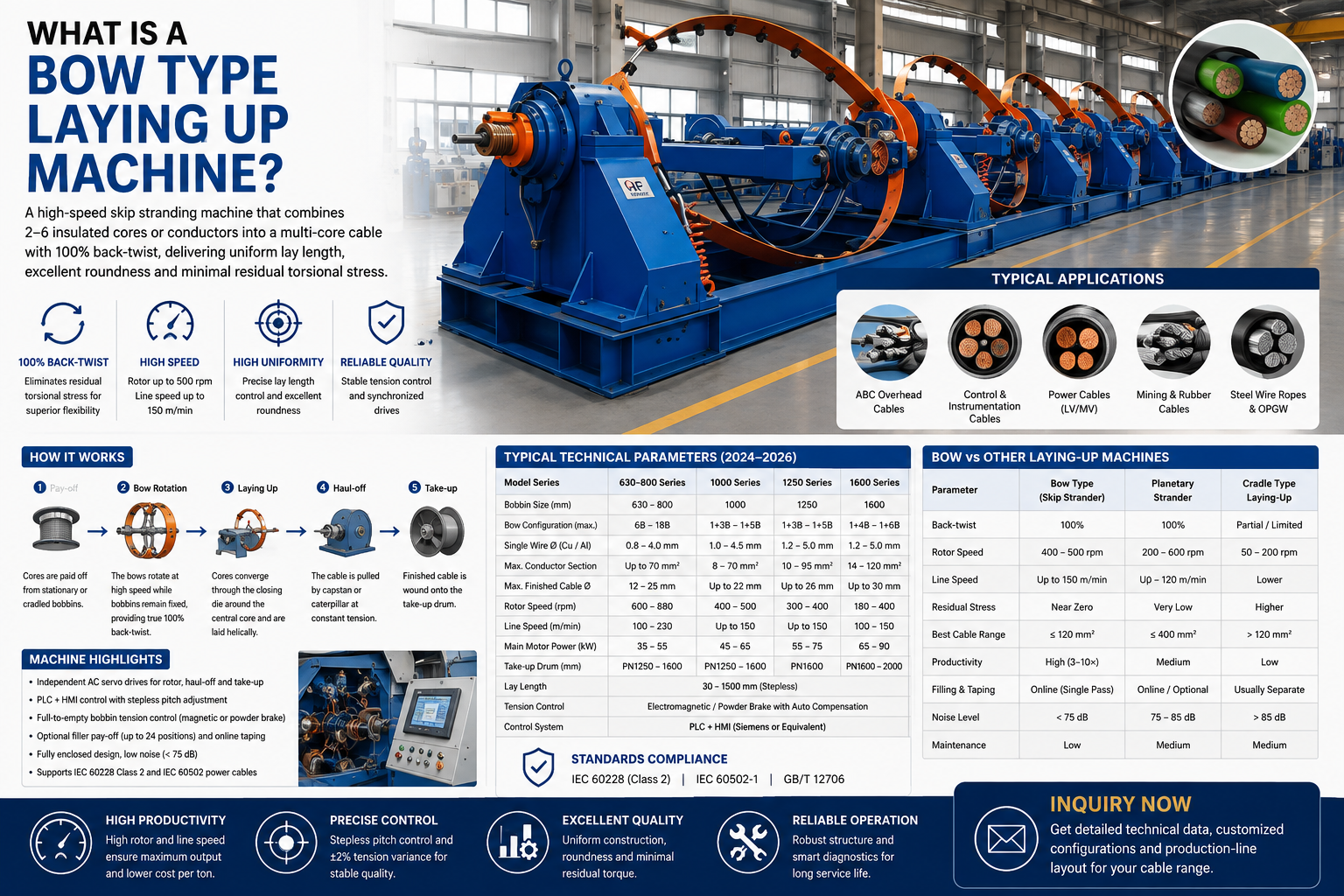
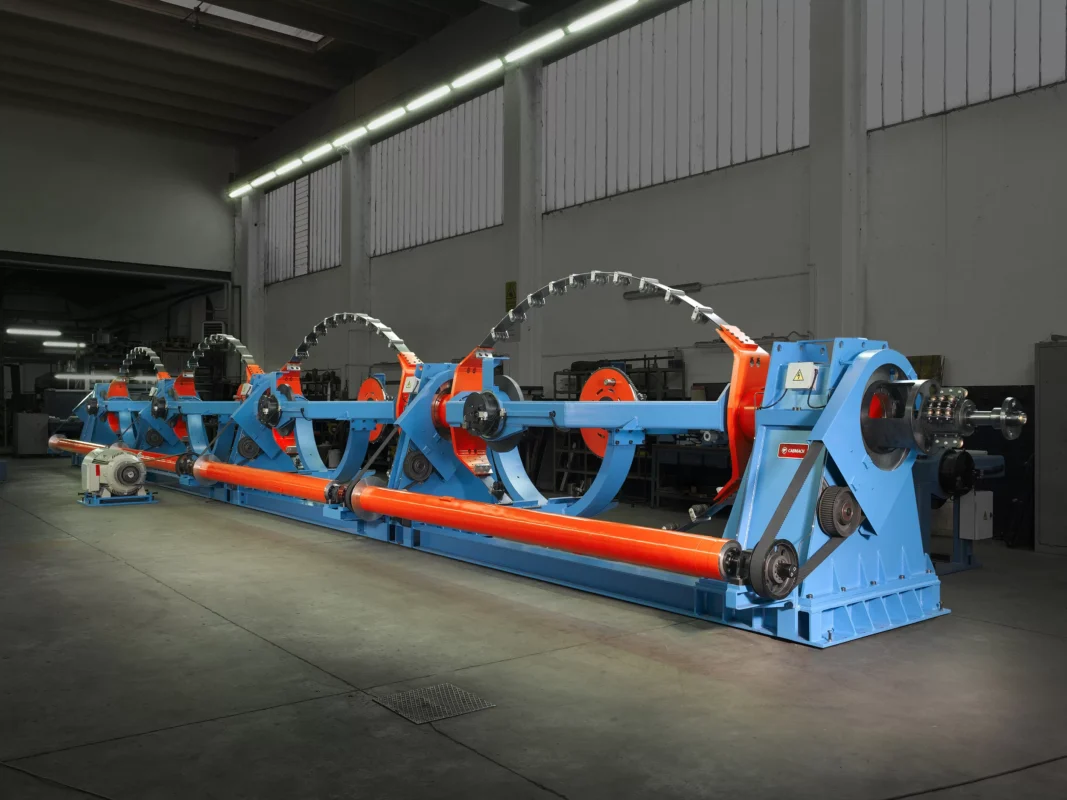
A Machine de pose de type arc (also known as a Bow Cabler, Skip Stranding Machine, or Bow Twister) is a high-speed cable manufacturing machine that assembles 2–6 (sometimes up to 7) insulated cores or conductors into a multi-core cable using rotating bows and 100% back-twist technology. It is primarily applied to ABC aerial bundled cables, control cables, mining cables, and low-to-medium voltage power cables typically up to 120 mm².

The machine delivers uniform lay length, excellent roundness, and near-zero residual torsional stress in the finished cable. Independent AC servo drives for the bow rotor, haul-off (capstan or caterpillar), and take-up, combined with PLC + HMI control, enable stepless pitch adjustment and line speeds commonly reaching 150 m/min.

How Does a Bow Type Laying Up Machine Work?

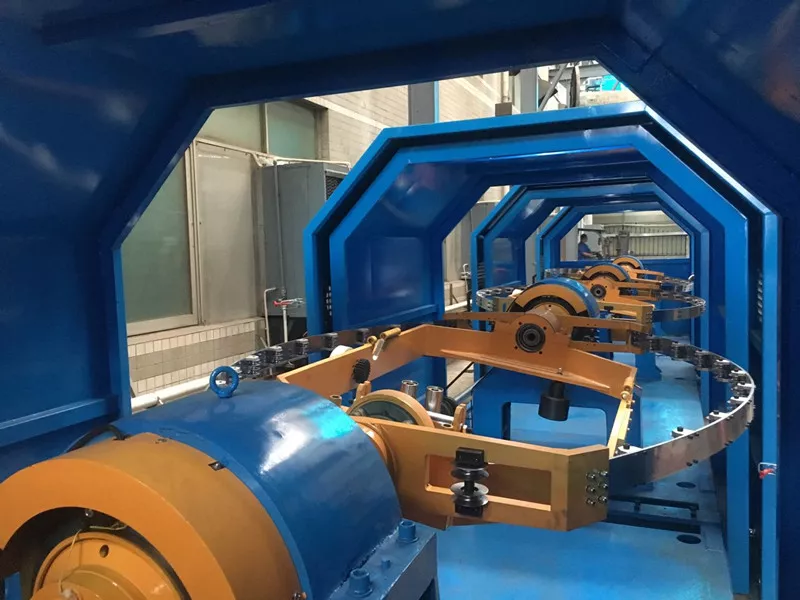
The machine operates on the skip/bow stranding principle. Insulated cores are paid off from stationary or cradled bobbins and guided through a series of high-tensile steel or carbon-fiber bows that rotate at high speed around the cable axis. As the bows rotate, each core is laid helically while receiving a precise 100% back-twist that cancels the rotational stress that would otherwise remain in the cable.

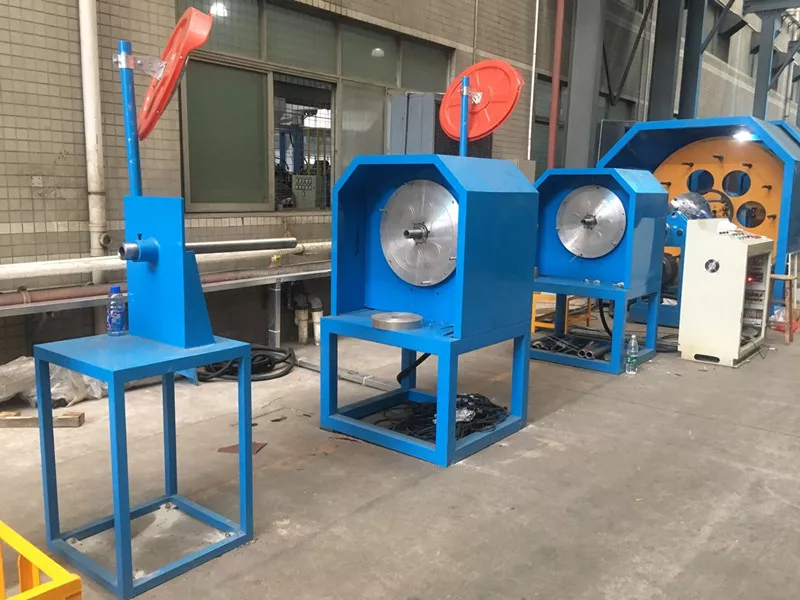
The central core (if present) runs straight through the axis. Optional filler pay-offs (up to 24 stations) and online semi-tangential taping heads can be integrated so that filling and wrapping occur in the same pass. A dual-wheel capstan or caterpillar haul-off pulls the finished cable at constant tension, and the take-up unit winds it onto large drums (commonly PN1250–PN2500). Full-to-empty bobbin tension is maintained by electromagnetic or powder brakes with automatic compensation.

This design produces cables that meet the geometric and mechanical requirements of multi-core constructions described in IEC 60502-1 for extruded power cables.

What Are the Main Technical Advantages Compared with Cradle-Type Laying-Up Machines?

Bow-type machines offer significantly higher productivity and better stress control for medium-section multi-core cables.

FonctionnalitéBow Type / Skip Stranding MachineMachine de pose de berceau traditionnelle
Back-twist100% (near-zero residual stress)Partial or limited
Max rotor speed150–500 rpm (model dependent)50–200 tr/min
Typical line speedUp to 150 m/minLower (inertia-limited)
Productivité3–10× higher for suitable sizesLower
Suitable cross-sectionABC, control & power ≤120 mm²Câbles d'alimentation de plus grande section (>120 mm²)
Pitch adjustmentVariation continue via automate programmable/IHMChangements de vitesse manuels
Tension stabilityConstant full-to-empty bobbinVariable
Noise & enclosureFully enclosed, typically <75 dBHigher noise, often open
Online filling & tapingEasy single-pass integrationUsually separate operations

Typical Technical Parameters of Modern Bow Type Laying Up Machines

Model RangeBobine de déroulement (mm)Max Rotate Speed (rpm)Vitesse de ligne (m/min)Section du conducteur (mm²)Max Core Ø (mm)Puissance moteur principal (kW)
630–800 series630–800600–880100–2901.5–10 / small control6–1535–55
KW-100 / 10001000400–5001508–70 (1+3B to 1+5B)1245–65
KW-125 / 12501250300–40015010–951655–75
KW-160 / 16001600180–400120–15014–1202065–90

Pay-off and take-up drum sizes are customizable. Copper single-wire diameter ≥1.5 mm and aluminum ≥1.7 mm are standard minimums. Lay length is typically adjustable from 30 mm to 1500 mm or more via PLC.

Which Cables Are Best Produced on a Bow Type Laying Up Machine?

The machine is optimized for:

  • ABC (Aerial Bundled Conductor) overhead cables (2–6 cores)
  • Control and instrumentation cables
  • Low- and medium-voltage multi-core power cables (XLPE, PVC, rubber)
  • Mining and flexible rubber-sheathed cables
  • Certain OPGW and reverse concentric-lay constructions when combined with tubular stranders

It is less suitable for very large cross-section power cables (>120–150 mm²) or heavily armoured constructions, where planetary or drum-type laying-up machines remain preferred.

Key Selection and Application Guidelines for Engineers and Purchasers

  1. Core count and size: Confirm 1+3B, 1+4B or 1+5B configuration matches the target cable.
  2. Back-twist requirement: 100% back-twist is essential for flexible or high-reliability cables to avoid insulation stress and improve bending performance.
  3. Haul-off choice: Dual-wheel capstan for medium cables; caterpillar for larger or heavier sections.
  4. Filling & taping: Specify number of filler stations and whether online non-metallic or copper-tape wrapping is required.
  5. Drive system: Independent AC servo motors + Siemens or equivalent PLC/HMI are now industry standard for pitch accuracy (±3% or better) and process data logging.
  6. Safety & noise: Fully enclosed guards with observation windows and noise below 75 dB improve operator environment and meet modern factory standards.

Common failure modes to prevent:

  • Uneven tension causing bird-caging or core migration → use closed-loop electromagnetic tension control.
  • Residual twist → verify 100% back-twist setting and correct bow geometry.
  • Pitch variation → ensure proper synchronization of main rotor, haul-off and take-up.

Industry Trends 2024–2026

Manufacturers continue to adopt lighter carbon-fiber or high-tensile steel bows, higher servo integration, and Industry 4.0 data interfaces. Demand remains strong for ABC cable production lines in Asia, Middle East and Latin America. Fully enclosed, low-noise designs with online quality monitoring are becoming the baseline expectation for new installations.

Key Takeaways

  • A Bow Type Laying Up Machine provides high-speed, low-stress assembly of 2–6 core insulated cables with 100% back-twist.
  • It delivers 3–10 times higher productivity than traditional cradle machines for cables up to approximately 120 mm².
  • Modern machines feature independent servo drives, PLC/HMI stepless pitch control, constant tension and optional online filling/taping.
  • Correct selection of bobbin size, haul-off type and filler configuration directly determines cable roundness, electrical performance and long-term reliability.

For detailed technical drawings, customized configurations or production-line layout proposals tailored to your specific cable constructions, Demande d'informations.

Laisser un commentaire

Votre adresse e-mail ne sera pas publiée. Les champs obligatoires sont indiqués avec *