Non classé

Qu'est-ce qu'une extrudeuse à vis bi-étagée ?

Extrudeuse à vis à deux étages

In advanced polymer compounding and specialty cable material production, achieving both superior dispersion of fillers and additives and protection of heat-sensitive or shear-sensitive components remains a core engineering challenge. Conventional single-stage extruders frequently force a compromise between mixing intensity and material integrity, leading to issues such as thermal degradation, inconsistent pellet quality, or excessive fiber breakage in reinforced compounds.

Le two-stage screw extruder (commonly referred to as a tandem extruder ou cascade extruder) addresses these limitations by physically separating the compounding and pressure-building functions into two distinct but interconnected extrusion units. This design enables high-shear, high-efficiency mixing in the first stage while providing low-shear, thermally controlled processing in the second stage. As a result, manufacturers can produce high-quality compounds with excellent dispersion, minimal degradation, and superior pellet consistency — capabilities that are especially critical for PVC insulation and sheathing compounds, cross-linked polyethylene (XLPE), halogen-free flame-retardant (LSZH/HFFR) materials, carbon black masterbatches, and glass or carbon fiber reinforced engineering plastics.

Qu'est-ce qu'une extrudeuse à vis bi-étagée ?

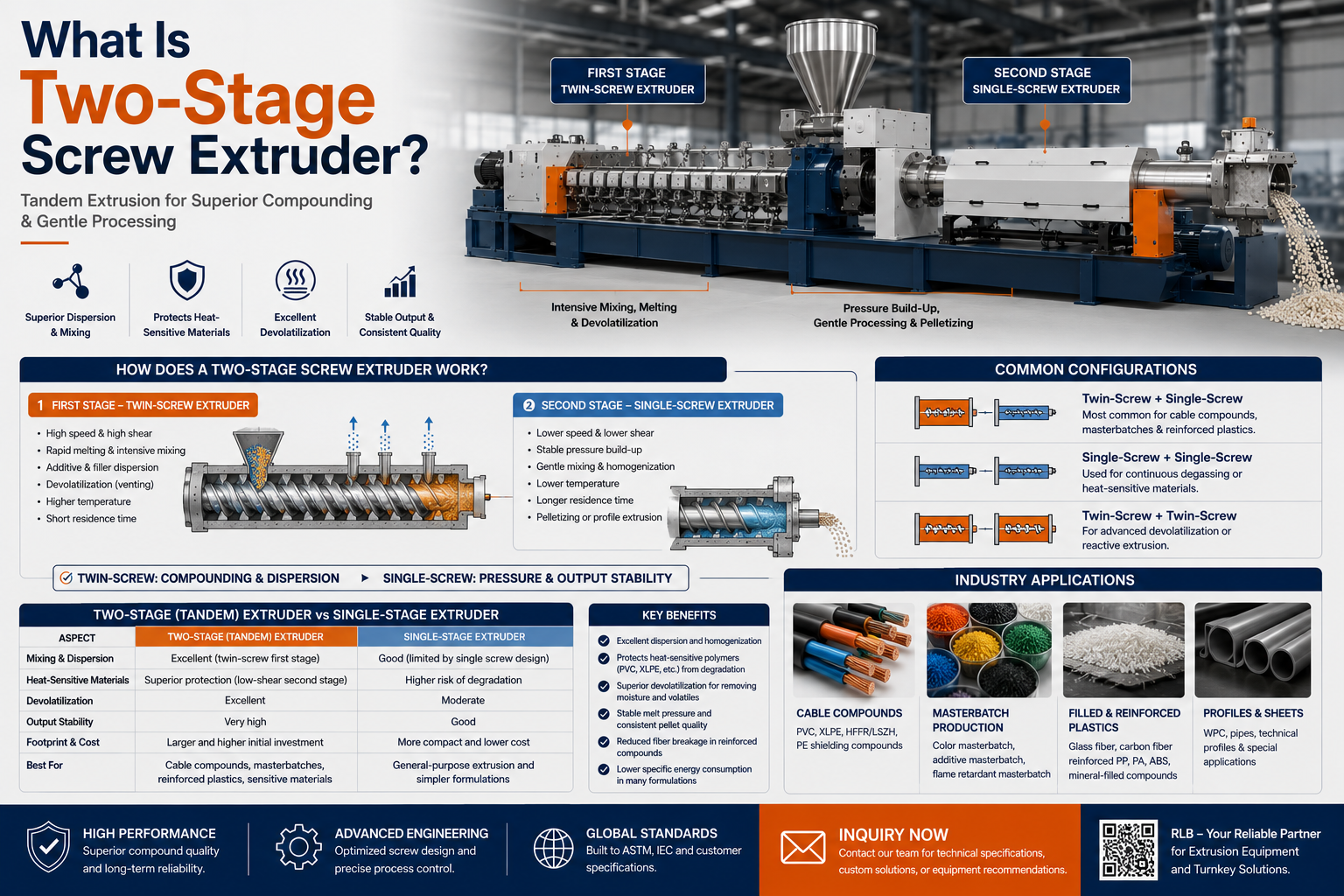
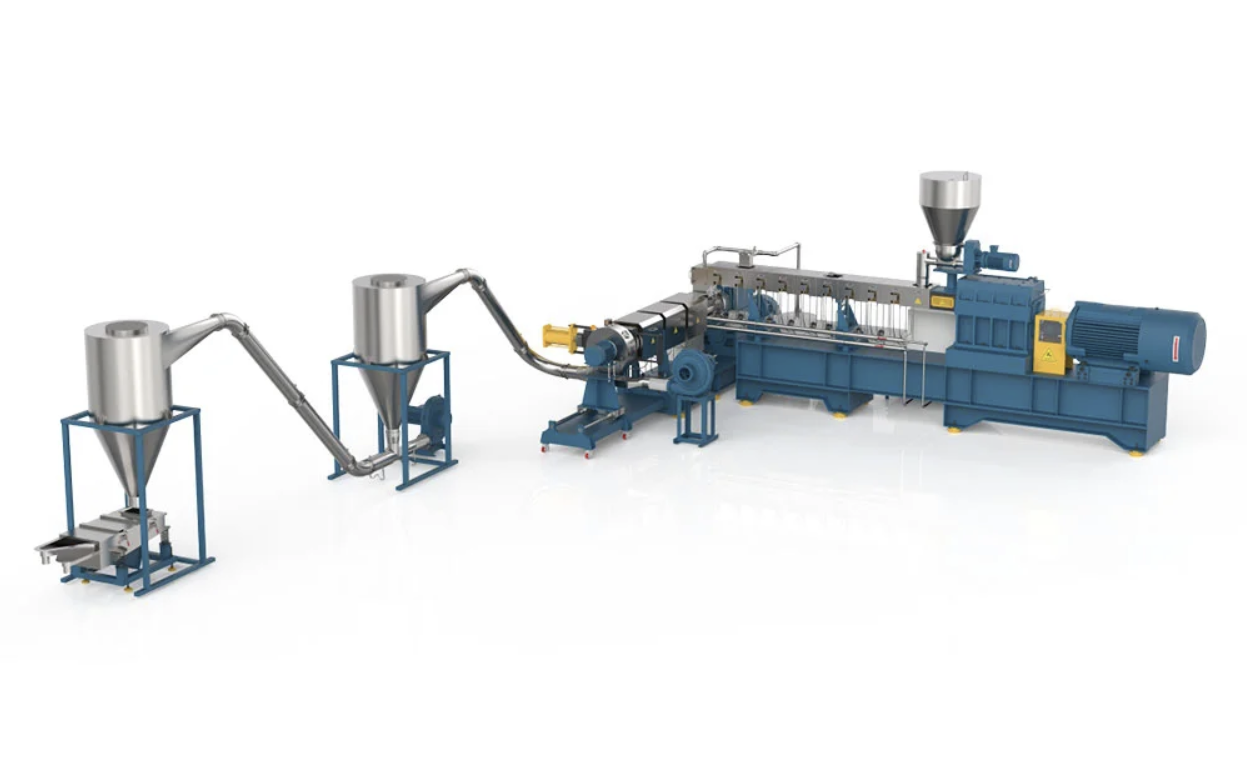
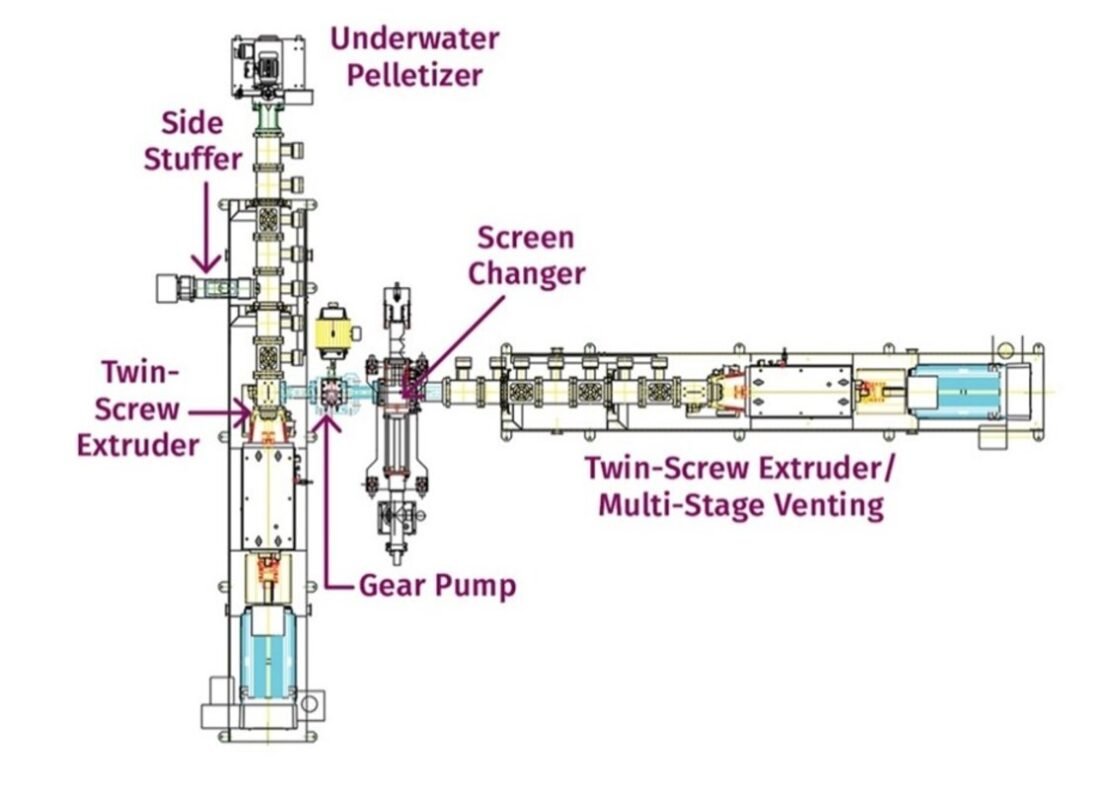
A two-stage screw extruder consists of two independent but connected extrusion systems. Plastic pellets, powders, or additives first enter the pre-extrusion unit (usually a co-rotating twin-screw extruder), where they are melted, mixed, and degassed. The uniform melt is then transferred to the main extrusion unit (typically a larger-diameter single-screw extruder) for final plasticization, stable pressure build-up, and pelletizing or shaping.

This design allows the first stage to operate at high speed and high shear for optimal dispersion, while the second stage operates at low speed and lower temperature to protect sensitive formulations from degradation.

How Does a Two-Stage Screw Extruder Work?

The material flow and processing are divided into two clearly defined stages:

Stage 1 – Co-Rotating Twin-Screw Compounding (High-Shear Mixing & Devolatilization)

Plastic pellets, powders, liquids, and additives are metered into the twin-screw extruder via gravimetric feeders. The co-rotating intermeshing screws generate high shear and extensional flow, rapidly melting the polymer and achieving excellent dispersive and distributive mixing. Multiple atmospheric and vacuum venting zones remove moisture, entrapped air, and low-molecular-weight volatiles. Modular screw elements (conveying, kneading, mixing, and reverse-pumping blocks) can be configured to optimize residence time distribution and shear history for specific formulations. Typical operating parameters include screw speeds of 300–600 rpm and L/D ratios of 36–48.

Stage 2 – Single-Screw Extrusion (Low-Shear Pressure Build-up & Pelletizing)

The uniformly compounded melt is transferred under controlled pressure and temperature into the single-screw extruder. This stage operates at significantly lower screw speeds (typically 65–85 rpm) and a carefully controlled temperature profile. The larger screw diameter and deeper flight channels provide gentle conveying with minimal additional shear, allowing the melt to stabilize thermally while building the consistent pressure required for high-quality pelletizing or profile extrusion. The low shear environment protects heat-sensitive components such as cross-linking agents, flame retardants, and certain stabilizers.

The result is pellets or extrudates with uniform size, excellent surface quality, and consistent physical and electrical properties.

Common Configurations of Two-Stage Extruders

  • Twin-Screw + Single-Screw (Most Widely Adopted): Offers the optimal combination of high-intensity mixing and gentle final processing. Preferred for cable compounds and masterbatches.
  • Single-Screw + Single-Screw: Used when continuous degassing or very low-shear processing is the primary requirement.
  • Twin-Screw + Twin-Screw: Applied in advanced reactive extrusion or processes requiring extended residence time and multiple devolatilization stages.

What is the Difference Between Single and Double (Twin) Screw Extruders?

Single-Screw Extruder

  • Features one rotating screw inside a barrel.
  • Relies mainly on friction and external heating for melting and conveying.
  • Good for basic melting, pressure build-up, and simple profile extrusion.
  • Limited mixing and dispersion capability — not ideal for complex formulations with high filler or additive content.
  • Lower shear, simpler operation, and lower cost.

Twin-Screw (Double-Screw) Extruder

  • Uses two intermeshing screws (co-rotating or counter-rotating).
  • Provides excellent dispersive and distributive mixing due to the interaction between the screws.
  • Superior devolatilization through multiple venting zones.
  • Precise control over residence time, shear, and temperature.
  • Higher output, better consistency, and ability to handle complex compounding tasks.
  • Higher cost and more complex operation.

Key Comparison Table

FonctionnalitéSingle-Screw ExtruderTwin-Screw ExtruderTwo-Stage (Tandem) System
Mixing & DispersionLimitéExcellentExcellent (from twin-screw stage)
Heat-Sensitive MaterialsModerate protectionCan cause degradationBest protection (gentle single-screw stage)
DevolatilizationModéréExcellentExcellent
Output StabilityBienTrès bienHighest
Idéal pourSimple melting & profilesCompounding & masterbatchesCable compounds, reinforced plastics, sensitive materials
Cost & ComplexityLowestPlus hautHighest

What Are the Different Types of Extruders?

Extruders are classified primarily by screw geometry and intended function:

  1. Single-Screw Extruders — Standard for melting, conveying, and profile extrusion. Simple design with lower capital and operating costs.
  2. Twin-Screw Extruders
    • Co-rotating Parallel: Dominant in compounding due to superior mixing and self-wiping action.
    • Counter-Rotating Parallel or Conical: Preferred for PVC pipe/profile extrusion and certain shear-sensitive applications.
  3. Conical Twin-Screw Extruders — Excellent feeding characteristics for high-viscosity or powder-heavy formulations; widely used in PVC processing.
  4. Two-Stage (Tandem / Cascade) Extruders — Combine the mixing advantages of twin-screw with the gentle processing of single-screw. Particularly effective for heat-sensitive cable compounds and high-filler masterbatches.
  5. Multi-Screw and Planetary Extruders — Specialized high-output or reactive processing machines.
  6. Laboratory and Micro-Extruders — Small-scale systems for formulation development and R&D.

Key Benefits and Trade-Offs of Two-Stage Screw Extruders

Benefits

  • Superior dispersion and homogenization from the twin-screw stage
  • Excellent protection of heat-sensitive materials (PVC, XLPE, flame retardants)
  • Outstanding devolatilization and removal of volatiles
  • Stable melt pressure and consistent pellet quality
  • Reduced fiber breakage in glass/carbon fiber reinforced compounds
  • Lower specific energy consumption in many formulations
  • High flexibility through modular screw and barrel design

Trade-Offs

  • Larger machine footprint
  • Higher initial capital investment
  • More complex temperature and drive system maintenance

Primary Industry Applications

  • Cable & Wire Compounds: PVC insulation and sheathing, XLPE, PE shielding compounds, and LSZH/HFFR materials.
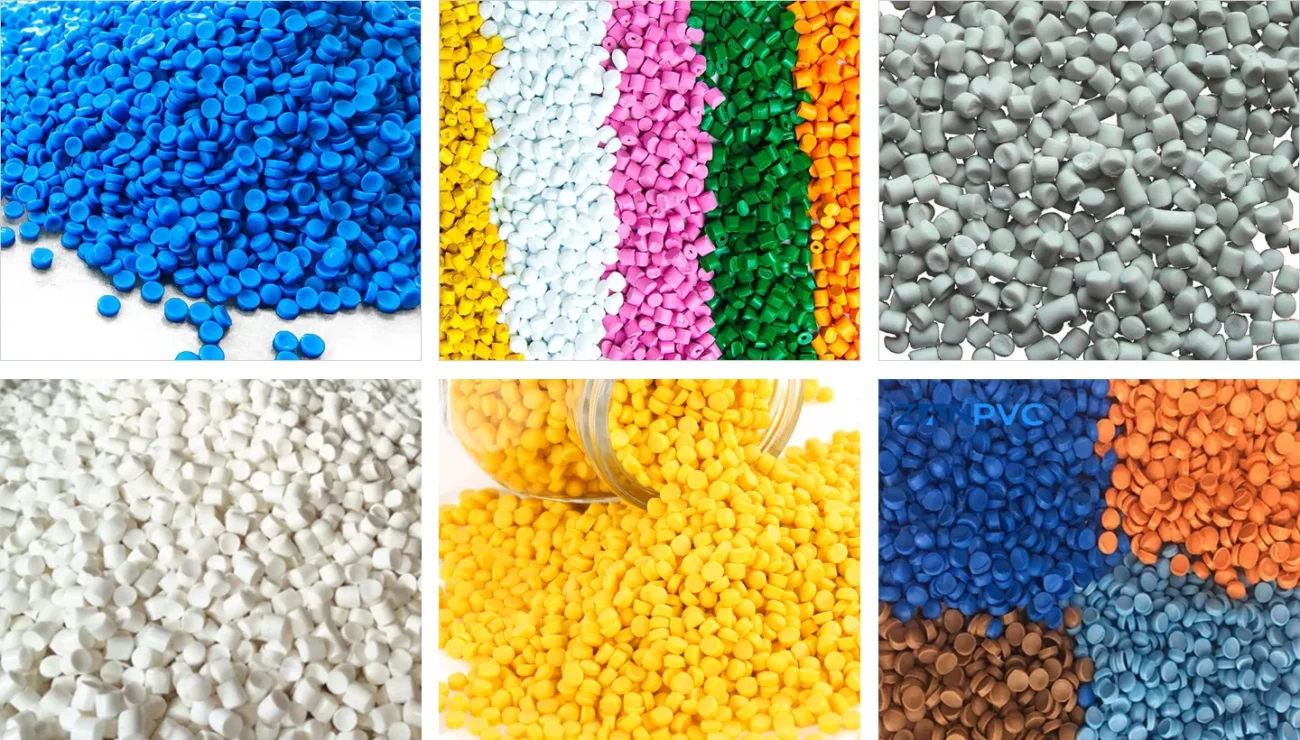
  • Masterbatch Production: High-concentration color, additive, and carbon black masterbatches.
  • Filled and Reinforced Plastics: Glass fiber and carbon fiber reinforced PP, PA, ABS, and other engineering plastics.
  • Plastic Alloys and Reactive Extrusion: Blends requiring precise control of reaction and devolatilization.
  • Specialty Compounds: Wood-plastic composites and technical materials demanding high consistency.

Conclusion

The two-stage screw extruder represents a technically advanced solution for manufacturers who require both intensive mixing performance and gentle processing of sensitive materials. By decoupling the compounding and pressure-building functions, this tandem design delivers measurable improvements in dispersion quality, thermal stability, devolatilization efficiency, and final pellet consistency compared with conventional single-stage systems.

For producers of PVC and XLPE cable compounds, high-performance masterbatches, and reinforced engineering plastics, the two-stage (tandem) extruder offers a compelling combination of product quality, process reliability, and long-term operational efficiency.

Laisser un commentaire

Votre adresse e-mail ne sera pas publiée. Les champs obligatoires sont indiqués avec *