Non classé

Qu'est-ce qu'une machine de blindage à feuillard emboîté en continu ?

Qu'est-ce qu'une machine de blindage à interverrouillage continu pour câbles

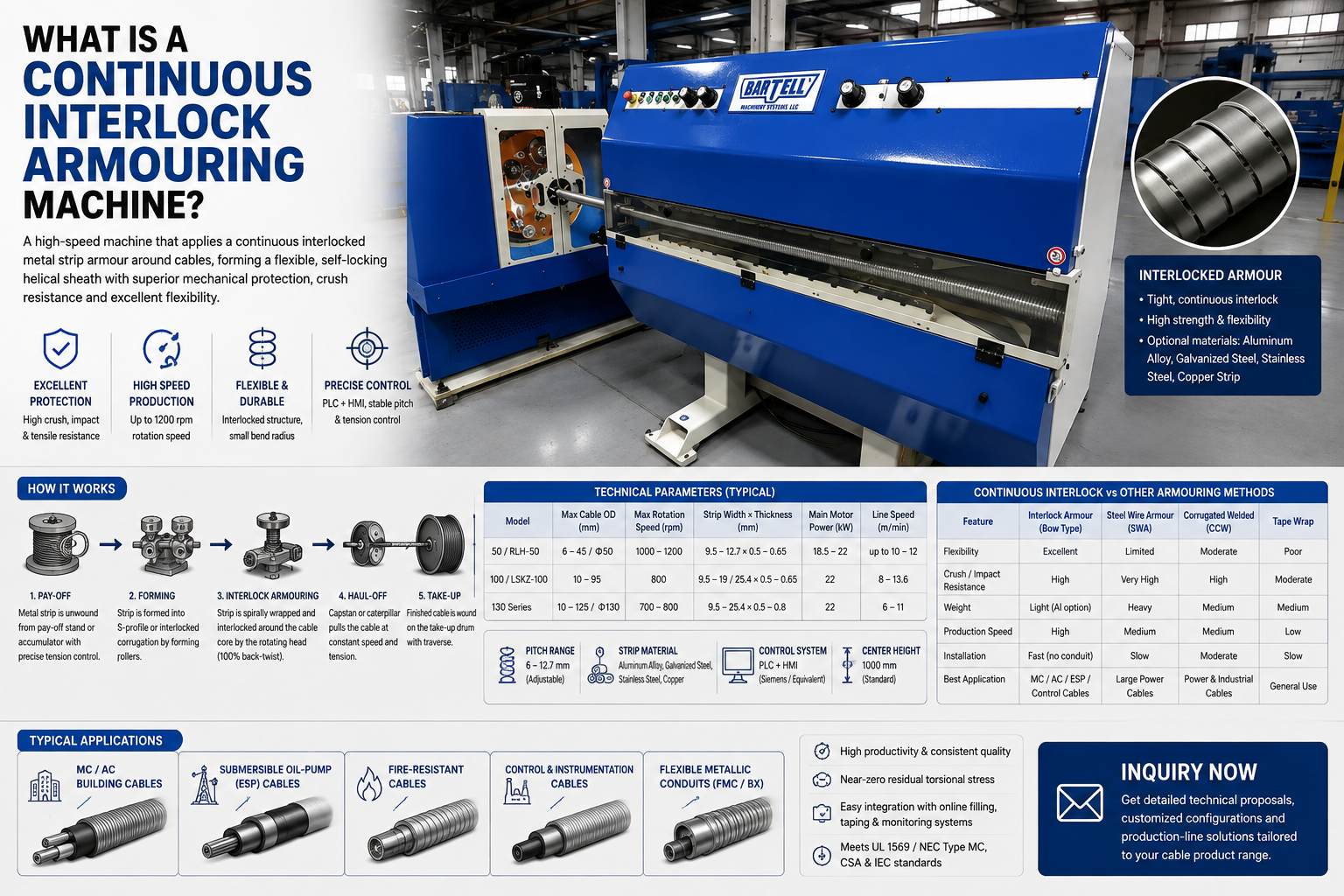
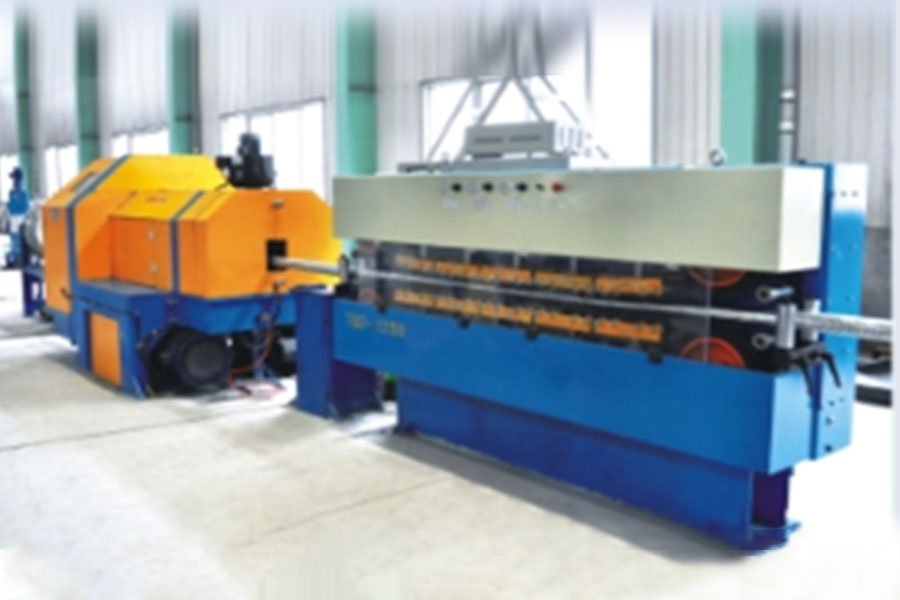
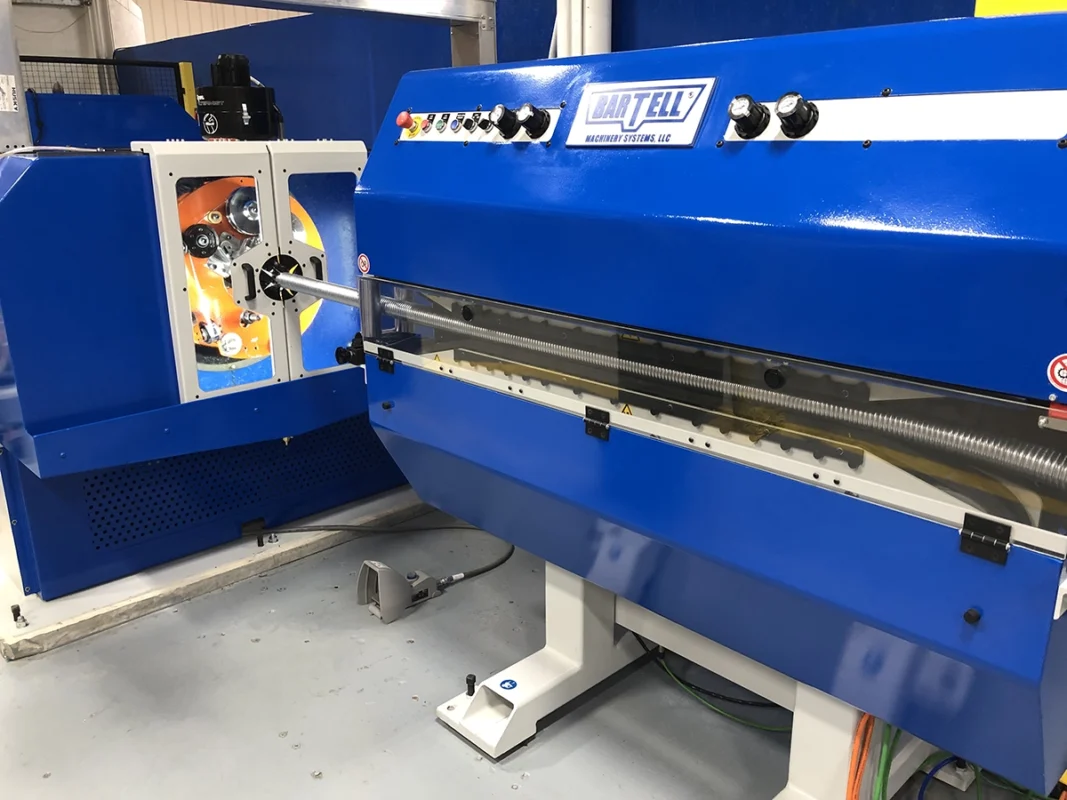
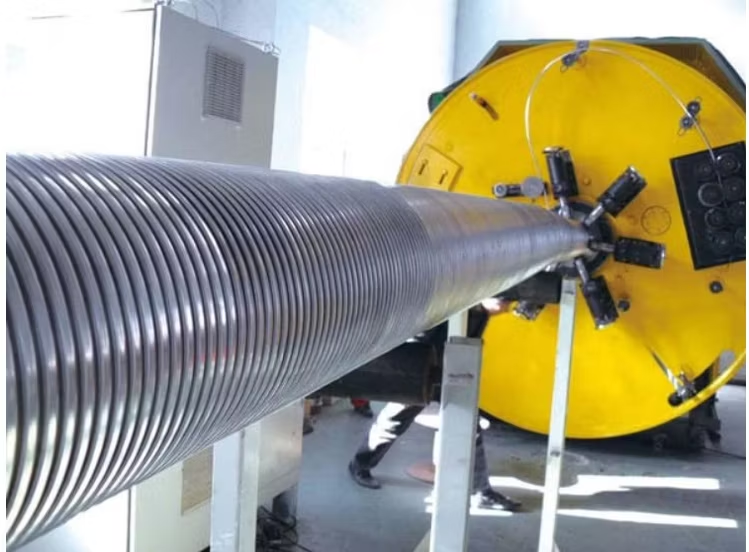
Machine de blindage à verrouillage continu is a specialized high-speed production line used in cable manufacturing to apply a continuous, interlocked metal strip armour around round or flat cable cores. It forms a flexible, self-locking helical metal sheath (typically aluminum alloy, galvanized steel, stainless steel or copper strip) that provides superior mechanical protection, crush resistance, tensile strength and flexibility without requiring rigid conduit.

This machine is the core equipment for producing Type MC (Metal-Clad), AC, BX, aluminum-alloy interlocked armour cables, submersible oil-pump (ESP) cables, fire-resistant cables and flexible metallic conduits. Unlike traditional tape-wrapping or wire-armouring methods, the continuous interlock process creates an S-shaped or corrugated interlocked profile in one continuous pass, enabling high line speeds and consistent armour integrity.

Working Principle of Continuous Interlock Armouring

A continuous interlock armouring machine feeds a flat metal strip (width 9.5–25.4 mm, thickness 0.5–0.8 mm) from a pay-off or accumulator. The strip passes through forming rollers that shape it into an S-profile or interlocked corrugation. The rotating head (or forming die system) spirally wraps the pre-formed strip around the advancing cable core so that each successive turn interlocks with the previous one, creating a continuous flexible metal tube.

Key process elements include:

  • Precise strip tension control (servo or pneumatic)
  • Synchronized rotation of the armouring head (up to 1200 rpm on smaller models)
  • Capstan or caterpillar haul-off that matches linear speed to pitch
  • Automatic pitch and diameter adjustment via PLC

The result is a tightly interlocked armour with typical pitch of 6.0–12.7 mm that remains flexible yet highly resistant to crush and impact.

Technical Parameters and Model Comparison

Typical production range for modern continuous interlock lines:

ModèleMax Cable OD (mm)Max Rotation Speed (rpm)Strip Width × Thickness (mm)Main Motor (kW)Typical Line Speed (m/min)Primary Application
50 / RLH-506–45 / Φ501000–12009.5–12.7 × 0.5–0.6518.5–22up to 10–12Round & flat ESP / Al-alloy cable
100 / LSKZ-10010–958009.5–19 / 25.4 × 0.5–0.65228–13.6MC / AC / fire-proof cables
13010–125 / Φ130700–8009.5–25.4 × 0.5–0.8226–11Large power & instrument cables

Data compiled from leading manufacturers (RLB, Handing, Herrman, Bartell-type lines). Center height is commonly 1000 mm. Control systems follow IEC standards with Siemens or equivalent PLC + HMI for pitch, tension and diameter closed-loop control.

Comparison: Continuous Interlock vs Other Armouring Methods

FonctionnalitéContinuous Interlock ArmourSteel-Wire Armour (SWA)Corrugated Welded Armour (CCW)Traditional Tape Wrap
FlexibilityExcellentLimitéModéréPoor
Crush / Impact ResistanceHautVery HighHautModéré
Installation SpeedFast (no conduit needed)SlowModéréSlow
PoidsLight (Al option)HeavyMediumMedium
Production SpeedHigh continuousMediumMediumFaible
Typical StandardsUL 1569 / NEC Type MC, CSAIEC 60502, GBIEC / APIVarious

Interlocked armour is preferred for North American MC/AC cables, oil & gas ESP cables, data/fiber protection and commercial building wiring where bend radius and ease of installation are critical.

Key Applications and Selection Logic

  • Aluminum-alloy interlocked armour cables (AC90, ACWU90, MC) – building and industrial power distribution.
  • Submersible oil-pump (ESP) cables – continuous flexible protection in harsh downhole environments.
  • Fire-resistant and instrument cables – mechanical integrity under fire and vibration.
  • Flexible metallic conduit (FMC / BX) – commercial and residential wiring.
  • Data, coaxial and fiber-optic protection – where crush resistance and flexibility are both required.

Selection criteria for engineers and procurement:

  1. Maximum finished cable diameter and core type (round vs flat).
  2. Required strip material (aluminum alloy for weight reduction, galvanized steel for higher strength, stainless for corrosion).
  3. Target pitch and armour coverage percentage.
  4. Production volume → choose high-rpm models (50-series) for smaller diameters or 100/130-series for larger cables.
  5. Integration needs: pay-off size (PN800–PN1250), caterpillar haul-off, take-up with traverse, and accumulator for continuous strip feed.

Standards, Performance Data and Reliability Considerations

Modern machines are designed to produce armour complying with:

  • UL 1569 / NEC Type MC
  • CSA standards for AC/MC cables
  • ICEA recommended interlocked armour thicknesses
  • IEC electrical equipment safety requirements for the machine itself

Typical performance metrics observed in 2024–2026 production lines:

  • Armour tensile and crush resistance significantly higher than non-interlocked constructions.
  • Bend radius performance superior to wire armour, enabling tighter installation routes.
  • Continuous operation capability with automatic strip changeover systems that minimize downtime.

Modes de défaillance courants et prévention :

  • Uneven interlocking or gaps → maintain precise strip tension and forming-roll alignment.
  • Strip breakage → use quality strip material and proper accumulator control.
  • Diameter variation → closed-loop diameter measurement and real-time pitch adjustment.
  • Excessive vibration at high rpm → dynamic balancing of the rotating head and proper foundation.

Regular maintenance focuses on forming dies, guide rollers, bearings of the rotating system, and servo tension units. Proper lubrication and periodic calibration of pitch and tension sensors are essential for long-term dimensional stability.

Summary of Technical Advantages

Continuous Interlock Armouring Machines deliver:

  • High productivity through continuous high-speed operation (up to 1200 rpm on smaller models).
  • Consistent interlocking geometry that provides both flexibility and mechanical strength.
  • Compatibility with aluminum, steel, stainless and copper strips for optimized cost/weight/performance.
  • Full line integration capability for modern cable factories producing MC, ESP, fire-resistant and specialty cables.

For cable manufacturers seeking reliable quality, customized engineering solutions and long-term production partnership, precise machine selection based on diameter range, material and target standards is critical.

Demande d'informations for detailed technical proposals, layout drawings, capacity calculations or customized continuous interlock armouring lines tailored to your cable product range.

Laisser un commentaire

Votre adresse e-mail ne sera pas publiée. Les champs obligatoires sont indiqués avec *