Kategorilendirilmemiş

Alüminyum Kılıflı Oluklu Boru Sürekli Ekstrüzyon Hattı

Alüminyum Kılıflı Oluklu Boru Sürekli Ekstrüzyon Hattı

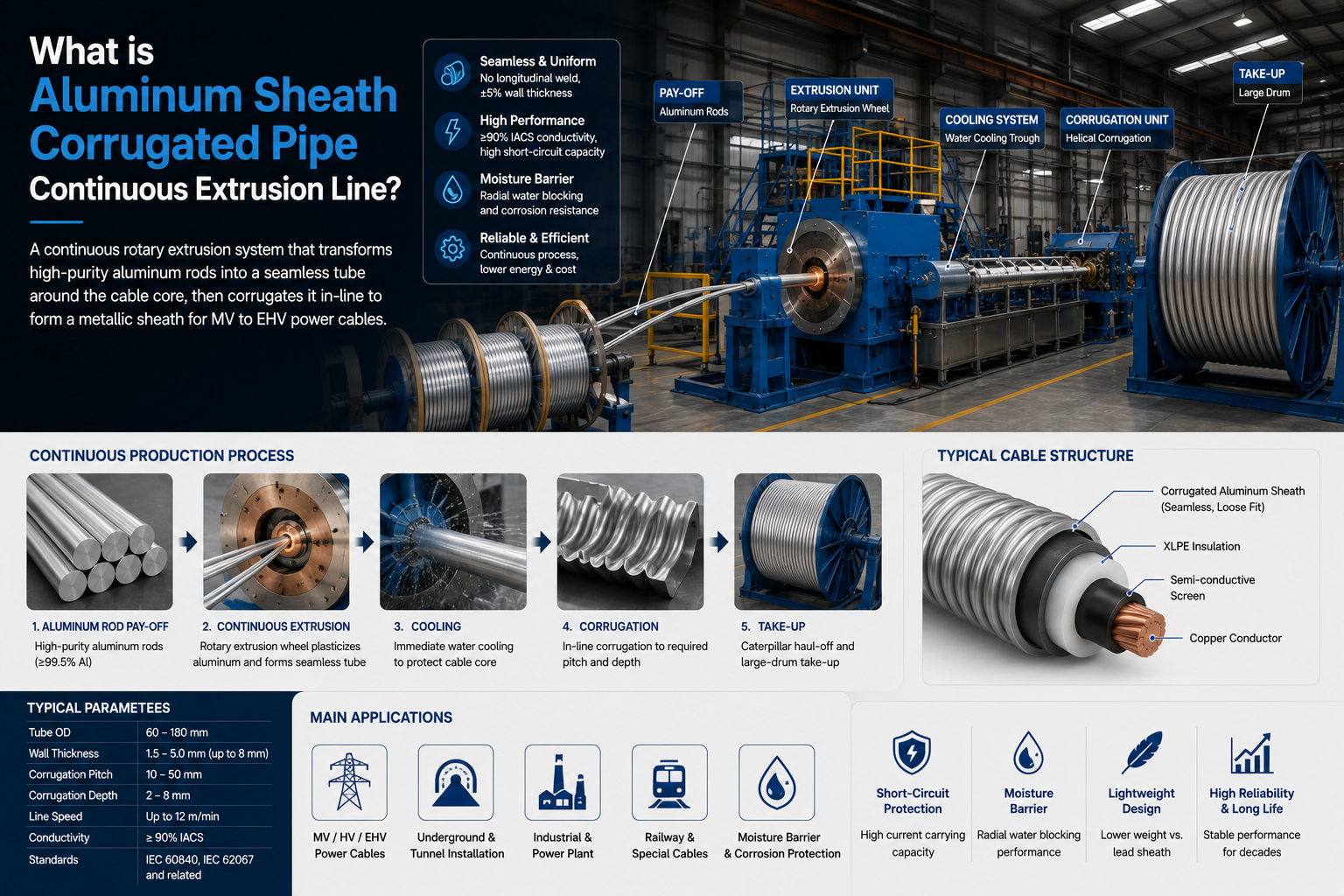
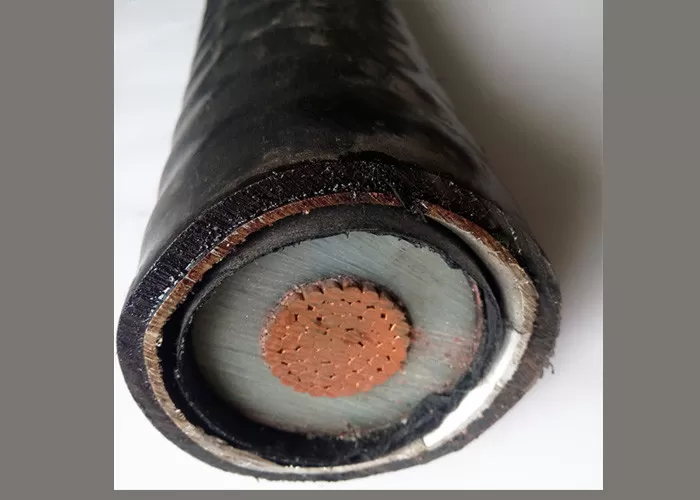
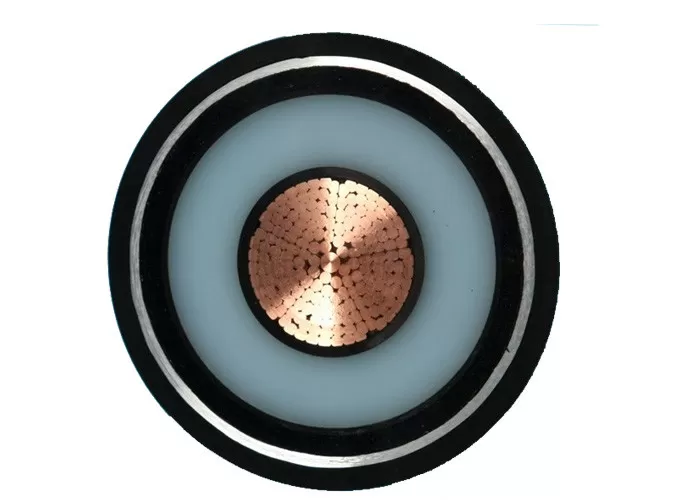
Alüminyum Kılıflı Oluklu Boru Sürekli Ekstrüzyon Hattı is a continuous rotary extrusion (Conform/Conklad/SheathEx-type) production system that converts high-purity aluminum rods into a seamless, loose-fitting aluminum tube around a cable core, followed by in-line corrugation to produce a metallic sheath for low-voltage to extra-high-voltage (EHV) power cables.

This process eliminates longitudinal welds, delivers uniform wall thickness, and provides radial moisture barrier, short-circuit current capacity, and mechanical protection required by IEC 60840, IEC 62067 and related national standards.

What Is an Aluminum Sheath Corrugated Pipe Continuous Extrusion Line and How Does It Work?

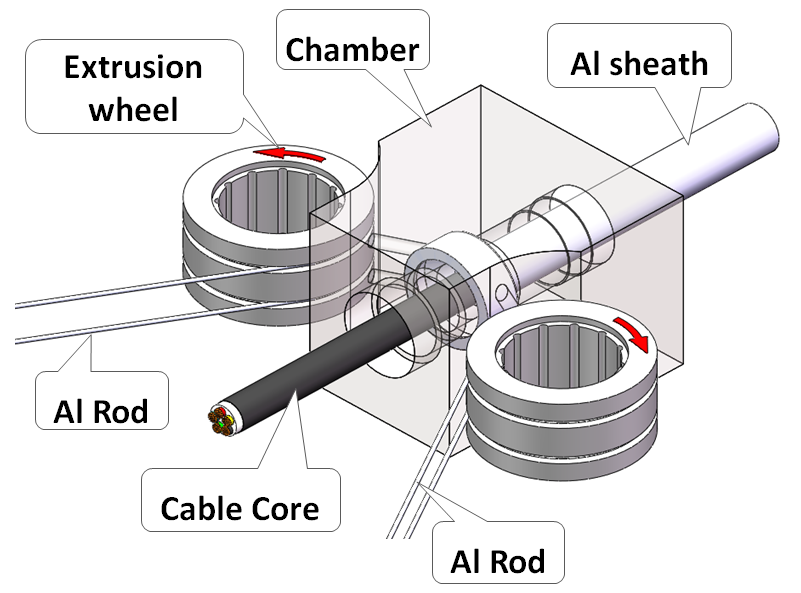
An Aluminum Sheath Corrugated Pipe Continuous Extrusion Line feeds multiple clean aluminum rods (typically Φ9.5 mm or Φ12–15 mm, GB/T 3954 A2 or equivalent 99.5 %+ purity) into a rotating extrusion wheel (or dual wheels) with circumferential grooves. Frictional heat and pressure plasticize the aluminum at approximately 450–500 °C. The metal flows into an extrusion chamber surrounding a cooled portal mandrel through which the cable core passes at synchronized speed. A seamless aluminum tube is formed around the core as a loose sheath, immediately water-cooled to protect the XLPE insulation, then corrugated (helical or annular) to the required pitch and depth before take-up.

Başlıca Teknik Avantajlar

  • Truly seamless aluminum tube – no weld line, no bead, no risk of weld-related corrosion or cracking.
  • Uniform wall thickness and superior concentricity thanks to balanced multi-rod feeding and double-groove Conform technology.
  • In-line water-cooled core protection ensures insulation integrity even at high extrusion temperatures.
  • Precision adjustable corrugation improves flexibility, bend radius and crush resistance while maintaining excellent radial moisture barrier performance.
  • High production efficiency and lower scrap rates compared with welding lines.
  • Compatible with standard continuous-cast and rolled (CCR) aluminum rod – lower raw-material cost than aluminum sheet or lead.
  • Robust design for 24/7 industrial operation with advanced PLC + HMI control, recipe management and real-time monitoring.
  • Customizable for smooth or corrugated sheath according to project requirements.

Typical process flow:

  1. Multiple high-purity aluminum rods (normally 4 × Φ9.5 mm or 2 × Φ12 mm, A2 grade per GB/T 3954) are paid off, surface-cleaned and fed into the main extrusion unit.
  2. The Conform extrusion machine with dual-groove wheel structure plasticizes and extrudes a seamless aluminum tube of the required diameter and wall thickness.
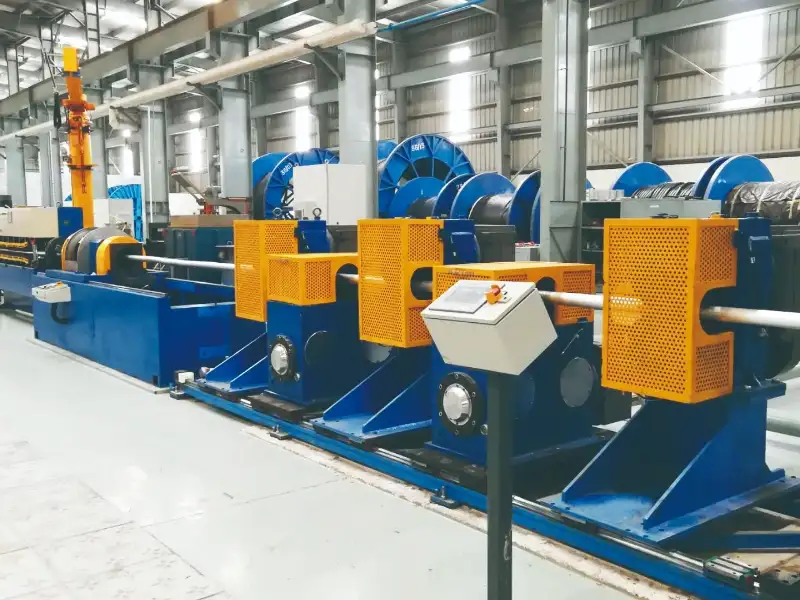
  3. The pre-manufactured cable core is paid off from a large gantry stand at synchronized linear speed and passes through a water-cooled insertion tube and extrusion die. A protective cooling jacket prevents thermal damage to the insulation while a loose-fitting aluminum sheath is formed around the core.
  4. Immediately after the die the aluminum tube is quenched by water cooling to stabilize dimensions and protect the core.
  5. The sheathed cable enters the corrugation unit where precise helical or annular corrugations (pitch 10–50 mm, depth 2–8 mm) are formed according to IEC, GB or customer specifications.
  6. Final cooling, inspection and take-up onto large bobbins (up to 4500 mm) complete the process.

This continuous method supports long-length production without stop marks, high material utilization and consistent quality suitable for demanding underground, submarine and extra-high-voltage applications.

Key process stages:

  1. Aluminum rod payoff → surface cleaning/polishing.
  2. Continuous extrusion (single-wheel double-groove or four-channel dual-wheel configurations).
  3. Synchronized cable-core payoff through water-cooled mandrel.
  4. Immediate post-die cooling.
  5. In-line corrugation unit (pitch 10–50 mm, depth 2–8 mm typical).
  6. Caterpillar haul-off and large-drum take-up.

Compared with traditional argon-arc longitudinal welding of aluminum tape, the continuous extrusion method produces zero weld defects, superior concentricity (roundness typically ≥99 %), and thickness deviation within ±5 %.

Technical Comparison: Continuous Extrusion Seamless vs. Welded Aluminum Sheath

ParametreContinuous Extrusion SeamlessLongitudinal Welded Aluminum Tape
Weld / SeamHiçbiriLongitudinal weld + bead
Wall thickness uniformityExcellent (±5 % typical)Variable; weld zone critical
Roundness≥99 % achievableLower; dependent on forming
Short-circuit performanceHomogeneous conductivityPotential weak points at weld
Bending radiusTypically 25× overall diameterOften 30–35× (smooth) or higher after corrugation stress
Production lengthContinuous, very long lengthsLimited by tape coil and stop-start
Energy & material efficiencyLower energy (approx. 440 kWh/t reported); uses standard CCR rodHigher scrap risk at weld; tape preparation
Typical OD range60–180 mmBroad, but weld integrity limits large sizes
Reference processesConform, Conklad, SheathEx, SSLB500 four-channelArgon-arc + corrugation

Typical Technical Parameters of Current Production Lines

ModelInlet Al Rod Dia. (mm)Ekstrüzyon Çarkı Çapı (mm)Al Tube OD (mm)Wall Thickness (mm)Corrugation Pitch (mm)Corrugation Depth (mm)Typical Pay-off / Take-up
LBF350×29.535060–1201.5–3.010–502–84500 mm
LBF420×29.5 ±0.342060–1701.5–5.010–502–84500 mm
LBF540×212 ±0.354060–1801.5–5.010–502–84500 mm
SSLB500 (4-channel)4×152×50060–1802–4 (up to 8)ConfigurableConfigurableLarge drums

Line speed is generally limited by thermal protection of the cable core (typically up to 12 m/min for large EHV sizes). Output can exceed 1000 kg/h aluminum on advanced SheathEx configurations.

Selection Logic and Application Guidelines

Select continuous-extrusion corrugated aluminum sheath when the cable requires:

  • Rated voltage from MV (6–30 kV) through HV (66–150 kV) to EHV (220–500 kV).
  • High short-circuit current capacity with homogeneous aluminum cross-section.
  • Radial water-blocking performance superior to laminated foil + copper wires.
  • Reduced overall cable weight versus lead sheath (aluminum density ~2.7 g/cm³ vs lead ~11.3 g/cm³).
  • Long continuous manufacturing lengths and lower installation handling cost.

Typical applications include:

  • Underground and tunnel-laid XLPE power cables (IEC 60840 / IEC 62067).
  • Fire-resistant and special railway/signal cables.
  • Certain OPGW and composite designs where aluminum tube provides mechanical and electrical functions.

Corrugation improves flexibility and crush resistance; smooth seamless variants are also produced by diameter reduction after extrusion when compact construction and tighter bending radius are prioritized.

Standards, Material and Quality Requirements

Aluminum feedstock must meet GB/T 3954 or equivalent purity (≥99.5 %) with controlled impurities to ensure conductivity and extrudability. Finished sheath thickness and integrity are verified according to IEC 60840 (measurement of metal sheath thickness) and IEC 62067 for higher voltages. Factory tests include dimensional checks, air-tightness or water-penetration resistance, and short-circuit current rating calculation based on actual aluminum cross-section.

Recent production data (2021–2025 industrial reports) confirm roundness of 99 % and thickness deviation within ±5 % on optimized four-channel dies, with weld-zone tensile strength in comparable continuous processes exceeding 78 MPa and elongation ~33 %.

Practical Considerations and Failure Prevention

  • Thermal damage to core: Mandatory water-cooling jacket inside the mandrel and immediate post-die cooling. Process stops must be managed to avoid localized overheating.
  • Concentricity and thickness variation: Optimized multi-channel die design and precise temperature control (induction heating on advanced lines) are required for diameters >120 mm.
  • Corrugation quality: Pitch and depth must match bending-radius requirements; excessive depth risks cracking; insufficient depth reduces flexibility.
  • Rod surface quality: Oxide or contamination causes surface defects or incomplete bonding in the chamber—continuous cleaning is essential.
  • Line synchronization: Pay-off, extrusion and haul-off speeds must remain matched to maintain loose-fit geometry and avoid stretching or buckling of the sheath.

Proper process control yields a stress-free corrugated sheath that maintains integrity through installation bending and long-term thermal cycling.

Uygulamalar

  • Seamless aluminum sheath for medium-voltage, high-voltage and extra-high-voltage power cables (IEC 60840 / IEC 62067 / relevant GB standards).
  • Underground and submarine power transmission cables requiring long-term radial moisture protection.
  • Oil-filled and specialized high-reliability cables.
  • Renewable energy grid projects and long-distance transmission lines where lightweight, flexible and corrosion-resistant metallic sheathing is critical.

Corrugated aluminum sheath significantly enhances cable flexibility and mechanical performance while providing a reliable moisture and chemical barrier.

Key Takeaways

The Aluminum Sheath Corrugated Pipe Continuous Extrusion Line delivers a seamless, homogeneous aluminum metallic sheath with superior uniformity, no weld defects, and excellent electrical and mechanical performance for MV to EHV power cables. It uses standard aluminum rod feedstock, supports continuous long-length production, and meets the radial moisture barrier and short-circuit requirements of current IEC and national standards. Technical parameters (tube OD 60–180 mm, wall 1.5–5.0 mm or higher, controllable corrugation) allow precise matching to cable design needs.

Why Partner with a Specialized Supplier

As a technology-driven manufacturer focused on cable production equipment, we emphasize reliable quality, precise process control and long-term technical partnership. Every line is engineered for continuous industrial duty, with full customization of layout, control system, corrugation type and capacity to match your specific voltage class and production volume. Our engineering team provides complete turnkey support including process layout, installation, operator training and ongoing technical solutions.

Şimdi bilgi isteyin for detailed technical quotation, custom configuration drawings, production capacity calculation or factory acceptance test arrangement. We are ready to support your next high-reliability cable project with proven continuous extrusion technology.

Bir yanıt yazın

E-posta adresiniz yayınlanmayacak. Gerekli alanlar * ile işaretlenmişlerdir