Kategorilendirilmemiş

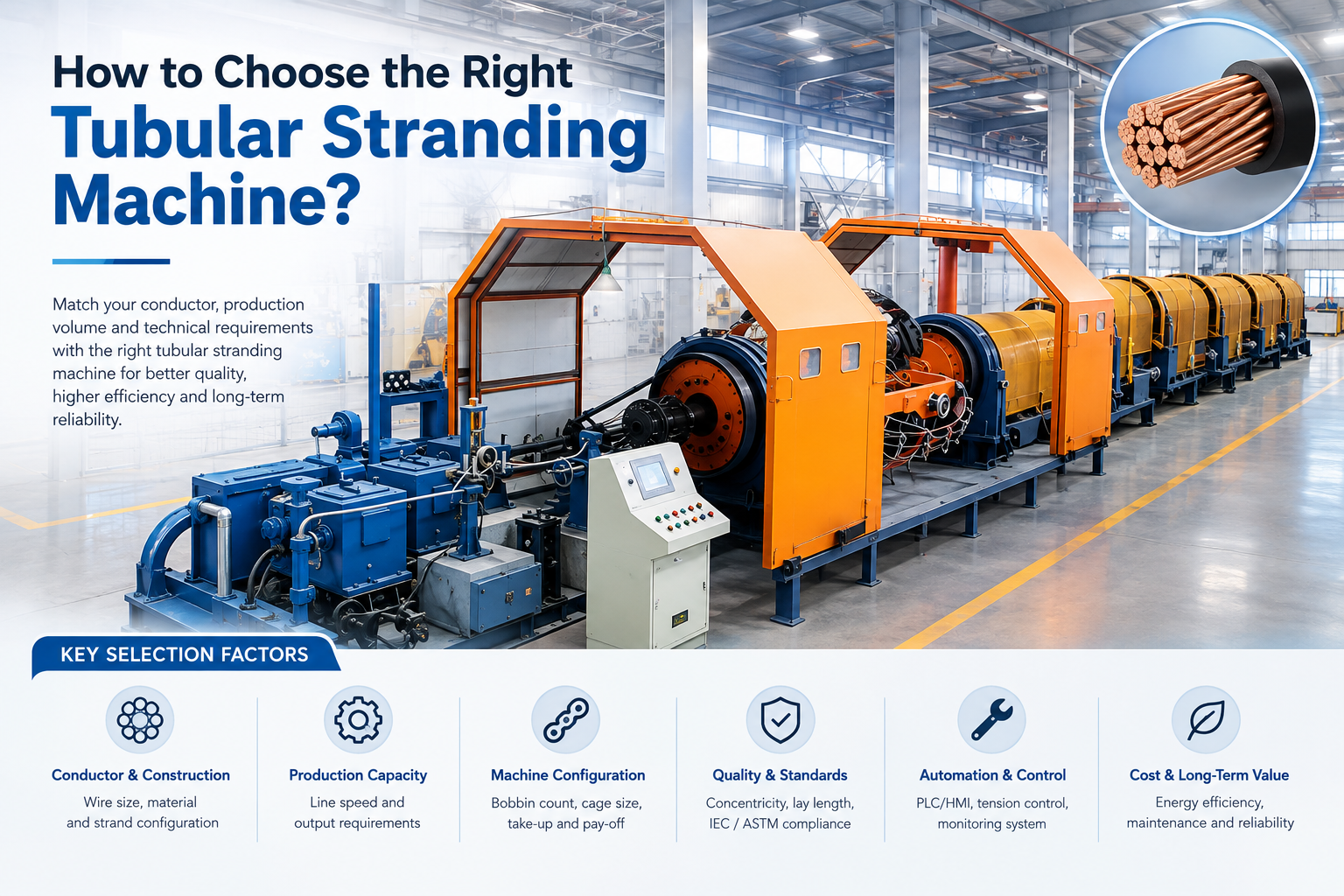
How to Choose the Right Tubular Stranding Machine?

How to Choose the Right Tubular Stranding Machine-doingcable

A tubular stranding machine is the correct choice when the plant must produce 7-wire or 19-wire concentric copper, aluminum or steel strand at high line speed with true 100% back-twist. Select first by construction and single-wire diameter, then by bobbin PN size, cage rpm, pitch range and take-up drum — not by catalog “max speed” alone.

Wrong cage size or missing preform/tension control shows up later as bird-caging, DC-resistance scatter and IEC 60228 Class 2 failures. The 2023 edition of IEC 60228 remains the baseline for insulated-cable conductors (0.5–3,500 mm², Cu/Al/AAAC). ASTM B8-23 covers concentric-lay copper in North America; IEC 61089 covers round-wire overhead conductors.

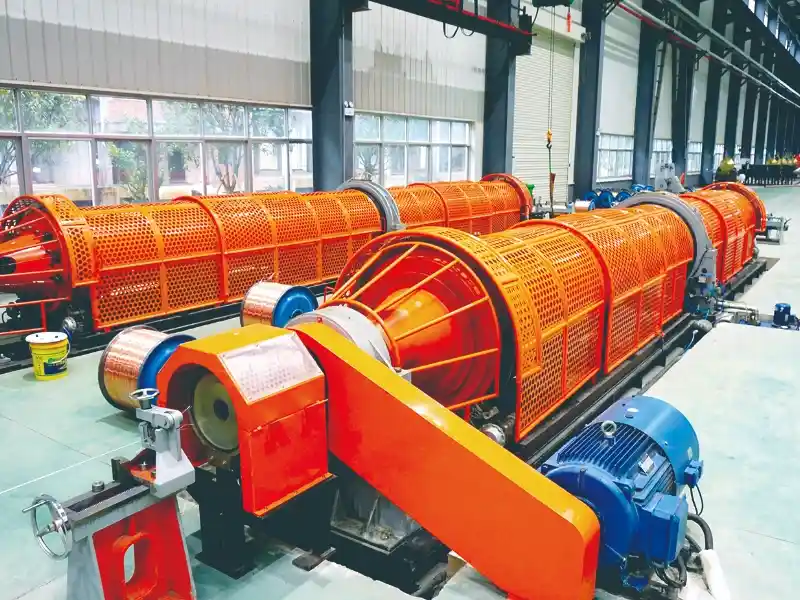
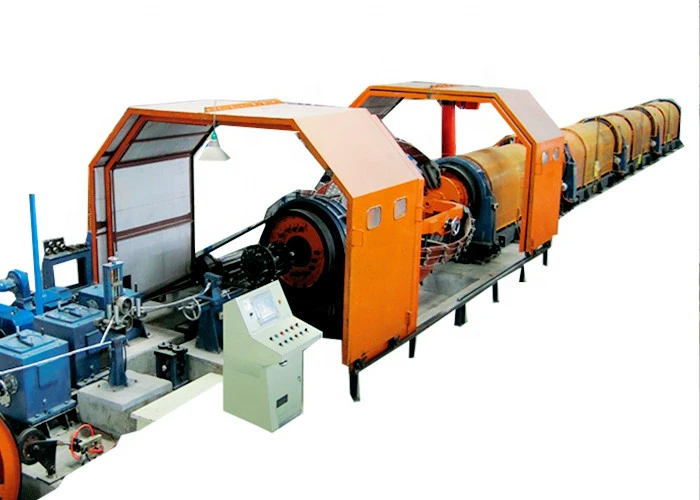
Two 12-bay tubes in one hall: output is set by rpm × pitch, not by how long the machine looks.

What is a tubular stranding machine and when should a cable plant use one?

A tubular stranding machine twists wires into a concentric strand by rotating a closed steel tube that carries the pay-off bobbins; the geometry itself gives 100% back-twist, so individual wires are not torsionally wound about their own axes. Use it for high-volume 1+6 and 1+12 work on copper, aluminum and steel in the roughly 1.5–400 mm² band, and for small steel rope — not as a substitute for a rigid-frame line on 61-wire MV/HV compacted cores.

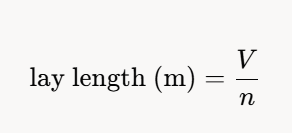
The tube is supported on large bearings with oil circulation. Wires travel along the tube, pass a preform “snake,” and lock in a tungsten closing die. Lay length is line speed divided by cage revolutions:

where VVV is line speed in m/min and nnn is cage speed in rpm. Example: 60 m/min at 50 mm lay requires 1,200 rpm. That equation is why a 400-series 6-bobbin cage at 1,200–1,500 rpm outruns a 630-series cage on small 7-wire building-wire strand, and why a large PN630 18-bobbin tube is slower but necessary for longer lot length and thicker aluminum.⁠Jsshuojie

Typical commercial windows published by machine builders in 2024–2026:

  • Rotor 400–1,200 rpm (high-speed 400/450 frames up to ~1,300–1,500 rpm on 6B)
  • Line speed 100–230 m/min on copper/aluminum
  • Tension variance held near ±2%, lay-length accuracy better than ±1% on PLC-locked lines
  • These numbers are what plants use to hold IEC 60228 Class 2 geometry and IEC 60502 conductor OD before extrusion.⁠Doingcable

How does a tubular strander compare with rigid-frame and planetary machines?

A tubular strander is faster and simpler than a planetary machine and has true 100% back-twist; a rigid-frame strander is slower but is the correct tool for large compacted power conductors and 61–91 wire ACSR. Do not buy a tubular line to replace a rigid cage on 240–800 mm² compacted MV cores.

ParametreTubularPlanetaryRigid frame
Tipik rotor hızı400–1,200 rpm (up to ~1,500 on small 6B)200–600 dev/dk80–300 rpm typical for large cages
Hat hızı100–230 m/dak50–120 m/dak40–100 m/dak
Geri bükülmeTrue 100% (tube geometry)100% (planetary gears)Genellikle 0%
Best range7/19 wire Cu/Al, steel rope, control coresFine / OPGW / precision flexibleLarge power, ACSR 61–91, sector
CompactionGood with closing/compacting dieÇok yüksekHighest (die + roll)
BakımOil-circulated bearings; lower gear countPlanetary gear trainOrta
NoiseLow–medium with guarded tubeOrtaMedium–high

Sources for the speed bands: current tubular product data (400–1,200 rpm, 100–230 m/min) and rigid-frame application notes for MV/HV and ACSR.

Practical plant rule:

  • Building wire, 10–70 mm² Class 2, 7-wire and two-pass 19-wire → tubular 400/500/630, 6B or 12B
  • AAC/AAAC 7-wire and small ACSR steel core → tubular; full ACSR 26/7 or 54/7 → rigid or tubular + rigid
  • 120 mm² and above compacted round or Milliken → rigid frame
  • OPGW, sensitive insulated cores, adjustable back-twist → planetary

A tubular machine is a one-layer-per-pass tool. 19-wire is 1+6 then 1+12, or a 6B+12B tandem. Buying one 18B tube “for 19-wire” without a center pay-off and a second pass plan is a common specification error.

Guarded multi-section tube — count bays and bearing supports, not only motor kW.

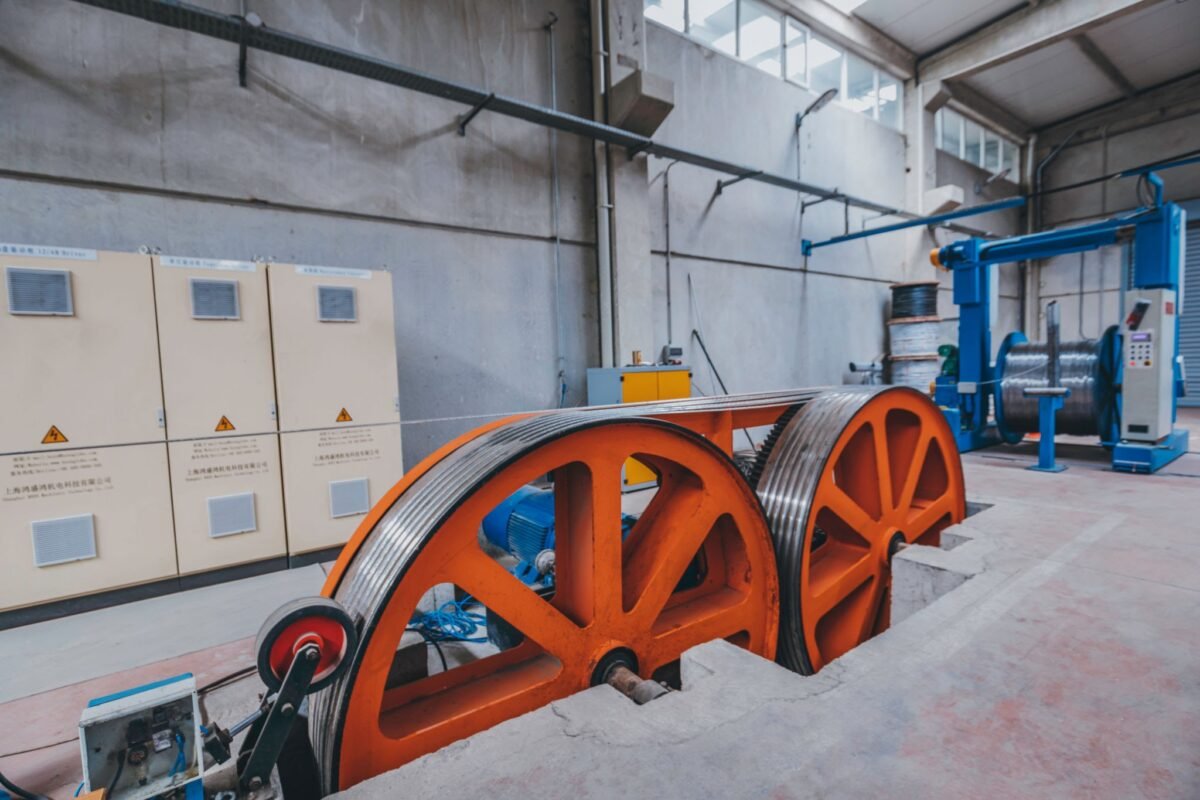
Heavy Machinery and steel cable processing equipments at the empty manufacturing plant in the factory warehouse.

Which bobbin count and PN size should you specify?

Specify bobbin count from the construction (6B for 7-wire, 12B for the outer 19-wire layer) and PN size from lot length and single-wire diameter, not from the highest rpm printed on a brochure. PN400–500 favors speed; PN630 favors fewer reel changes on aluminum and steel.

SeriesCageCu / Al wire ØMax strand Ø (typ.)Cage rpm (order of magnitude)Line speed (typ.)Pay-off / take-up
High-speed 400–4506B–18B0.8–4.0 / 1.2–4.0 mm12–25 mm800–1,300160–230 m/minPN400–500 / PN1250–1600
500 serisi6B / 12B1.2–5.0 / 1.5–5.0 mm15–21 mm500–800150–200 m/minPN500 / PN1600
630 serisi6B / 12B / 18B1.5–5.0 / 1.8–6.0 mm21–35 mm400–700100–180 m/minPN630 / PN1600–2000

Published rpm examples: 6B on a 200-frame ~1,500 rpm; 6B on 500 ~750 rpm; 6B on 630 ~500 rpm. 12B and 18B drop 15–40% from the 6B figure on the same frame because rotor mass and critical speed fall.

Selection sequence used by process engineers:

  1. Finished construction and standard (IEC 60228 Class 2, ASTM B8, IEC 61089).
  2. Single-wire Ø and metal (soft Cu vs hard Al vs galvanized steel).
  3. Annual tonnage and preferred reel change interval → PN400 vs PN630.
  4. Need for compacting die, sector, or insulated-core cabling.
  5. Hall length: a 12B+18B tandem plus 1,600 mm capstan and portal take-up is a different civil package than a single 6B 400-frame.

If the plant already draws on PN630, do not force PN400 just to gain 200 rpm. Handling cost and weld/joint count often erase the speed gain.

What pitch, tension and die package keep the conductor inside the standard?

Lay length, per-wire tension and closing-die ID determine whether the strand meets IEC 60228 / ASTM B8 geometry and DC resistance. PLC-locked pitch with hysteresis or magnetic-particle brakes and a tungsten die + preform head is the minimum package for export cable.

Lay is not a free marketing number. Short lay (about 8–16 × strand OD on many Class 2 constructions) improves flexibility and lock-up but lengthens the current path and can raise DC resistance. Long lay raises output and can loosen the strand in bending. ASTM B8 and plant drawings treat lay as a controlled dimension, not an operator preference.

Control points that belong in the purchase specification:

  • Independent motors on tube, capstan and take-up; pitch entered in mm on HMI and held under acceleration
  • Per-bobbin tension: band brake is acceptable on steel; hysteresis / magnetic particle is preferred on soft copper to keep variance near ±2%
  • Preform head before the closing die on hard Al and steel — without it, residual spring-back opens the strand after the die
  • Tungsten carbide dies; die ID set to the compressed or uncompressed diameter on the drawing
  • Wire-break detection on every path, not only on the capstan
  • Oil circulation and temperature on main bearings; unbalanced tubes destroy lay long before they seize

Closed-loop servo tension is a 15–30% add-on on some lines; plants that measure conductor resistance lot-by-lot usually recover it in scrap reduction.

Standards to write on the RFQ and on the QC sheet:

  • IEC 60228:2023 — conductor class, size, DC resistance
  • GB/T 3956 — China equivalent used with export inspection
  • ASTM B8-23 — concentric-lay copper (Classes AA, A, B, C)
  • ASTM B496 — compact round copper, if a compacting die is fitted
  • IEC 61089 / EN 50182 — overhead AAC/AAAC/ACSR
  • IEC 60502 — finished LV/MV cable dimensional envelope after stranding

EN IEC 60228:2024 is the European adoption of IEC 60228:2023; specify the edition on the PO so incoming inspection and the machine FAT use the same resistance table.

Which failure modes appear when the machine is specified or run incorrectly?

Bird-caging, high DC resistance, oval strand, broken wires at the die and bearing overheating are the five failures that dominate tubular-line scrap; each maps to a specification or maintenance item, not to “operator skill” alone.

Bird-caging / loose strand after the die.

Cause: no preform on hard aluminum or steel; lay too long; tension too low on outer wires. Fix: preform head, shorter lay, matched outer-wire tension.

DC resistance above IEC 60228 / GB/T 3956 max.

Cause: excessive lay (path length), over-reduction in a compacting die, mixed wire diameters, or a joint in the lot. Fix: lock pitch, measure incoming wire Ø and conductivity, ban mixed heats on one strand.

Oval or “flat” strand.

Cause: worn or oversized closing die, misaligned die stand, one high-tension bobbin. Fix: die log (hours vs. OD), motorized die alignment, individual brake check.

Wire break at the die or inside the tube.

Cause: nicks from worn guides, overfill on a small PN reel, steel wire with no preform, emergency stop without coordinated capstan ramp. Fix: ceramic/tungsten guides, fill-factor limit, coordinated stop ramp.

Vibration, noise, pitch drift at high rpm.

Cause: tube not re-balanced after a crash, dry main bearing, coupling backlash. Fix: balance report in the FAT, oil-flow interlock, do not run a 630 tube at 400-series rpm.

Full line with capstan house and multi-section tube — FAT should include load run at the rpm you will actually sell, not only no-load spin.

How should a 2024–2026 cable plant write the RFQ?

Write the RFQ as a conductor list plus a duty cycle, not as a single model number. Include metal, construction, annual km, bobbin logistics, hall length and the standard edition.

Minimum data package for a serious quotation:

  • Metals: ETP/OF copper, 1350/AAAC aluminum, galvanized steel grade
  • Constructions and annual volume: e.g. 7×2.52 mm Cu 25 mm², 19×2.52 mm two-pass, 7×3.0 mm AAC
  • Incoming reel: PN400 or PN630, flange, barrel, max fill
  • Take-up: PN1250 / 1600 / 2000, shaft or pintle, traversing vs portal
  • Compact vs non-compact; round only or sector later
  • Utilities: 380/400/415 V, 50/60 Hz; compressed air for pneumatic pintles
  • FAT: balance certificate, 4-hour load run, pitch sample vs. drawing, noise at 1 m, bearing temperature
  • Packing: steel-base + film + crate for the HMI and motors; tube sections as marked for reassembly

Export plants in Southeast Asia, the Middle East and Africa typically standardize on 500/1+6 plus 500 or 630/12B tandem for Class 2 copper and small AAC. European and North American overhead shops add steel-capable brakes and preform for ACSR cores, then send large aluminum layers to a rigid cage.

Do not accept “max 230 m/min” without the construction that number was measured on. A 6B 400-frame on 1.2 mm copper is not the same machine as an 18B 630-frame on 4.5 mm aluminum.

Key takeaways

  • Tubular = high-speed, 100% back-twist, one layer per pass, best at 7-wire and 19-wire Cu/Al/steel.
  • Rigid frame = large compacted power and heavy ACSR. Planetary = adjustable back-twist and delicate cores.
  • Choose PN size and bay count from construction and lot length; rpm follows from lay and V/nV/nV/n.
  • Preform + tungsten die + per-wire tension + PLC pitch are not options if the plant sells to IEC 60228:2023 or ASTM B8-23.
  • FAT must include balance, load rpm, pitch and tension — paper speed ratings do not strand cable.

Şimdi bilgi isteyin .

Send the conductor table (size, wire Ø, metal, annual km), bobbin PN and take-up drum. We return a 6B / 12B / tandem configuration, die list and FAT protocol sized to that table.

Bir yanıt yazın

E-posta adresiniz yayınlanmayacak. Gerekli alanlar * ile işaretlenmişlerdir