Kategorilendirilmemiş

What is An Aluminum Sheath Corrugated Pipe Continuous Extrusion Line?

What Is an Aluminum Sheath Corrugated Pipe Continuous Extrusion Line-doingcable

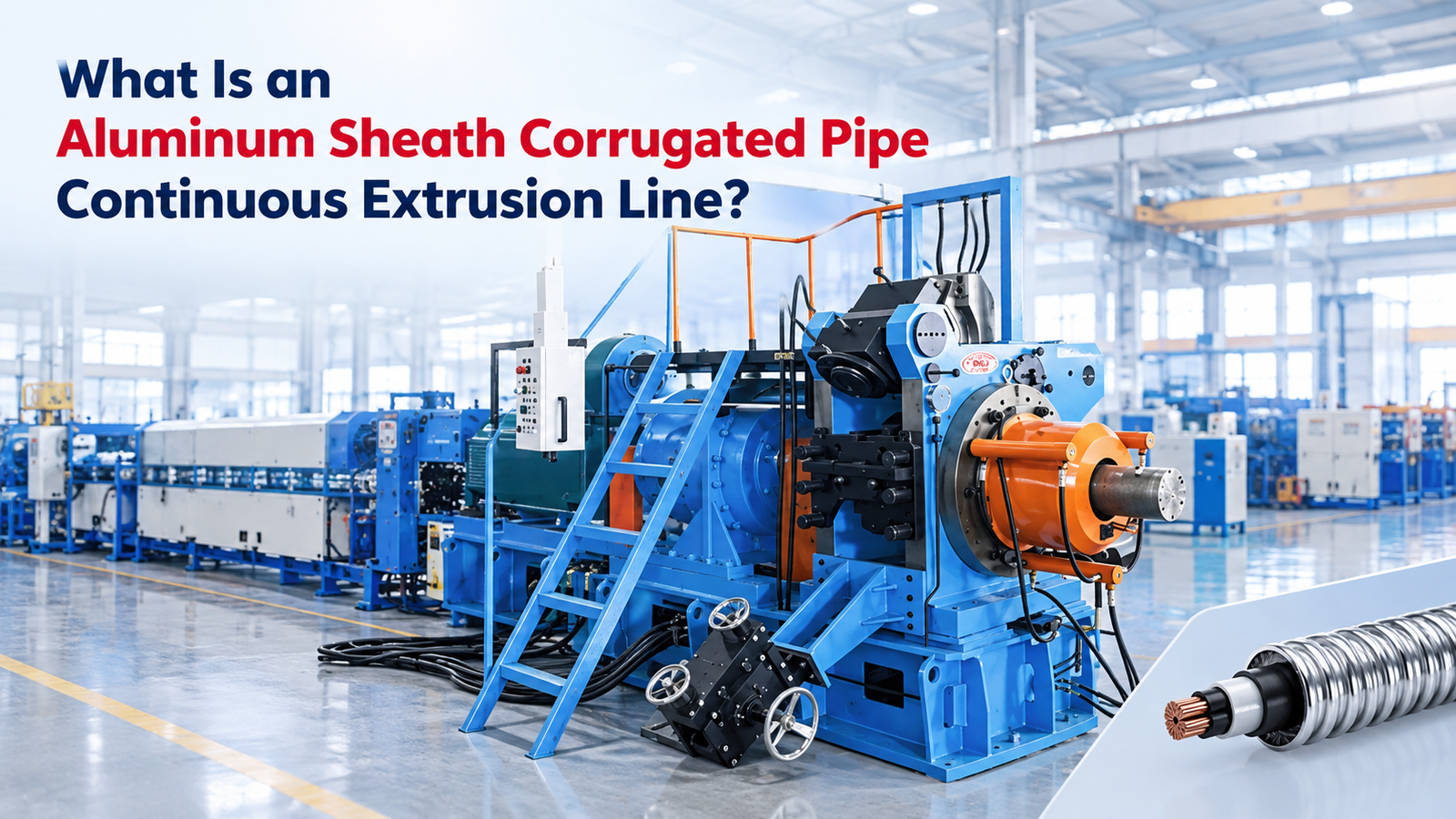
An Aluminum sheath corrugated pipe continuous extrusion line is a Conform-type continuous rotary extrusion system that converts high-purity aluminum rods into seamless, uniform-wall aluminum tubes that are formed directly around a cable core and then corrugated online. The process eliminates longitudinal welds, delivering superior mechanical strength, corrosion resistance and radial water-blocking performance for MV, HV and EHV power cables.

Typical lines process Φ9.5–12 mm aluminum rods on 420–540 mm extrusion wheels to produce tubes of Φ60–180 mm outer diameter with 1.5–5.0 mm wall thickness and helical or annular corrugations of 10–50 mm pitch and 2–8 mm depth.

How Does the Continuous Rotary Extrusion and Corrugation Process Work?

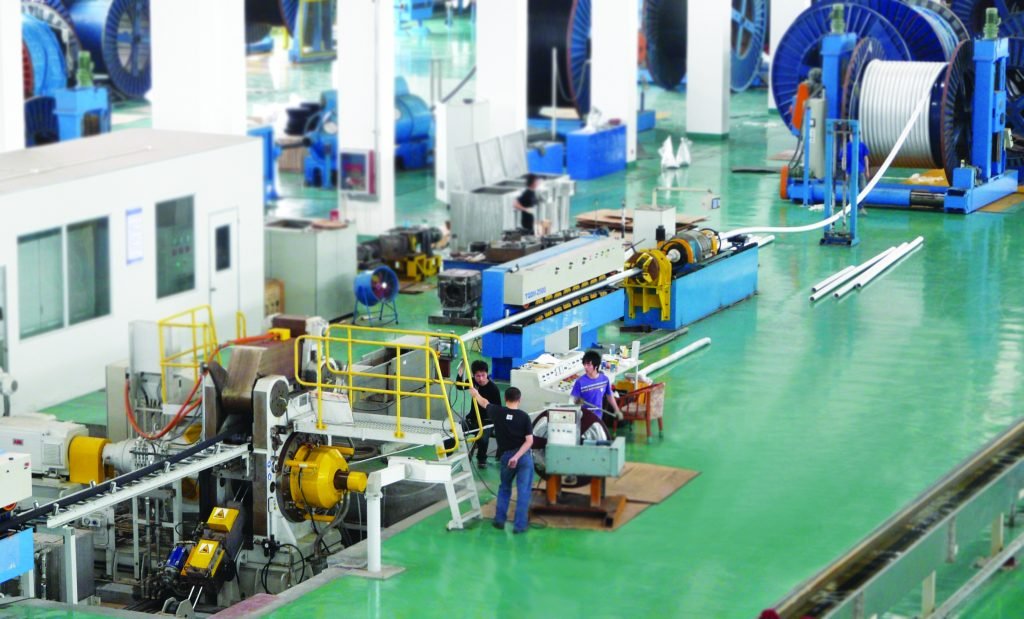
High-purity aluminum rods (typically A2 grade per GB/T 3954) are cleaned, straightened and fed continuously into a dual-groove Conform extrusion wheel. Frictional heat and plastic deformation generate a continuous seamless aluminum tube that is extruded over the synchronized cable core. A water-cooled jacket protects the insulation during passage through the die.

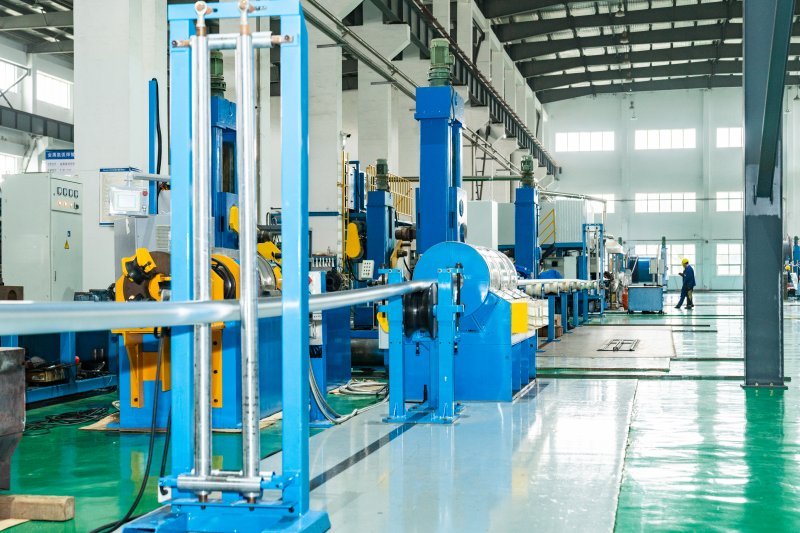
Immediately after extrusion the tube is cooled to lock dimensions, then enters a rotating or reciprocating corrugation unit that forms precise helical or annular corrugations. The finished sheathed cable is taken up on large reels. PLC/HMI control synchronizes pay-off, extrusion, cooling, corrugation and take-up while storing recipes for diameter, wall thickness and corrugation parameters.

What Are the Typical Technical Parameters of Aluminum Sheath Corrugated Continuous Extrusion Lines?

Typical Parameters of Aluminum Sheath Corrugated Pipe Continuous Extrusion Lines

ParametreLBF420x2 / EquivalentLBF540x2 / EquivalentNotlar
Aluminum rod diameterΦ9.5 ± 0.3 mmΦ12 ± 0.3 mm4 rods typical
Extrusion wheel diameter420 mm540 mmDual-groove
Tube OD rangeΦ60–170 mmΦ60–180 mmSeamless
Wall thickness1.5–5.0 mm1.5–5.0 mmUniform
Corrugation pitch10–50 mm10–50 mmHelical/annular
Corrugation depth2–8 mm2–8 mmAdjustable
Hat hızıUp to ~12–60 m/minSimilarSize dependent
Output350–600+ kg/hDaha yüksekAl typical
Pay-off / take-upUp to 4500 mmSameLarge reels
ControlPLC + HMISameRecipe storage

Exact output and speed depend on tube diameter, wall thickness and corrugation geometry. Seamless construction and consistent wall thickness are primary acceptance criteria.

How Does Continuous Extrusion Compare with Longitudinal Welded Aluminum Sheathing?

Comparison of Continuous Extrusion versus Welded Aluminum Sheath

ÖzellikContinuous Extrusion (Conform)Longitudinal TIG/Welded Sheath
SeamSeamlessLongitudinal weld
Wall uniformityYüksekVariable at weld
Corrosion riskLow (no weld defects)Higher at weld zone
Mechanical flexibilityExcellent with corrugationİyi
Production lengthContinuous long lengthsLimited by strip
Material utilizationYüksekScrap from edges
Suitable voltageMV to EHVMV to EHV
Standards supportIEC 60840 / 62067Same

Continuous extrusion eliminates weld-related defects that can initiate corrosion or mechanical failure, while providing more uniform metal distribution. Welded lines remain viable for certain lower-voltage or cost-sensitive applications.

Which Cable Types and Standards Does the Line Support?

The line is applied to the production of:

  • MV, HV and EHV power cables with corrugated aluminum sheaths (typically 6–500 kV range).
  • Cables requiring high radial water-blocking and mechanical protection.
  • Long-length installations where seamless construction improves reliability.

Finished sheaths are designed to meet the mechanical, dimensional and performance requirements of IEC 60840, IEC 62067 and relevant GB standards for metal-sheathed power cables. Controlled corrugation improves flexibility and crush resistance while maintaining radial moisture barrier integrity.

What Process Controls Ensure Uniform Wall Thickness and Reliable Corrugation?

Critical controls include:

  • Precise multi-rod feed synchronization and surface cleaning of aluminum rods.
  • Closed-loop control of extrusion wheel speed and core pay-off tension.
  • Immediate post-extrusion cooling to stabilize dimensions before corrugation.
  • Adjustable corrugation pitch, depth and profile matched to cable design.
  • PLC recipe storage for diameter, wall thickness, speed and corrugation parameters.
  • Continuous monitoring of temperature, pressure and dimensional feedback.
  • Protective water jacket around the cable core during extrusion.

These measures maintain wall uniformity, seam-free integrity and consistent corrugation geometry.

What Are Common Failure Modes and How Are They Prevented?

Typical defects include wall-thickness variation, incomplete corrugation, core overheating, surface defects and dimensional instability.

Prevention measures are:

  • Regular inspection and replacement of extrusion tooling (wheel, dies, guides).
  • Controlled aluminum rod quality and surface cleanliness.
  • Accurate synchronization of core speed with extrusion rate.
  • Proper cooling water temperature, flow and jacket integrity.
  • Calibration of diameter and wall-thickness measurement systems.
  • Controlled start-up and speed ramping.
  • Operator training on recipe selection, material changeover and quality verification.

These practices support stable production of specification-compliant seamless corrugated aluminum sheaths.

Key Takeaways

  • An aluminum sheath corrugated pipe continuous extrusion line produces seamless aluminum tubes of Φ60–180 mm OD and 1.5–5.0 mm wall thickness with online corrugation (10–50 mm pitch) using Conform rotary extrusion of Φ9.5–12 mm aluminum rods.
  • The process eliminates longitudinal welds, delivering superior uniformity, corrosion resistance and mechanical performance compared with welded sheaths.
  • Typical systems support MV to EHV cable production meeting IEC 60840 and IEC 62067 requirements.
  • Precise multi-rod feed, core protection, controlled cooling and adjustable corrugation are essential for dimensional accuracy and reliability.
  • PLC recipe management and continuous monitoring enable consistent multi-shift production of high-quality metal sheaths.

Reliable aluminum sheath corrugated continuous extrusion lines are engineered for continuous industrial duty, customizable for cable diameter and corrugation geometry, backed by long-term technical support. Contact us with your target sheath OD, wall thickness, corrugation requirements and production rate for a detailed technical proposal.

Bir yanıt yazın

E-posta adresiniz yayınlanmayacak. Gerekli alanlar * ile işaretlenmişlerdir