Uncategorized

What is Aluminium Alloy Wire?

What is Aluminium Alloy Wire

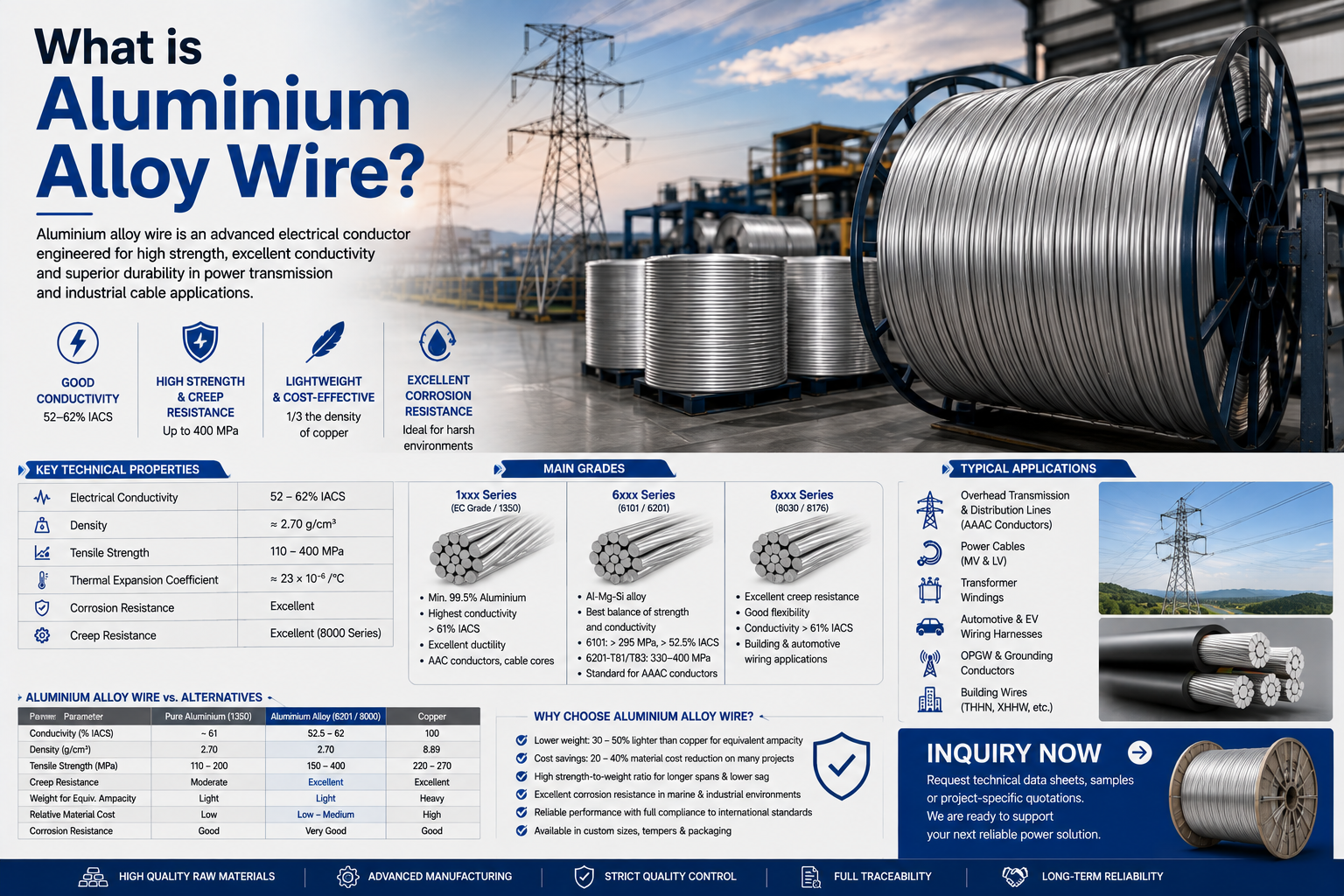
Aluminium alloy wire is a high-performance electrical conductor material produced by alloying high-purity aluminium (typically ≥99.5 %) with controlled amounts of magnesium, silicon, iron, copper or rare-earth elements, followed by continuous casting, rolling, drawing and precise heat treatment. The resulting wire delivers a reliable combination of electrical conductivity (52.5–62 % IACS), tensile strength, creep resistance and corrosion performance that pure aluminium cannot achieve and copper cannot economically match in large-scale power applications.

In modern cable and overhead systems it is the preferred conductor material for All Aluminium Alloy Conductors (AAAC), medium- and low-voltage power cables, building wire (AA-8000 series) and specialised harnesses.

Why Do Engineers Choose Aluminium Alloy Wire Over Pure Aluminium or Copper?

Aluminium alloy wire solves the classic engineering trade-off between conductivity, mechanical strength and long-term connection reliability.

Pure EC-grade aluminium (AA-1350) offers good conductivity (≈61 % IACS) but low tensile strength (70–160 MPa) and high creep under continuous load. Copper provides excellent conductivity and creep resistance but is approximately three times denser and significantly more expensive. Aluminium alloy wires close this gap through precipitation hardening (6xxx series) or stable intermetallic formation (8xxx series).

Key performance data (2024–2026 industry benchmarks):

  • Conductivity: 52.5–62 % IACS
  • Tensile strength: 115–350 MPa (depending on alloy and temper)
  • Creep resistance: up to 300 % higher than pure aluminium in 500-hour tests
  • Density: ≈2.70 g/cm³ (one-third of copper)
  • Continuous operating temperature: typically 90–95 °C for overhead, 90 °C for insulated cables

These properties enable longer spans, lighter supporting structures, lower installation tension and terminations that remain stable after repeated thermal cycling.

Key Technical Properties

Aluminium alloy wire offers a practical balance of electrical and mechanical performance:

  • Electrical conductivity: Typically 52–62% IACS (International Annealed Copper Standard). Pure EC-grade 1350 exceeds 61% IACS, while high-strength 6xxx alloys range from 52.5–57% IACS.
  • Tensile strength: From approximately 110 MPa (soft pure aluminium) up to 295–400 MPa for 6201-T81 and similar grades.
  • Density: ≈2.70 g/cm³ — only about one-third the density of copper.
  • Creep resistance: Especially strong in the 8000 series, offering up to 300% improvement over pure 1350 aluminium.
  • Corrosion resistance: Excellent in most environments, including coastal and industrial atmospheres (no steel core means no galvanic corrosion risk).
  • Strength-to-weight ratio: Outstanding, enabling longer spans, reduced sag and lower structural loading on towers.
  • Thermal expansion coefficient: Approximately 23 × 10⁻⁶/°C.

These characteristics allow aluminium alloy conductors to achieve equivalent current-carrying capacity to copper at substantially lower weight and material cost when the cross-section is properly sized (typically 1.5–1.6 times larger).

What Are the Main Alloy Families Used in Cable Conductors?

Two families dominate industrial applications:

6xxx series (Al-Mg-Si) – primarily AA-6201-T81 and AA-6101 Used almost exclusively for bare overhead AAAC conductors. Magnesium and silicon form fine Mg₂Si precipitates after solution treatment and artificial aging (T81 temper). Result: tensile strength ≥300 MPa with conductivity ≥52.5 % IACS, excellent strength-to-weight ratio and superior atmospheric corrosion resistance.

8xxx series (Al-Fe-Cu) – primarily AA-8030 and AA-8176 Developed specifically for insulated power and building cables. Iron (0.30–0.80 %) and copper (0.15–0.30 %) form thermally stable Al₃Fe and Al-Cu intermetallics that raise creep resistance to levels comparable with copper while retaining conductivity ≥61 % IACS. These alloys are approved under NEC for solid and stranded building wire and can be terminated with standard copper lugs when oxide inhibitor is correctly applied.

PropertyPure Al (1350)AA-6201-T81 (AAAC)AA-8030 / 8176 (Cable)Copper (annealed)
Conductivity (% IACS)61–6252.5–5461–62100
Tensile strength (MPa)70–160300–350110–160200–250
Creep resistanceLowHighVery high (near Cu)Excellent
Density (g/cm³)2.702.702.708.89
Typical continuous temp.80–90 °C90–95 °C90 °C90–105 °C

How Is Aluminium Alloy Wire Manufactured to Meet International Cable Standards?

Production is a tightly controlled sequence that determines final properties:

  1. Continuous casting and rolling of the alloyed melt into 9.5–15 mm wire rod.
  2. Multi-pass drawing with intermediate annealing to the required final diameter (typically 1.5–5 mm).
  3. Solution heat treatment + artificial aging (6xxx) or controlled annealing (8xxx) to lock the required temper.
  4. Concentric stranding into finished conductors (7, 19, 37 or 61 wires) according to IEC 61089, ASTM B399 or ASTM B800/B801.

Critical process variables include Fe/Si ratio, homogenisation temperature, aging time (commonly 160–180 °C for 4–8 hours) and residual cold work. Modern production lines maintain conductivity variation within ±0.5 % IACS and tensile uniformity better than ±5 %.

Which Standards and Certifications Apply?

  • Overhead AAAC: ASTM B398 / B399, IEC 61089, EN 50182, GB/T 1179
  • Building & power cable: ASTM B800 (AA-8000 series), UL 44 / UL 854, NEC Article 310
  • Conductivity & mechanical testing: ASTM B193, IEC 62641

Compliance with these standards guarantees that the wire maintains mechanical integrity after current-cycle testing and remains dimensionally stable under continuous load at rated temperature.

Where Is Aluminium Alloy Wire Applied in Real Projects?

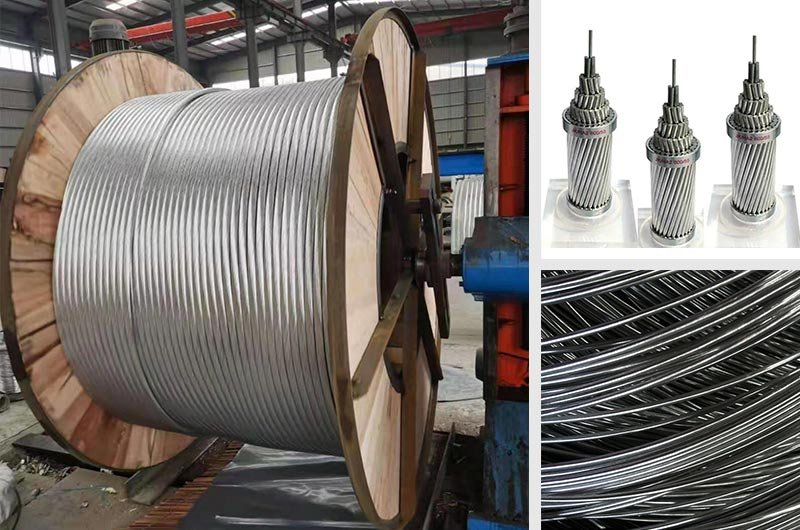
  • Bare overhead distribution and transmission lines (AAAC 6201-T81) — especially coastal and industrial environments where ACSR steel cores suffer corrosion.
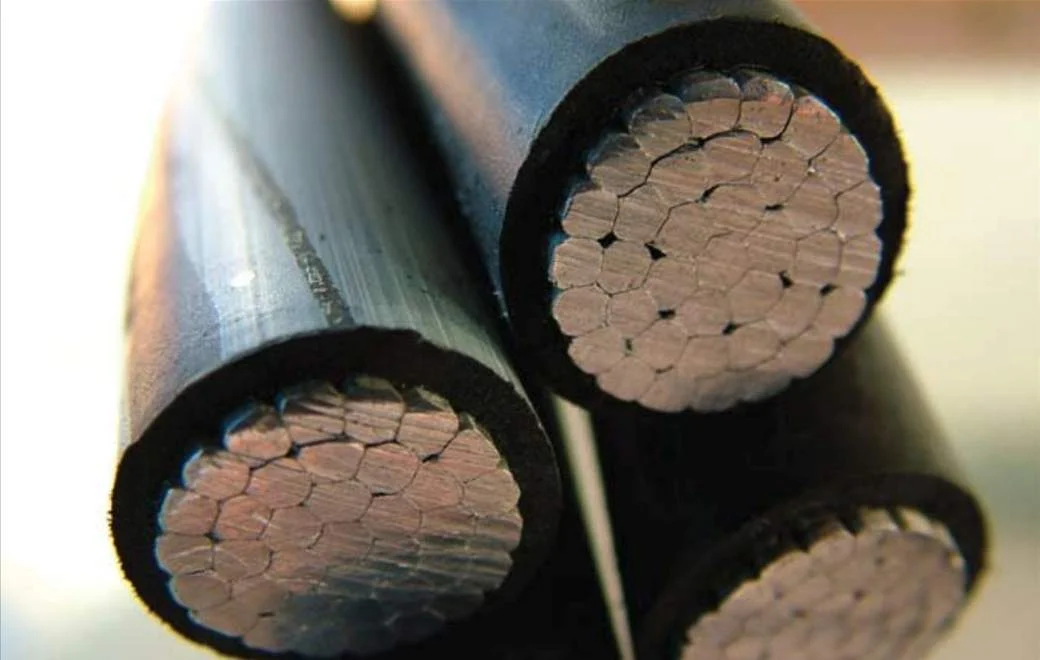
  • Medium- and low-voltage power cables (AA-8030/8176) — urban feeders, renewable energy interconnections and industrial plants.
  • Building wire and service-entrance conductors — large cross-sections where weight and material cost savings are decisive.
  • Automotive and EV wiring harnesses — high-strength 6xxx alloys for vibration resistance and weight reduction.

Practical Selection and Failure-Prevention Guidelines

  1. Match the alloy to the service environment: 6201-T81 for high mechanical load and corrosion exposure; 8030/8176 for insulated cables requiring copper-compatible terminations.
  2. Always apply oxide-inhibiting compound and correct torque on terminations — residual oxide film is the primary cause of progressive contact resistance growth.
  3. Size the conductor for equivalent resistance (typically 1.5–1.6 × copper cross-section), not equal diameter.
  4. Demand certified conductivity and tensile data for every production lot; small deviations in Mg/Si or Fe content shift the strength–conductivity balance.
  5. For long-span overhead lines, perform sag-tension calculations using the higher modulus and lower thermal expansion coefficient of the alloy conductor.

Summary of Technical Advantages

Aluminium alloy wire provides a proven combination of low mass, adequate conductivity, high strength-to-weight ratio and long-term connection reliability that pure aluminium cannot deliver and copper cannot economically justify in high-volume applications. When manufactured to ASTM/IEC standards and installed with correct termination practices, it offers decades of reliable service with lower total installed cost and reduced structural loading.

For project-specific conductor designs, custom stranding configurations, or full material data sheets meeting the latest 2024–2026 standards, Inquiry Now.

Leave a Reply

Your email address will not be published. Required fields are marked *