Kategorilendirilmemiş

How to Produce Qualified 8 mm Copper Rod from Copper Scrap and Copper Cathode?

How to Produce Qualified 8 mm Copper Rod from Copper Scrap and Copper Cathode-doingcable

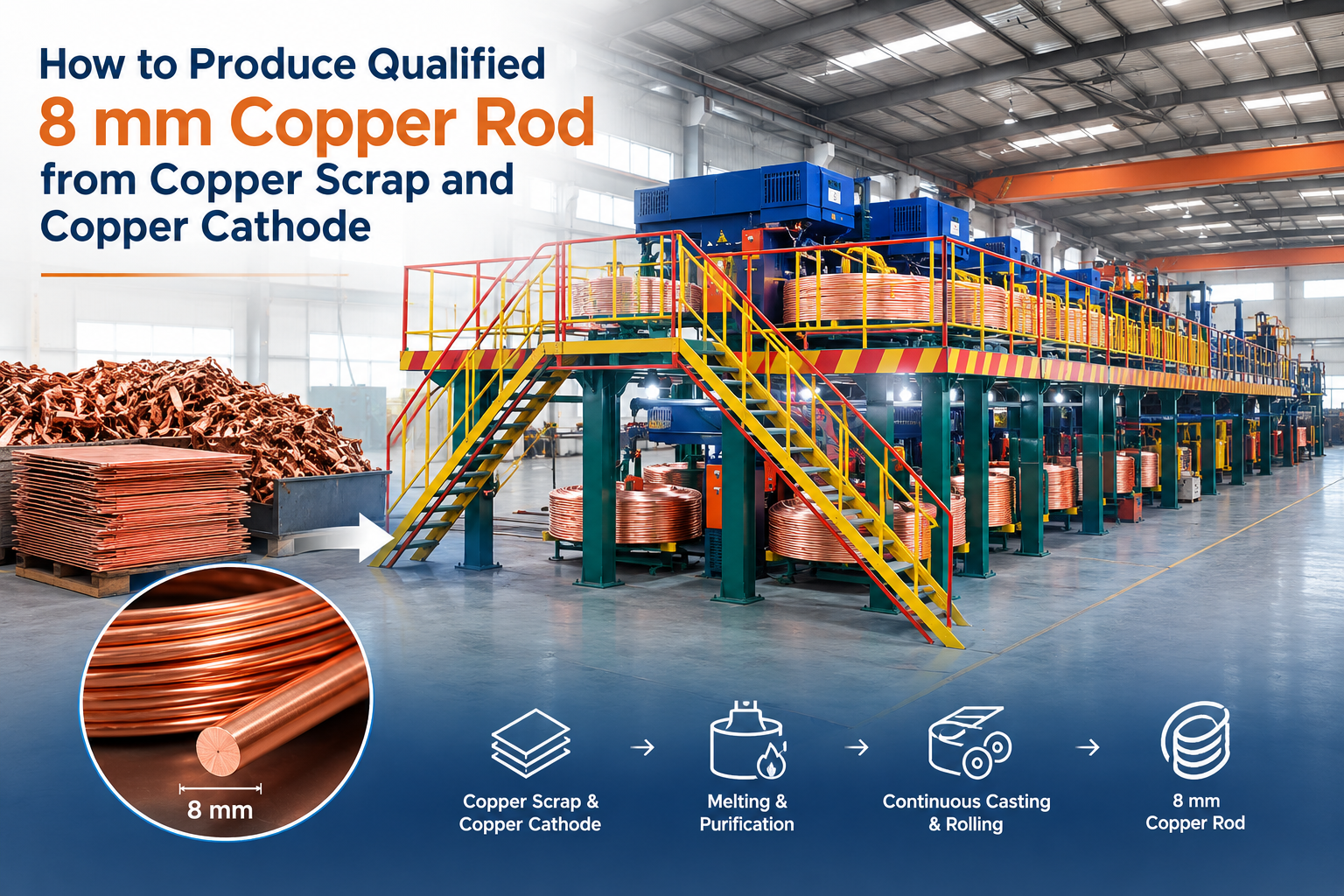
A qualified 8 mm copper rod is electrical drawing stock that meets ASTM B49, EN 1977 (prEN 1977:2025 draft) and GB/T 3952-2016 for chemistry, oxygen, conductivity and drawability. Two industrial routes produce it: upward continuous casting (Upcast) of oxygen-free rod from clean cathode or refined high-grade scrap, and continuous casting and rolling (CCR) of low-oxygen ETP/FRHC rod from cathode and/or fire-refined scrap. Capacity, scrap grade, oxygen target and downstream drawing size decide which line is correct — not marketing language.

For cable plants, 8 mm rod is the standard inlet to rod-breakdown drawing. If resistivity, oxygen or surface scale drift outside specification, the failure appears later as die wear, wire breaks, hydrogen embrittlement or failed IEC 60228 conductor tests. This article states the process windows, feedstock rules, comparison data and inspection logic used by mill engineers.

What is a qualified 8 mm copper rod for electrical drawing?

A qualified 8 mm copper rod is circular drawing stock, typically 7.92–8.08 mm for Upcast OF and about 7.56–8.32 mm for CCR ETP, with conductivity ≥100% IACS (resistivity ≤0.017241 Ω·mm²/m at 20 °C) and oxygen controlled to the selected grade. It must draw without systematic breaks into intermediate and fine wire.

Typical commercial grades:

SeviyeProcessOxygenConductivity @ 20 °CTypical feedstock
Cu-OF / TU1 / C10200Upcast≤10 ppm (often ≤5 ppm)≥100–101.4% IACSCu-CATH-1 cathode; selected millberry scrap after refining
Cu-ETP / T1–T2 / C11000CCR (shaft + holding)100–650 ppm; plants often hold 200–400 ppm≥100% IACSLME Grade A / Cu-CATH-1 cathode
Cu-FRHC / recycled ETPCCR + reverberatory fire refiningSimilar to ETP if refining is complete≥100% IACS when chemistry is controlledNo.1 / No.2 red scrap + optional cathode blend

ASTM B49 lists ETP oxygen at 100–650 ppm and oxygen-free copper at max. 10 ppm without metallic deoxidizers. EN 1977 / CW004A (Cu-ETP) and CW005A (Cu-FRHC) both require max. 0.01724 μΩ·m; CW003A (Cu-ETP1) and CW007A (Cu-OF1) target 0.01707 μΩ·m (101% IACS). GB/T 3952-2016 T1 oxygen is ≤0.040% (400 ppm); TU1 is ≤0.0010% (10 ppm). Total listed impurities for premium T1/TU1 stock are typically ≤65 ppm excluding oxygen.

The original claim of “resistivity 0.10724” is not an electrical-rod value. The IACS reference remains 1/58 = 0.017241 Ω·mm²/m.

Which production route should a plant choose: Upcast or CCR?

Choose Upcast when annual volume is about 3,000–8,000 t, oxygen must stay ≤10 ppm, and the product is fine-wire, magnet wire or hydrogen-sensitive conductor. Choose CCR when volume is 8–25 t/h (roughly 50,000–180,000 t/year on a continuous mill) and the market is building wire, power cable and general ETP drawing stock.

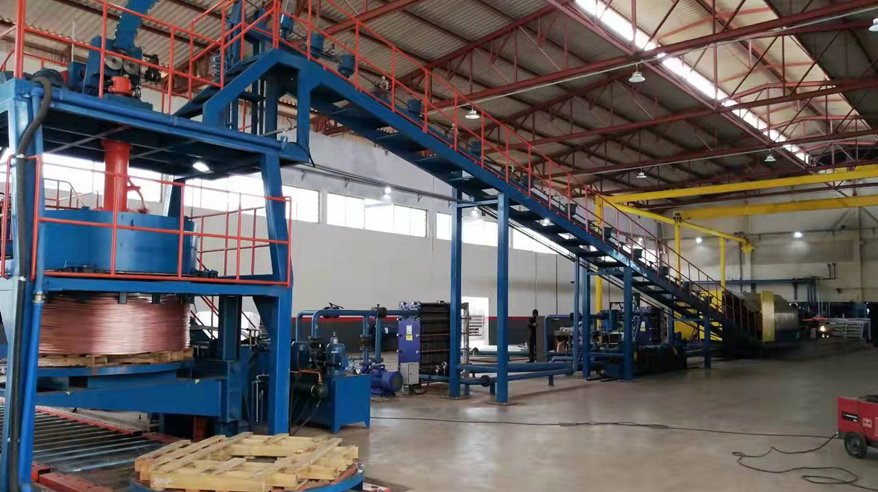
Upcast route (OF rod). Cathode or fully refined melt is held under charcoal or graphite flake so air does not contact the bath. Holding temperature is typically 1150 °C ±10 °C. Graphite crystallizers freeze the metal upward into 8–20 mm rod. For 8 mm finished rod, plants either cast 8 mm directly from high-purity cathode, or cast 17–20 mm from mixed/refined melt and cold-roll to 8 mm to close porosity and improve workability. Soft-state resistivity is specified ≤0.01724 Ω·mm²/m; elongation is commonly >37%; density ~8.9 g/cm³. Drawing speed on a multi-strand Upcast line is typically 0–3000 mm/min with dual-servo traction. A 1050 kg/h melting rate corresponds to about 8,000 t/year at ~7,920 operating hours.

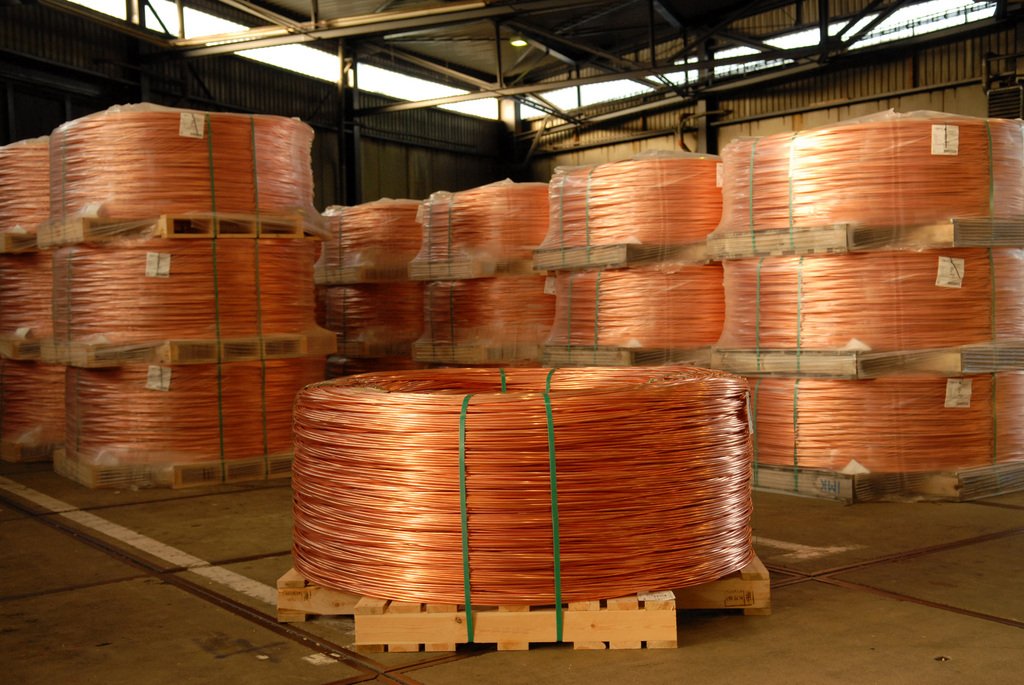
CCR route (low-oxygen ETP/FRHC rod). Cathode is melted in a shaft furnace; scrap is melted and fire-refined in a reverberatory or tilting furnace. Metal flows through a launder into a 5-wheel caster (casting wheel commonly Ø1800–2200 mm; cast-bar section ~2300–2500 mm²). After shear, straighten, edge shave and brush, a 12-stand two-high mill reduces the bar to Ø8 mm at about 9.5–11.6 m/s. Line output on mid-size plants is 12–16 t/h; coil mass is 3–5 t; plant footprint excluding furnace is about 40 × 8 × 6 m. Alcoholic-water or emulsion cooling plus optional wax coat protects the surface for export.

ParametreUpcast OF lineCCR ETP/FRHC line
Finished diameterØ8–20 mm (8 mm direct or 17–20 → 8 mm cold roll)Ø8 mm hot-rolled
Typical capacity0.8–3 t/h per line; 3,000–8,000 t/y common5–25 t/h; 12–16 t/h typical mid-line
Melt coverCharcoal / graphite flakeShaft atmosphere + holding furnace
Oxygen in rod≤10 ppm200–400 ppm plant target; spec 100–650 ppm
Holding temperature1150 °C ±10 °CCast bar ~1080–1120 °C into mill
Final mill / drawServo up-traction 0–3000 mm/min12-pass mill, max ~10–11.6 m/s
Installed power (process, excl. large furnace)~410–620 kVA class for 8 kt/y~550–1200 kW / 1000–1200 kVA class
Best useFine wire, OFHC, vacuum/brazing dutyBuilding wire, MV/LV power cable, high volume

KSH International’s 5,000 t/y Upcast plant started in Pune in 2026 specifically to close the loop on process scrap — evidence that small OF lines remain the rational choice below CCR economic scale.

How must copper cathode and copper scrap be specified before melting?

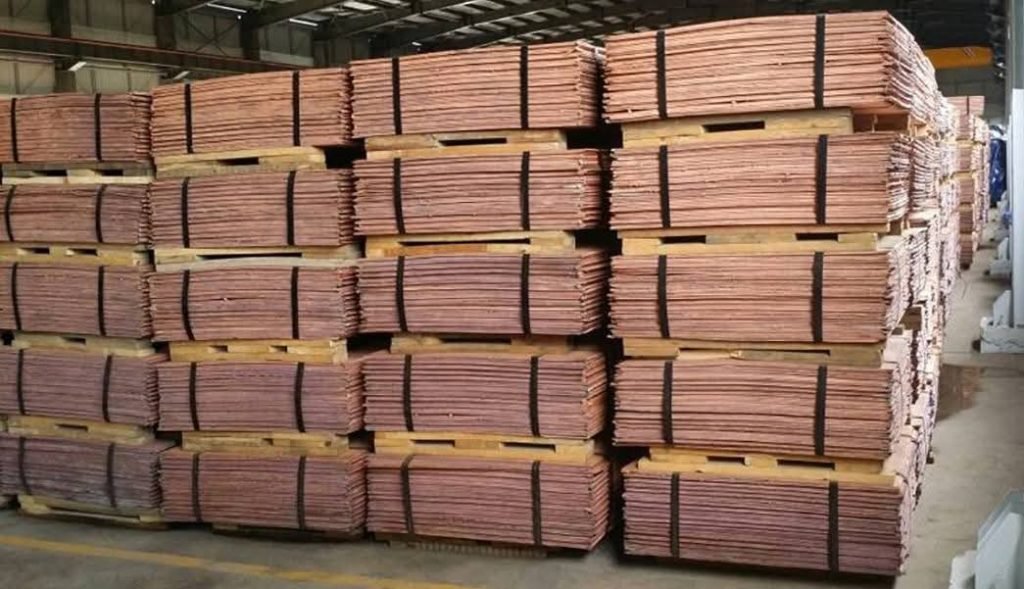
Cathode for electrical rod must be Cu-CATH-1 / LME Grade A, typically 99.975–99.99% Cu with metallic impurities well below 65 ppm. Scrap for direct melt or fire refining must be sorted by copper content, coating and foreign metal — plated, tinned or PVC-coated material is not charged into an OF Upcast furnace.

Cathode rules. Cu-CATH-1 group limits used by refiners: (As+Cd+Cr+Mn+P+Sb) ≤15 ppm; (Bi+Se+Te) ≤3 ppm; (Co+Fe+Ni+Si+Sn+Zn) ≤20 ppm. Se, Te and Bi are the most damaging because they are almost insoluble in solid copper and form grain-boundary films that cause hot shortness and drawing breaks. Shaft-furnace CCR plants specify electrolytic Grade A and usually limit first-grade scrap blend to 10–15% if rod quality is tight.

Scrap rules used on qualified 8 mm lines.

  • Electrolytic copper ≥99.95% Cu: charge directly to the Upcast or shaft furnace.
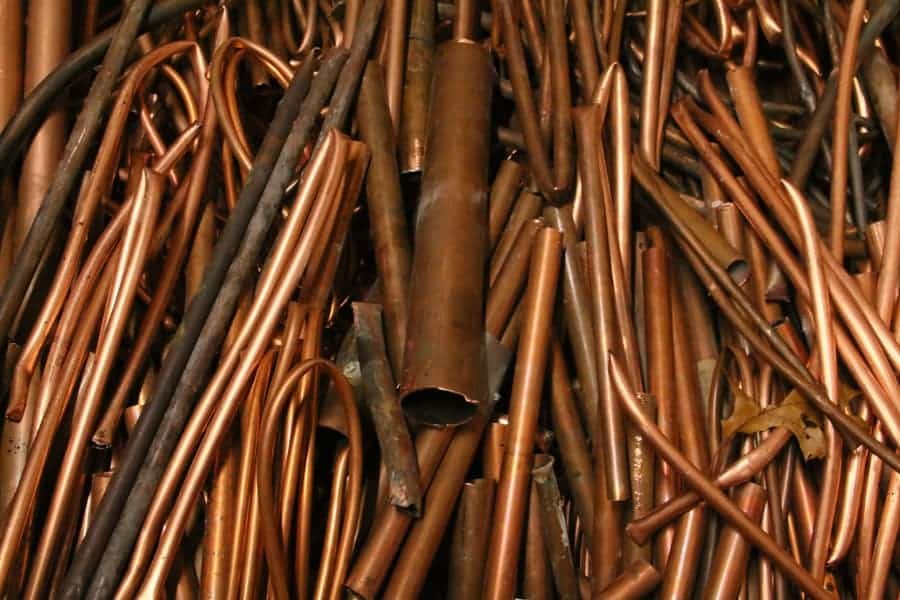
  • First-grade recycled copper / millberry / bare bright: ≥98% Cu; a small fraction at 96% may be blended only after assay. No tin, nickel or other plating. Surface must be clean; PVC and other coverings removed. Only very clean bright wire may enter an Upcast furnace without a refining furnace.
  • Typical CCR scrap mix quoted by mill builders: 60% first-grade red scrap + 40% second-grade, then adjusted after OES.
  • Practical blend used on mixed Upcast plants: 50% electrolytic copper + 50% refined scrap melt, then trimmed to chemistry.

ISRI No.1 (Barley) and No.4 nodules (Clove, min. 99% Cu, no tin/lead/zinc/Al/Fe) are the scrap families that behave closest to cathode. No.2 and insulated wire require fire refining. Plating metals (Sn, Ni, Pb) and phosphorus are the usual reasons a “cheap” scrap lot destroys conductivity and annealability.

2025–2026 fire-refining research shows impurity removal order Sb < Ni < Pb < Sn < Fe (Zn): antimony and nickel are the hardest to slag. A CaO–SiO₂–FeOₓ–Al₂O₃ flux at ~1200 °C and higher oxygen potential can push fire-refined copper toward 99.5–99.9% Cu, but electrical rod still needs tight control of residual Sb, Ni and S — not only a high Cu assay.

How does fire refining convert scrap into rod-grade melt?

Fire refining converts scrap melt into rod-grade copper by deep oxidation of impurities, slag removal, then controlled reduction so oxygen falls back into the ETP window. Temperature and oxygen — not furnace brand — decide whether the rod will draw.

Engineering sequence used on tilting / reverberatory furnaces feeding CCR or Upcast:

  1. Charge and melt. Dry, sorted scrap. Wet insulation and oil cause gas porosity and hydrogen later.
  2. Deep oxidation. Air or oxygen lances raise bath oxygen so Fe, Zn, Sn, Pb, As and Sb oxidize and float as slag. Bath is commonly 1150–1200 °C. Incomplete oxidation leaves Sn/Zn that re-dissolve in the reduction step.
  3. Slag-off. Acid or basic flux is selected from the impurity suite. Dirty slag left on the bath recontaminates the next heat.
  4. Quasi-reduction. Carbonaceous reductant (poling / carbon cover) lowers oxygen to the target: ≤10 ppm for OF transfer into Upcast; ~200–400 ppm for ETP CCR. Over-reduction makes a “dead” melt that picks up hydrogen; under-reduction leaves Cu₂O networks that crack in drawing.
  5. Transfer. Covered launder or sealed ladle. Open pouring of refined metal into an Upcast furnace undoes the oxygen work.

Plant practice summarized by secondary-rod producers is “deep oxidation, accurate reduction, clean slag.” Zn and Sn that survive oxidation re-enter the metal during reduction and show up as fluctuating Cu% and failed resistivity. Ni and Sb need extra flux time; they are the usual reason a scrap-only heat misses GB/T 3952 T1 chemistry.

For Upcast after refining, the original process is: refining furnace → sealed transfer of clean liquid → Upcast 17 mm rod → cold rolling 17 mm → 8 mm to close as-cast structure and raise mechanical uniformity before breakdown drawing.

What process parameters keep 8 mm rod inside ASTM B49 / GB/T 3952?

Qualified 8 mm rod stays inside specification when melt chemistry, oxygen, cast-bar temperature, mill reduction and surface oxide are measured on every coil group — not only on the first heat of a campaign.

Target product window used by mill QA

ItemOF Upcast 8 mmETP/FRHC CCR 8 mmTest
Diameter / ovality8.00 ±0.4 mm class; tighter plant limits common8 ±0.38 mm typical CC rod tableMicrometer, 3 axes
İletkenlik≥100–101.4% IACS≥100% IACSKelvin bridge / ASTM B193
Resistivity @ 20 °C≤0.017241 Ω·mm²/m (≤0.01707 for OFE)≤0.017241 Ω·mm²/mSame
Uzama≥30–37% (200 mm gauge)≥35% typical CC rodTensile, 200 mm
Tensile~170–190 N/mm² OF~208–260 N/mm² ETP range in mill sheetsUTM
Oxygen≤5–10 ppm200–350 ppm plant; 100–650 ppm specInert-gas fusion / oxygen analyzer
Surface oxide filmLow; wax optionalResidual oxide film often <1000 Å on CC tablesOxide-film method GB/T 3952 App.
Coil2–4 t, ID ~700–900 mm, OD ~1500–1800 mm3–5 t star / drop coilWeigh + wrap

In-line process numbers that actually move quality

  • Holding furnace: 1150 °C ±10 °C for Upcast; charcoal ≤7 kg and graphite flake ≤2 kg per typical small holding furnace duty.
  • Cast-bar section on CCR: ~2320–2500 mm² on Ø1820–2200 mm wheels; delivery ~10–13 m/min.
  • Rolling: 12 passes, roll Ø255–274 mm, finish 8.0 mm, 9.6–11.6 m/s, emulsion and gear oil separated.
  • Cooling water on caster: softened water ~0.8 MPa, ≤35 °C, on the order of 150–170 m³/h on a 12–15 t/h line.
  • Energy on modern CCR packages is quoted in the 320–360 kWh/t process band by some builders; furnace fuel for scrap reverberatory units is often 100–110 Nm³ natural gas per tonne Cu. Use these as planning figures, then verify on the heat balance of the actual furnace.

Downstream, Ø8 mm rod feeds 9/11/13-die breakdown machines (inlet Ø8 mm, outlet ~1.2–3.5 mm, mechanical speed up to 1500 m/min). Rod that passes chemistry but fails torsion or surface oxide still breaks at this stage.

Which defects appear when scrap or oxygen control is wrong?

The dominant failure modes on 8 mm electrical rod are impurity films, wrong oxygen, surface scale and hydrogen — not “insufficient melting power.” Each mode has a measurable signature and a process correction.

1. Hot shortness and drawing breaks (Se, Te, Bi, Pb, Sb).

Grain-boundary films from Se/Te/Bi cause intergranular fracture during hot rolling or first drawing passes. Correction: reject off-grade cathode; keep scrap free of leaded bronze and free-machining alloys; assay every scrap lot by OES before charging.

2. Hydrogen embrittlement (“hydrogen disease”) on ETP rod.

ETP oxygen exists as Cu₂O. Annealing or brazing in reducing gas turns oxide into steam and blisters the metal. OF rod (≤10 ppm O) is specified where this risk exists. ASTM B577 / GB/T 23606 hydrogen-embrittlement tests are mandatory on OF stock. Do not sell ETP into vacuum or reducing-atmosphere duty.

3. High resistivity from P, Fe, Ni, Sn.

Phosphorus is especially damaging per 0.01% addition. Plated wire and bronze contamination are the usual sources. Correction: ban plated feed on OF lines; extend oxidation and slag-off on CCR scrap heats.

4. Cast porosity and slivers.

Wet scrap, open launders and unstable caster cooling produce pores that open as slivers on the mill or as copper powder on the rod surface. GB/T 3952 added copper-powder and surface-oxide requirements for this reason. Correction: dry charge, stable wheel cooling, shave and brush the cast bar before the first stand.

5. Over-reduction / under-reduction.

Over-poled metal absorbs hydrogen; under-poled metal leaves Cu₂O networks. Both fail elongation and twist tests even when Cu% looks acceptable.

6. Mixed-grade coils.

A 50/50 cathode–refined-scrap plant that does not homogenize the holding furnace will ship coils that pass the first sample and fail the third. Sampling per GB/T 3952 is every 15 coils or 60 t — not one coupon per week.

Inspection set that actually protects a cable customer:

  • Full-spectrum OES for Cu and residuals (C, P, S, N and metals).
  • Oxygen analyzer (inert-gas fusion).
  • Digital resistance bridge at 20 °C.
  • Torsion / twist-off tester.
  • Servo UTM for tensile and elongation (200 mm gauge).
  • Hydrogen-embrittlement test on OF heats.
  • Surface oxide / copper-powder check on CCR rod.

How should a cable manufacturer specify and buy 8 mm rod in 2026?

Specify the standard, grade, oxygen band, coil mass and drawing duty in the purchase order. “8 mm bright copper rod” is not a specification.

Minimum PO content:

  • Standard: ASTM B49 veya EN 1977 veya GB/T 3952-2016, named grade (T1 / TU1 / Cu-ETP / Cu-OF / Cu-FRHC).
  • Diameter and ovality, coil ID/OD, coil mass (2–5 t), weld-free coil.
  • Oxygen: ≤10 ppm (OF) or 200–400 ppm (ETP plant window).
  • Conductivity / resistivity at 20 °C, elongation, twist.
  • Feedstock declaration: 100% Cu-CATH-1, or max. scrap %, or FRHC route.
  • MTC with OES + oxygen + resistivity per coil group.
  • Packing: PE wrap, pallet, optional wax; no wet storage.

Selection logic:

  • MV/HV, magnet wire, audio, vacuum, brazing → Upcast OF from cathode.
  • LV building wire and general power cable at high volume → CCR ETP from cathode.
  • Cost-down with closed-loop mill scrap → fire-refine + CCR or refine + Upcast 17→8 mm, but keep plated scrap out and keep OES on every heat.
  • 3,000–6,000 t/year new plant → Upcast first; add a tilting refiner only if scrap is the economic feedstock.
  • ≥12 t/h continuous demand → CCR with shaft furnace (cathode) or reverberatory furnace (scrap).

2024–2026 market direction is higher scrap ratios and more captive Upcast loops, not a change in electrical physics. Recycled rod is acceptable when it meets the same ASTM/EN/GB numbers. It is not acceptable when “99.9% Cu” hides 50 ppm P or 8 ppm Bi.

Key takeaways

  • Qualified 8 mm rod is defined by ASTM B49 / EN 1977 / GB/T 3952-2016: conductivity ≥100% IACS, oxygen in the chosen band, drawability proven by torsion and elongation.
  • Cathode route: shaft + CCR for ETP, or charcoal-covered Upcast at 1150 °C ±10 °C for OF.
  • Scrap route: sort to ≥98% Cu, no plating; fire-refine (deep oxidize → slag → accurate reduce); transfer under cover; then CCR 8 mm or Upcast 17 mm + cold roll to 8 mm.
  • Typical CCR mid-line: Ø1820–2200 mm wheel, ~2300–2500 mm² bar, 12-stand mill, 12–16 t/h, 3–5 t coils.
  • Typical small OF line: 3,000–8,000 t/y, oxygen ≤10 ppm, resistivity ≤0.01724 Ω·mm²/m.
  • Failures come from Se/Te/Bi films, wrong oxygen, plated scrap and unstable caster cooling — not from missing a brand name on the mill.

If the plant target is a documented 8 mm OF or ETP/FRHC line — Upcast, refining furnace, 17-to-8 mm cold mill, or 12–16 t/h CCR — send cathode grade, scrap mix, annual tonnage and finished-wire size. The process window can be engineered to the standard, not to a generic brochure.

Şimdi bilgi isteyin

Bir yanıt yazın

E-posta adresiniz yayınlanmayacak. Gerekli alanlar * ile işaretlenmişlerdir