Kategorilendirilmemiş

Boru Tipi Masura Büküm Makinesi

Borulu Örmüş Makinesi (Tubular Stranding Machine)

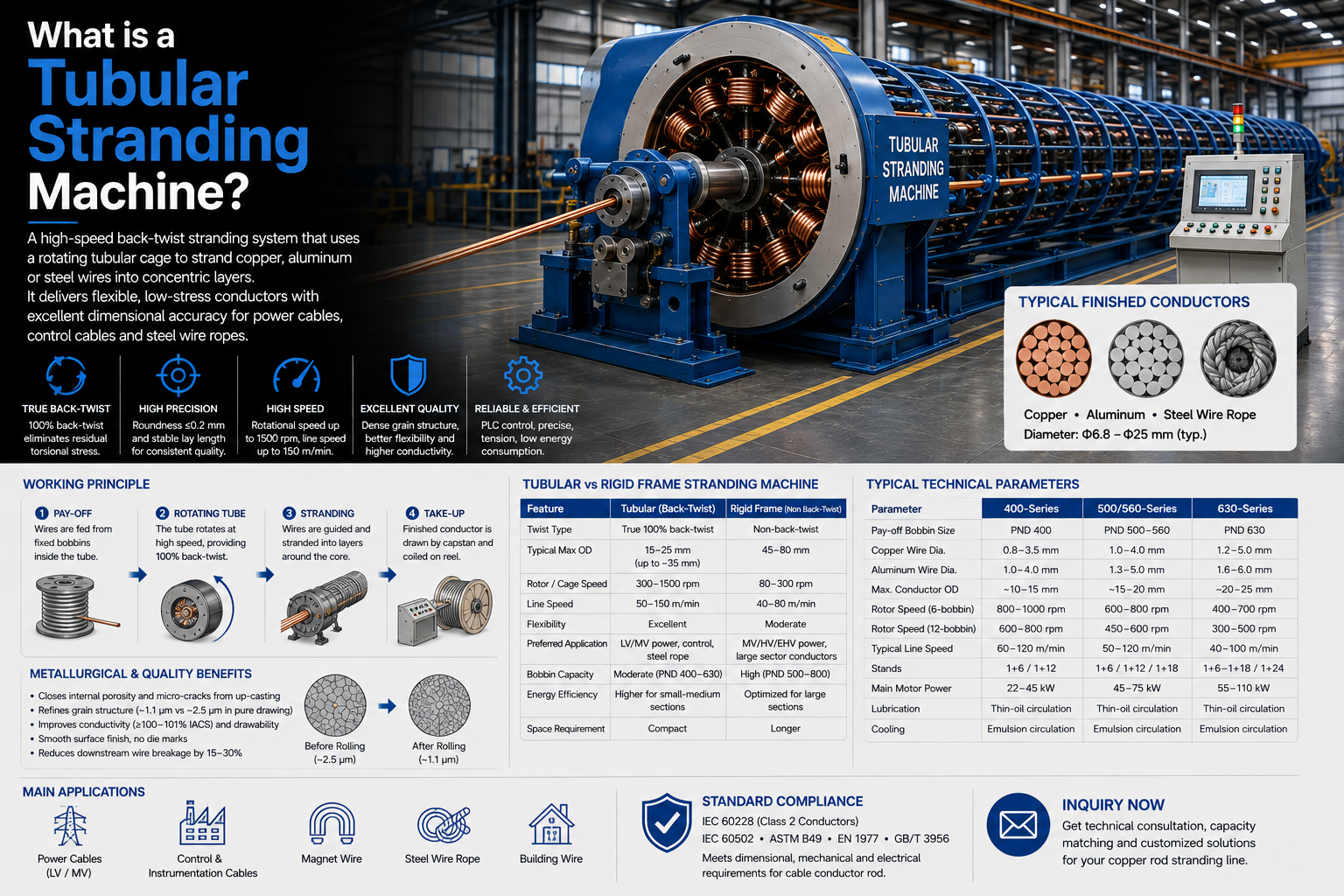
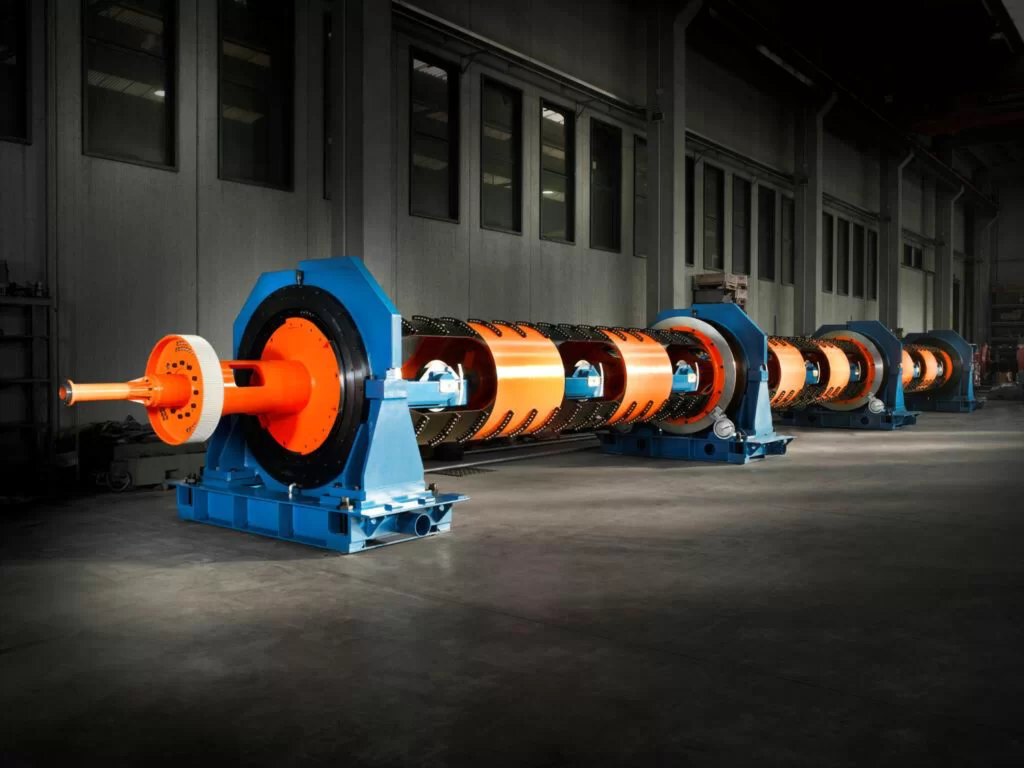
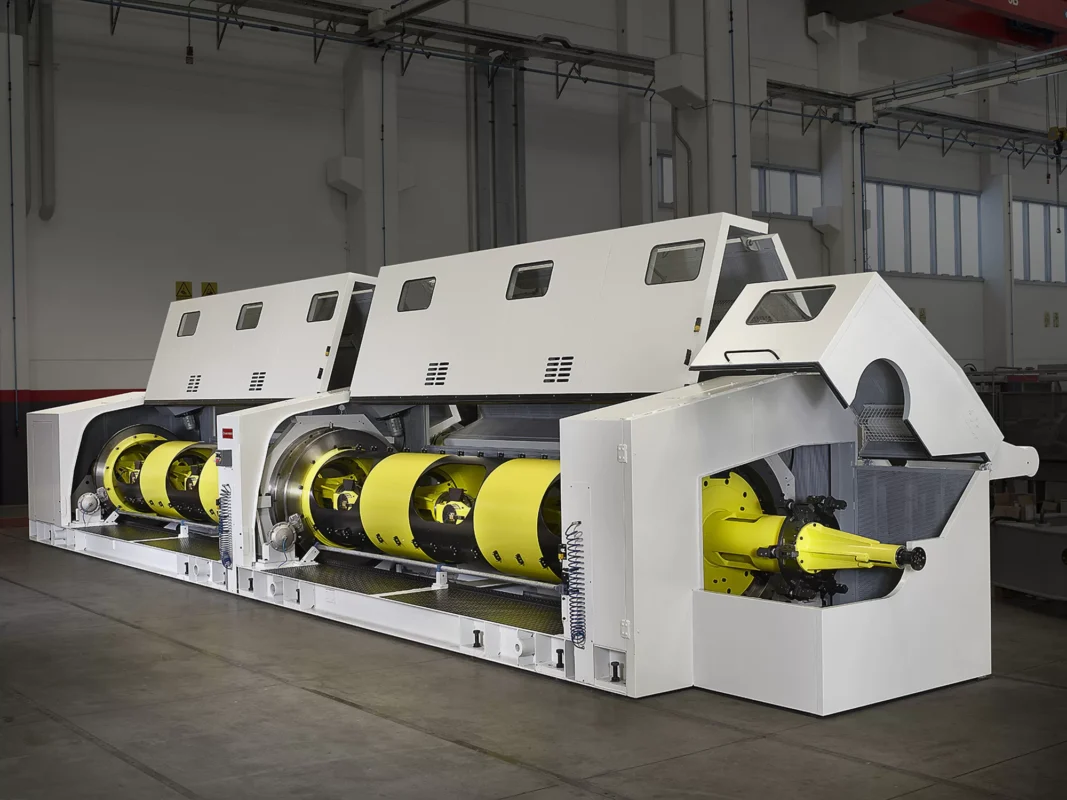
A boru bükme makinesi is a high-speed, true back-twist conductor stranding system that uses a rotating seamless steel tube to form concentric layers of copper, aluminum, or steel wires around a central core. The bobbins remain orientation-fixed inside the tube while the tube itself rotates at high speed, producing conductors with minimal residual torsional stress, excellent flexibility, and uniform lay. This design is widely applied for low- and medium-voltage power cable conductors, control cables, steel-wire ropes, and certain overhead conductors where high production speed and dimensional consistency are required.

The machine is particularly valued when manufacturers need long continuous lengths of Class 2 conductors complying with IEC 60228 while maintaining high line speeds that rigid-frame systems cannot match for smaller-to-medium cross-sections.

Büümsel Büküm Makinesi Nasıl Çalışır?

A tubular stranding machine works by mounting pay-off bobbins inside a long, dynamically balanced rotating tube supported by precision bearings at both ends and intermediate points. As the tube rotates at speeds typically ranging from 300 to 1500 rpm (depending on bobbin size and configuration), the wires are drawn through guide rollers and a closing die at the exit end. Because the bobbins do not rotate relative to the tube axis, each wire receives a true 100% back-twist. This eliminates the internal torsional stress that occurs in non-back-twist systems and results in a conductor with superior flexibility and fatigue resistance.

Modern machines use PLC + HMI control for stepless pitch adjustment, individual or group tension control (magnetic particle, hysteresis, or mechanical), and synchronized haul-off via dual-wheel or single-wheel capstans. Configurations commonly range from 1+6 to 1+12, 1+18, or higher bay counts for multi-layer constructions. Typical single-wire diameters are 0.6–5.0 mm for copper and 1.0–6.0 mm for aluminum, with finished conductor diameters usually limited to approximately 15–25 mm for standard high-speed models.

Tubular vs Rigid Frame Stranding Machine – Which Should Cable Manufacturers Choose?

Tubular stranders excel in speed and back-twist quality for medium-section conductors, while rigid frame stranders dominate large-section power cable production.

ÖzellikBorulu Bükme MakinesiRigid Frame Stranding Machine
Twist typeTrue 100% back-twistNon-back-twist
Tipik maksimum iletken dış çapı15–25 mm (up to ~35 mm on larger models)45–80 mm
Rotor / cage speed300–1500 rpm80–300 rpm
Hat hızı50–150 m/min40–80 m/dak
Tercih edilen uygulamaLV/MV power, control, steel ropeMV/HV/EHV power, large sector/Milliken
Flexibility of finished conductorHarikaIlıman
Masura kapasitesiModerate (PND 400–630 typical)Yüksek (PND 500–800)
Space requirementCompact relative to outputLonger machine length
Energy efficiency (relative)Higher for small-medium sectionsOptimized for large sections

What Are the Key Technical Parameters of Current Tubular Stranding Machines?

The following table summarizes representative performance data for 2024–2026 production models:

Parametre400-Series500/560-Series630 Serisi
Açma masurası boyutuPND 400PND 500–560PND 630
Copper wire diameter0.8–3.5 mm1.0–4.0 mm1.2–5.0 mm
Aluminum wire diameter1.0–4.0 mm1.3–5.0 mm1.6–6.0 mm
Max. finished conductor OD~10–15 mm~15–20 mm~20–25 mm
Rotor speed (6-bobbin)up to 800–1000 rpmup to 600–800 rpmup to 400–700 rpm
Rotor speed (12-bobbin)up to 600–800 rpmup to 450–600 rpmup to 300–500 rpm
Typical line speed60–120 m/min50–120 m/dak40–100 m/dak
Capstan diameter600–1000 mm1000–1600 mm1200–2000 mm
Main motor power22–45 kW45–75 kW55–110 kW
Common configurations1+6, 1+121+6, 1+12, 1+181+6 to 1+18 / 1+24

These parameters support continuous production of IEC 60228 Class 2 conductors and equivalent national standards. Larger models can also handle steel wires for armouring or ACSR cores.

How Should Manufacturers Select a Tubular Stranding Machine for Their Cable Range?

Selection starts with the target conductor cross-section and construction. For low-voltage building wires and medium-voltage power cables up to approximately 120–240 mm², a 1+6 or 1+12 tubular machine on 500 or 630 bobbins provides an optimal balance of speed and quality. When higher layer counts or slightly larger diameters are required, multi-bay configurations (1+12+18) become necessary.

Key decision criteria include:

  • Required continuous production length and take-up reel capacity
  • Need for simultaneous steel-wire armouring or copper screening capability
  • Available factory floor length and foundation requirements (tubular machines generally need less civil work than large rigid systems)
  • Preference for magnetic-particle or closed-loop tension control to maintain ±2 % tension uniformity
  • Integration with upstream wire-drawing and downstream extrusion or cabling lines

Turnkey suppliers typically recommend tubular stranders as the high-productivity front-end for LV/MV XLPE or PVC power-cable plants where conductor sizes remain within the machine’s efficient working range.

What Standards and Industry Trends Apply to Tubular Stranding?

Conductors produced on tubular stranders must meet IEC 60228 (Conductors of insulated cables), the relevant parts of IEC 60502 for power cables, and corresponding national standards such as GB/T 3956. Lay length accuracy, compaction, and surface quality directly influence subsequent insulation extrusion performance and long-term cable reliability.

Industry trends observed between 2024 and 2026 include:

  • Wider adoption of true 100 % back-twist designs with improved bearing lubrication and dynamic balancing for quieter, higher-speed operation
  • Integration of automatic bobbin loading and wire-break detection systems to reduce downtime
  • Increased use of regenerative drive systems and energy-efficient motors
  • Growing demand for hybrid lines that combine tubular stranders for core conductors with rigid-frame machines for larger outer layers or armouring

Başlıca Uygulamalar

  • Stranded copper and aluminum conductors for LV and MV power cables
  • ACSR, AAC, and AAAC overhead transmission conductors
  • Steel wire strands and steel wire ropes
  • Steel-wire armoring of cables
  • Certain control and instrumentation cables
  • OPGW and specialized grounding conductors
  • Secondary stranding operations for multi-layer constructions

Comparison with Rigid Stranding Machines

Tubular stranders excel in high-speed production of smaller-to-medium cross-section conductors where flexibility and back-twist are important. Rigid-frame (non-back-twist) stranders are generally preferred for very large-section conductors, heavy armoring layers, and applications requiring maximum mechanical rigidity and compaction at lower rotational speeds. Many modern cable plants operate both types according to product mix.

Selection Considerations

When choosing a Tubular Stranding Machine, evaluate:

  • Required wire range, finished strand diameter, and construction (7-wire, 19-wire, etc.)
  • Target production volume and continuous running requirements
  • Need for true back-twist and conductor flexibility
  • Integration with existing pay-off, insulation, or armoring lines
  • Tension control method, safety features, and automation level
  • Long-term reliability, spare-parts availability, and technical support

What Are the Common Failure Modes and How Are They Prevented?

Typical operational issues include wire breakage inside the tube, pitch instability, uneven tension, and excessive vibration or bearing wear. Wire breaks often result from incorrect tension settings, damaged bobbin flanges, or sharp edges in guide paths; prevention requires calibrated tension systems, regular inspection of bobbins, and smooth wire paths. Pitch variation is usually caused by loss of synchronization between the tube and the haul-off; digital PLC control with encoder feedback eliminates most of these problems. Bearing overheating or vibration is minimized by automatic lubrication systems and proper dynamic balancing of the tube at the design stage.

Routine maintenance of main bearings, tension brakes, and safety interlocks, together with clean wire and correct die selection, ensures long-term reliable performance.

Key Takeaways for Cable Manufacturers

Tubular stranding machines remain the high-speed solution of choice for producing flexible, low-stress conductors in the low- to medium-voltage range. Their true back-twist design, compact footprint relative to output, and high rotational speeds deliver consistent quality and productivity for Class 2 copper and aluminum conductors. When conductor sizes stay within the machine’s optimal window, a modern tubular strander provides lower energy consumption per kilogram and shorter change-over times than larger rigid systems. Correct selection of bobbin size, tension control, and integration with the overall production line determines long-term operational success.

For detailed technical proposals, capacity calculations, and configuration options matched to your specific LV/MV power or control cable range, contact our engineering team.

Bir yanıt yazın

E-posta adresiniz yayınlanmayacak. Gerekli alanlar * ile işaretlenmişlerdir