Kategorilendirilmemiş

Alüminyum Alaşımlı Yaşlandırma Fırını Nedir?

Alüminyum Alaşımlı Yaşlandırma Fırını Nedir

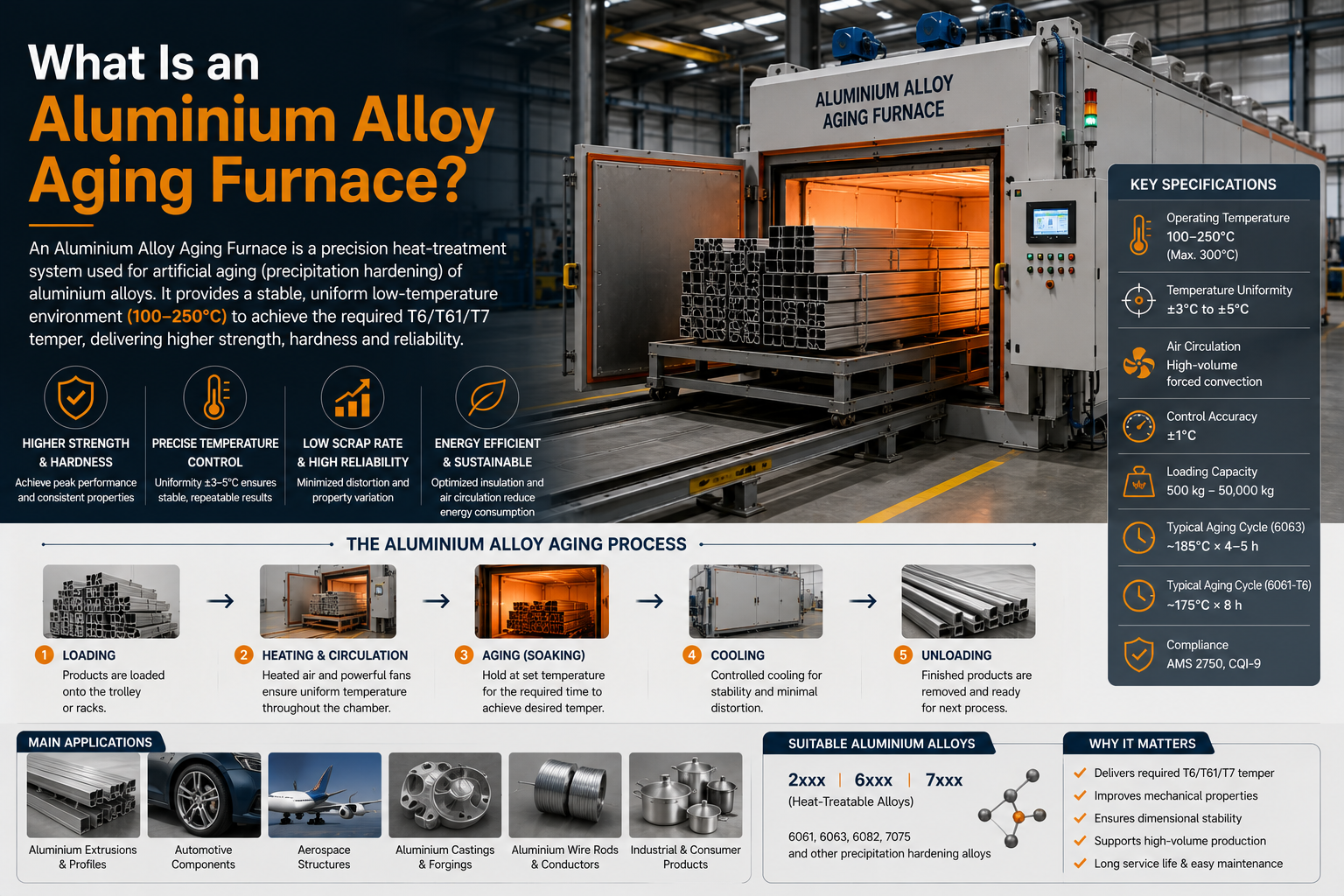
An Alüminyum Alaşım Yaşlandırma Fırını (also called an aluminum aging oven or precipitation hardening furnace) is a specialized low-temperature industrial heat-treatment system engineered for the artificial aging process of heat-treatable aluminium alloys. After solution heat treatment and rapid quenching, aluminium alloys remain in a supersaturated solid-solution state. The aging furnace provides a precisely controlled thermal environment—typically between 100°C and 250°C (maximum design temperature usually 300°C)—to promote the controlled precipitation of fine intermetallic phases (primarily Mg₂Si in 6xxx series alloys).

These precipitates impede dislocation movement within the crystal lattice, significantly increasing tensile strength, yield strength and hardness while maintaining acceptable ductility. The result is the widely specified T6 (or T61/T7) temper condition required by automotive, aerospace, construction and industrial applications.

Unlike general-purpose ovens, a professional aluminium alloy aging furnace prioritizes temperature uniformity (±3°C to ±5°C across the working zone), high-volume forced-air circulation, long-term thermal stability and energy-efficient insulation. These features ensure batch-to-batch consistency, minimize scrap and support long-term production reliability.

The Science of Aging: Natural vs. Artificial Aging

Aluminium alloys of the 2xxx, 6xxx and 7xxx series are precipitation-hardenable. After solution treatment (typically 450–550°C) and quenching, alloying elements are trapped in a supersaturated solid solution.

  • Natural aging occurs at room temperature over days to weeks (or months for some 6xxx alloys). It produces moderate strength (T4 temper) with higher ductility but is too slow for modern production schedules.
  • Artificial aging accelerates the process by heating the material in a controlled furnace. For 6xxx-series extruded profiles (6060, 6063, 6061, 6005A), typical parameters are approximately 180–185°C for 4–5 hours. For 6061-T6, common cycles include 175°C for 8 hours or similar optimized ranges. Higher-strength 7xxx alloys (e.g., 7075) often require longer soaks at lower temperatures (around 120–125°C for 24 hours).

Over-aging (excessive time or temperature) causes precipitates to coarsen, reducing strength. Precise control of temperature, time and uniformity is therefore critical to achieve peak mechanical properties without dimensional distortion or property scatter.

How an Aluminium Alloy Aging Furnace Works

  1. Loading – Workpieces (castings, extrusions, hubs, profiles, wire rods or panels) are placed on a trolley, bogie or racks and transferred into the furnace chamber.
  2. Heating & Circulation – Electric resistance elements or indirect gas heating raise the chamber temperature. Powerful centrifugal or axial fans create high-volume hot-air circulation (often 30–50 air changes per minute in high-performance designs). Horizontal or vertical airflow ensures even heat penetration through dense loads.
  3. Soaking – The load is held at the set temperature for the required duration (typically 4–24 hours depending on alloy and section thickness). Multi-zone PID/PLC control with multiple thermocouples maintains uniformity.
  4. Cooling & Unloading – After the cycle, the charge is cooled (natural or forced) and removed. Some systems integrate ambient or chilled-air cooling.

The entire process is designed for repeatability and compliance with standards such as AMS 2750 (temperature uniformity classes) and CQI-9 (automotive heat-treat assessment).

Key Design Features of a Professional Aging Furnace

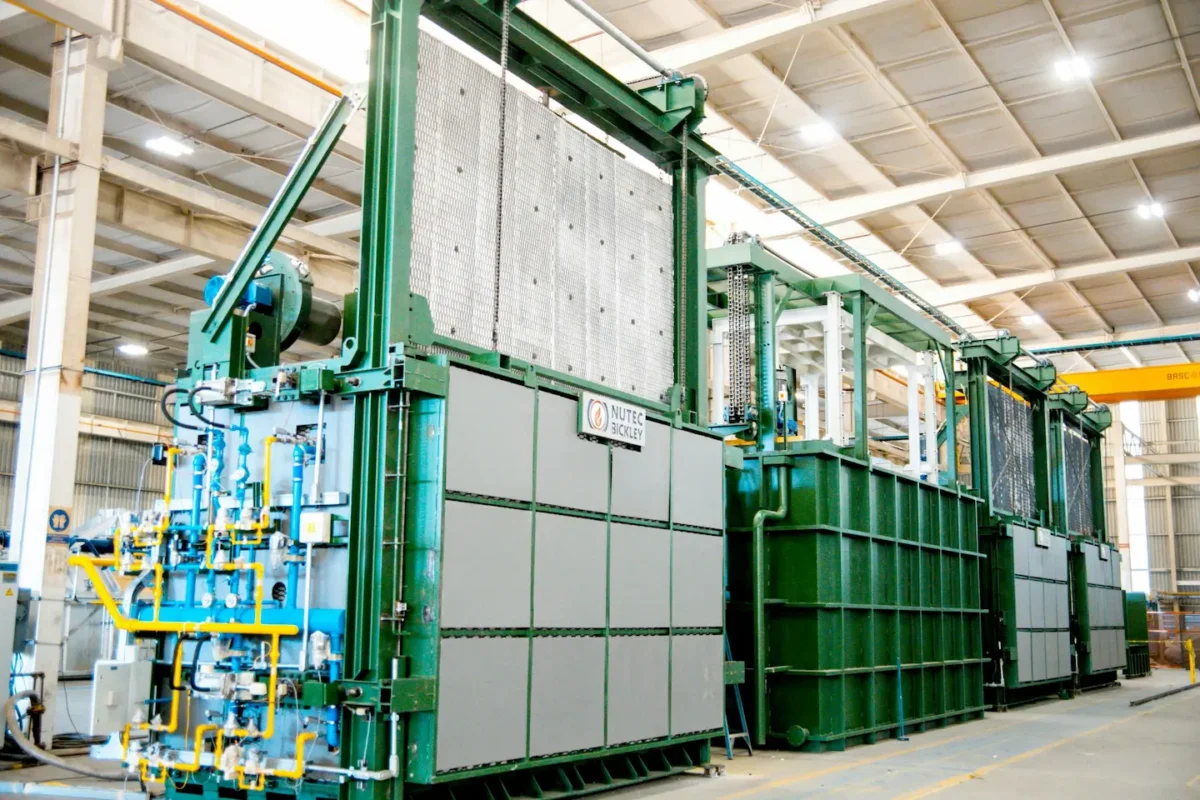
  • Furnace Body & Insulation – Heavy-duty steel structure with high-density ceramic fibre or rock-wool lining for minimal heat loss and low outer-shell temperature.
  • Hot-Air Circulation System – Large-capacity fans, guide vanes and dual-duct designs deliver excellent temperature uniformity (±3–5°C).
  • Heating System – Electric (ribbon or tubular elements) or indirect gas-fired, controlled by thyristor/SCR power regulation.
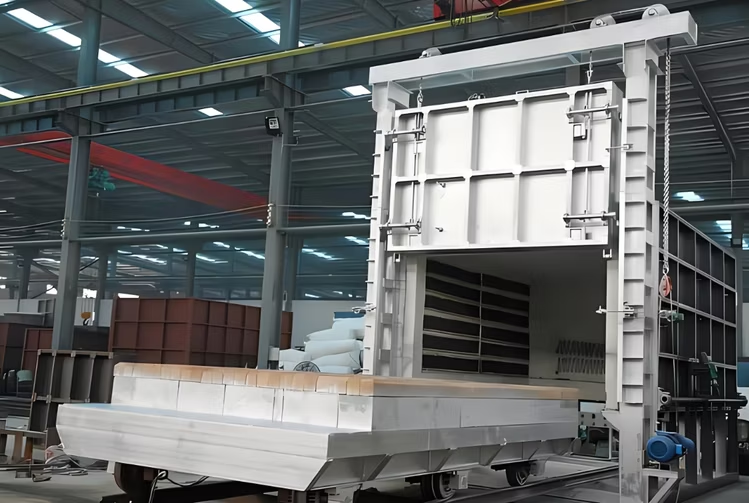
  • Loading System – Trolley/bogie-hearth (car-bottom) for heavy loads, box-type or continuous configurations for high throughput.
  • Kontrol Sistemi – Advanced PLC + PID with programmable multi-step profiles, data logging, over-temperature alarms and interlocking safety features.
  • Sealing & Safety – Robust door seals, interlocks that cut power when the door opens, and optional AMS 2750 Class 1 capability.

Typical capacity ranges from a few hundred kilograms to 50 tonnes per batch, with chamber sizes customizable from small laboratory units to long profile furnaces (up to 6–9 m or more).

Tipik Teknik Parametreler

ParametreTypical Range
Çalışma Sıcaklığı100–250°C (Max 300°C)
Temperature Uniformity±3°C to ±5°C
Heating SourceElectric or Indirect Gas
Air CirculationHigh-volume forced convection
Control Accuracy±1°C
Loading Capacity500 kg – 50,000 kg
Common Cycle (6063)~185°C × 4–5 h
Common Cycle (6061-T6)~175°C × 8 h

Custom designs readily accommodate specific alloy requirements, section thicknesses and production volumes.

Benefits of Using a High-Quality Aluminium Alloy Aging Furnace

  • Achieves consistent peak mechanical properties (tensile strength, yield strength, hardness) required for structural applications.
  • Minimizes residual stress and dimensional distortion.
  • Delivers high process reliability and low scrap rates through superior temperature uniformity.
  • Supports energy-efficient operation via advanced insulation and optimized airflow.
  • Enables full compliance with aerospace (AMS) and automotive (CQI-9) standards.
  • Offers long service life and low maintenance when built with industrial-grade components.

Ana Uygulamalar

  • Extruded aluminium profiles and architectural sections (6xxx series)
  • Automotive components (wheels, suspension parts, engine blocks, structural castings)
  • Aerospace extrusions and forgings requiring high strength-to-weight ratio
  • Aluminium alloy hubs, pistons, panels and die-castings
  • Aluminium wire rods, conductors and related products
  • Industrial castings and cookware requiring improved hardness and stability

Factors That Influence Aging Results

Temperature accuracy and uniformity are the most critical variables. Even a few degrees of deviation can cause under-aging (insufficient strength) or over-aging (reduced hardness). Residence time between quench and aging, load density, airflow pattern and section thickness must also be controlled. Professional furnace design addresses these variables through multi-zone heating, high recirculation rates and precise instrumentation.

Selecting the Right Aluminium Alloy Aging Furnace

When specifying equipment, prioritize:

  • Proven temperature uniformity data
  • Flexibility for multi-stage profiles (T6, T61, T7)
  • Custom loading systems matched to your product geometry
  • Energy efficiency and long-term reliability
  • Compliance with relevant industry standards
  • After-sales technical support and spare-parts availability

A well-engineered aging furnace is not merely a heating chamber—it is a process-critical asset that locks in material performance and supports long-term production quality.

Ready to upgrade your aluminium heat-treatment capability? Our engineering team designs and supplies customized Aluminium Alloy Aging Furnaces tailored to your alloy range, capacity and quality requirements. We focus on reliable quality, precise process control and long-term technical partnership.

Şimdi bilgi isteyin for detailed technical proposals, layout drawings and competitive quotations. Let us help you achieve consistent T6 performance and production reliability.

Bir yanıt yazın

E-posta adresiniz yayınlanmayacak. Gerekli alanlar * ile işaretlenmişlerdir