Kategorilendirilmemiş

Yüksek Hızlı İzolasyon Ekstrüzyon Üretim Hattı

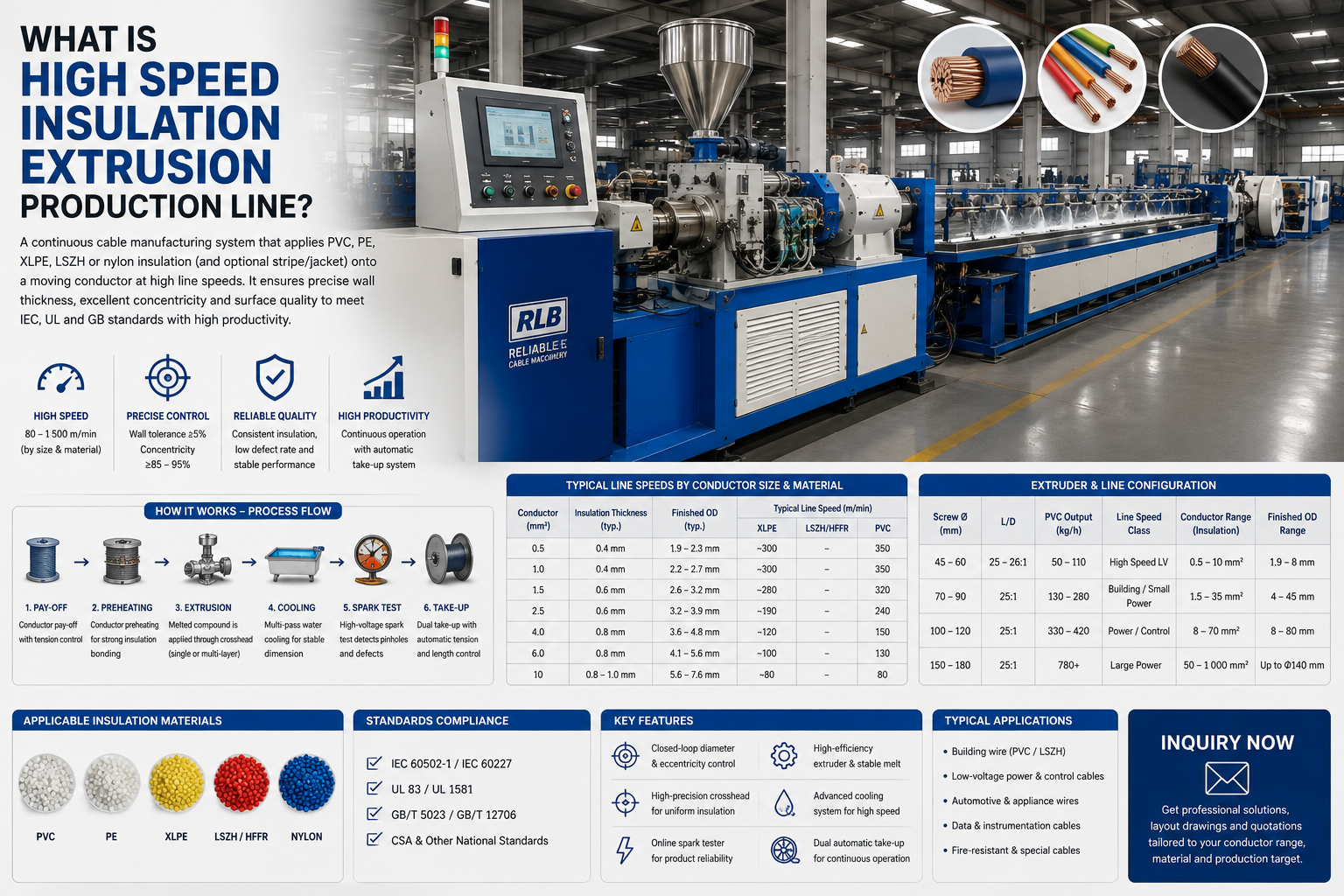
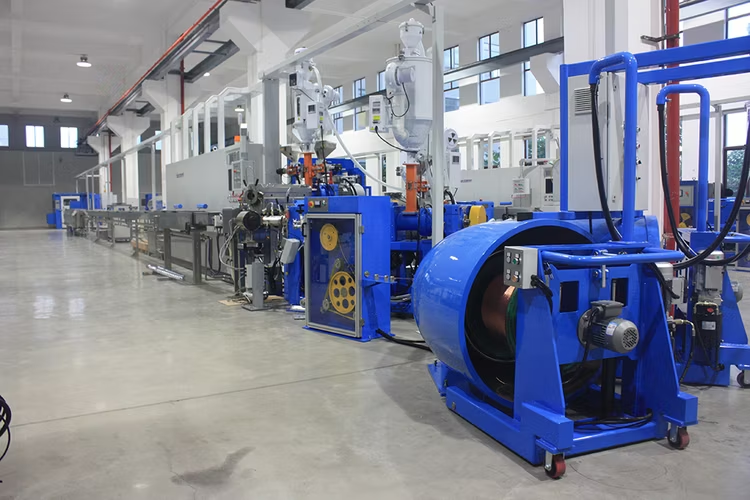
A Yüksek Hızlı Yalıtım Ekstrüzyon Üretim Hattı is a continuous cable manufacturing system that applies PVC, PE, XLPE, LSZH/HFFR or nylon insulation (and optional skin/stripe or jacket layers) onto a moving conductor at line speeds typically from 80 m/min up to 500–1 500 m/min, depending on conductor size and compound. The line integrates pay-off, conductor preheating, single or multi-extruder crosshead application, closed-loop diameter/eccentricity control, water cooling, spark testing and dual take-up. Its purpose is to deliver insulation wall thickness, concentricity and surface quality that comply with IEC 60502, IEC 60227, UL 83 and GB/T building-wire / power-cable standards at industrial throughput.

Typical building-wire lines reach 300–1 200 m/min on 0.5–6 mm² conductors. Power-cable insulation lines for larger sections run slower (45–180 m/min) but handle finished diameters up to Φ80–140 mm. Wall-thickness tolerance of ±5 % and concentricity ≥85–95 % are standard targets on modern closed-loop lines.

How the Line Works — Process Sequence and Critical Parameters

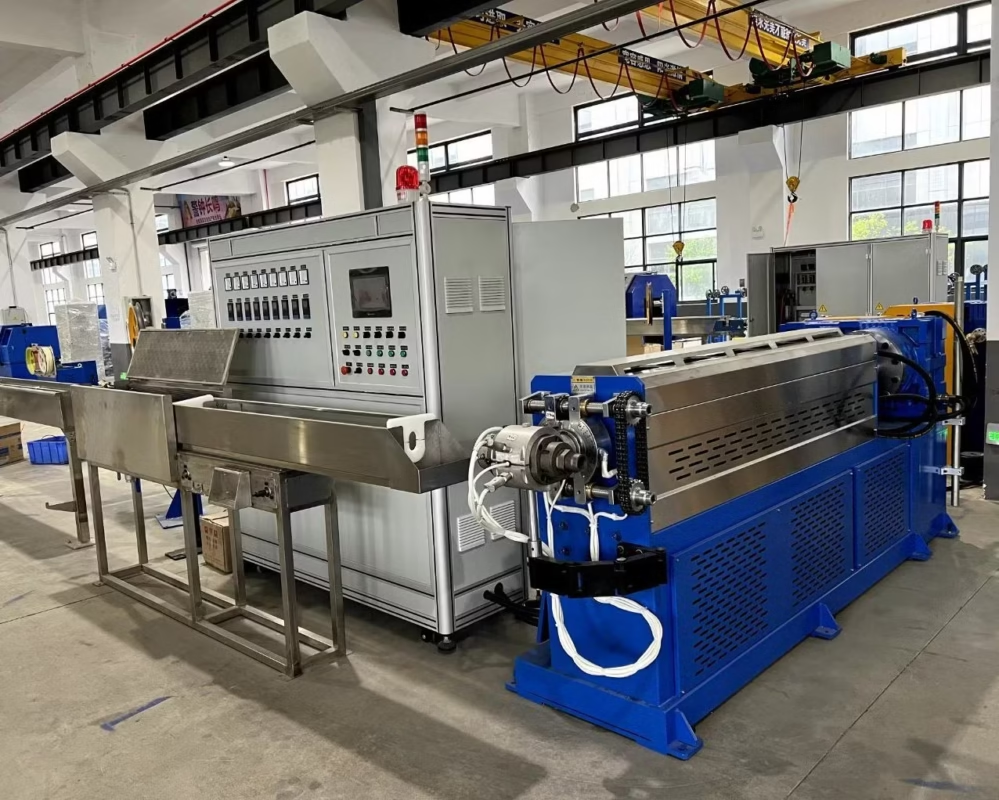
Conductor (solid or stranded copper/aluminium) is paid off under controlled tension, optionally drawn and annealed in tandem, then preheated (typically 80–140 °C) so that insulation bonds without voids. Compound pellets are dried, fed into a single-screw extruder (L/D 25:1–30:1 for PVC; longer, gentler screws for XLPE to avoid premature scorch). Melt is forced through a pressure or tube-type crosshead. For dual-colour, skin/stripe or XLPE MV constructions, a second (or third) extruder feeds the same crosshead (co-extrusion) or a tandem head.

After the die the insulated core enters a multi-pass spray / immersion cooling trough. A practical sizing rule used by process engineers is approximately 1 m of active cooling length per 1 mm wall thickness per 10 m/min line speed; high-speed fine-wire lines add air quench or pressurised water. Laser diameter gauges and eccentricity sensors close the loop to screw rpm or haul-off speed. A DC spark tester (typically 5–15 kV for LV, higher for MV) detects pinholes before dual automatic take-up.

Typical Line Speeds by Conductor Size and Compound

KondaktörInsulation thickness (typ.)Finished OD (typ.)XLPE speedLSZH/HFFR speedPVC speed
0.5 mm²0.4 mm1.9–2.3 mm~300 m/min350 m/min
1.0 mm²0.4 mm2.2–2.7 mm~300 m/min350 m/min
1.5 mm²0.6 mm2.6–3.2 mm~280 m/min320 m/min
2.5 mm²0.6 mm3.2–3.9 mm~190 m/min240 m/min
4.0 mm²0.8 mm3.6–4.8 mm~120 m/min150 m/min
6.0 mm²0.8 mm4.1–5.6 mm~100 m/min130 m/min
10 mm²0.8–1.0 mm5.6–7.6 mm~80 m/min80 m/min

Fine-wire / automotive / data-cable lines with 30–60 mm screws routinely exceed 800–1 500 m/min. Large power-cable insulation lines (screw Φ100–180 mm) run 45–180 m/min on 10–1 000 mm² conductors.

Extruder and Line Configuration Data

Screw ØTypical L/DPVC outputLine speed classConductor range (insulation)Finished OD range
Φ45–60 mm25–26:150–110 kg/hHigh-speed LV0.5–10 mm²1.9–8 mm
Φ70–90 mm25:1130–280 kg/hBuilding / small power1.5–35 mm²4–45 mm
Φ100–120 mm25:1330–420 kg/hPower / control8–70 mm²8–80 mm
Φ150–180 mm25:1780+ kg/hLarge power50–1 000 mm²up to Φ140 mm

Barrel temperature profiles (indicative): PVC 160–190 °C; PE 180–210 °C; XLPE insulation 200–240 °C (avoid scorch); LSZH requires precise moisture control and often grooved-feed barrels.

Single-Layer vs Tandem vs Co-Extrusion — Selection Logic

Line typeLayersTypical speedBest useControl demand
Single-screw180–1 200 m/minPVC/PE building wire, general insulationOrta
Tandem (sequential heads)230–200 m/minInsulation + jacket, THHN nylon jacketMedium–high
Co-extrusion (one head)2–3 simultaneous20–150 m/min (MV lower)XLPE conductor screen + insulation + insulation screenYüksek
Fine-wire high-speed1 (+ stripe)500–2 000 m/minAutomotive, telecom, magnet-adjacentVery high (temp ±1 °C)

MV/HV XLPE with triple-layer dry-cure CCV/VCV is a different class (line speeds typically 25–50 m/min, towers 16–23 m) and is not the same machine as a high-speed LV insulation line.

Quality Metrics, Standards and Failure Modes

Concentricity is calculated as (min wall ÷ max wall) × 100. LV building-wire practice targets ≥85 %; MV XLPE commonly requires ≥80–90 %. IEC 62067 discusses eccentricity limits around 10 % for certain HV constructions because thin-side field enhancement accelerates ageing.

Primary defects and prevention:

  • Eccentricity / thin wall — misaligned tip/die, unstable melt, inadequate closed-loop control. Use self-centering or servo-adjustable crossheads plus 8-point laser eccentricity gauges.
  • Pinholes / spark failures — moisture in compound, gels, die lines, inadequate cooling. Pre-dry LSZH/XLPE; polish dies; size trough length to speed and wall.
  • Melt fracture / shark-skin — excessive shear at the die. Raise die temperature or reduce speed; use processing aids.
  • Scorch in XLPE — barrel too hot or residence time too long. Use 30:1 L/D screws and melt-temperature monitoring before the head.
  • Diameter drift — open-loop screw/haul-off. Laser gauge feedback to PLC (Siemens / Mitsubishi class) keeps wall within ±5 %.

Applicable product standards include IEC 60502-1 (1–3 kV extruded power cables), IEC 60227 / GB building-wire series, and UL 83 for THHN/THWN constructions common in North America and the Middle East.

Uygulamalar

  • Building wire and housing wire (PVC, nylon-jacketed THHN)
  • Low-voltage power and control cables
  • Automotive and appliance harness wire
  • LSZH / HFFR public-building and transit cables
  • Data and instrumentation cores (high-speed fine-wire variants)

Insulation quality at this stage determines subsequent spark-test yield, high-voltage withstand, fire-performance certification and drawing/stranding behaviour of multi-core cables.

Engineering Notes for Plant Layout and Long-Term Operation

Closed-loop diameter and eccentricity control, gravimetric dosing and dual auto-change take-up are the items that most directly cut scrap on high-speed lines. Cooling-trough length and water temperature stability become the bottleneck above ~400 m/min. Specify conductor range, compounds (PVC / XLPE / LSZH), target speeds, bobbin sizes and whether tandem nylon or stripe is required before layout engineering. Utility list typically covers 380–415 V 3-phase, process water, compressed air and compound drying capacity.

Bir yanıt yazın

E-posta adresiniz yayınlanmayacak. Gerekli alanlar * ile işaretlenmişlerdir