Machines et équipements pour câbles, Base de connaissances produit, Non classé, Machines à tréfiler

À quoi sert une machine à tréfiler ?

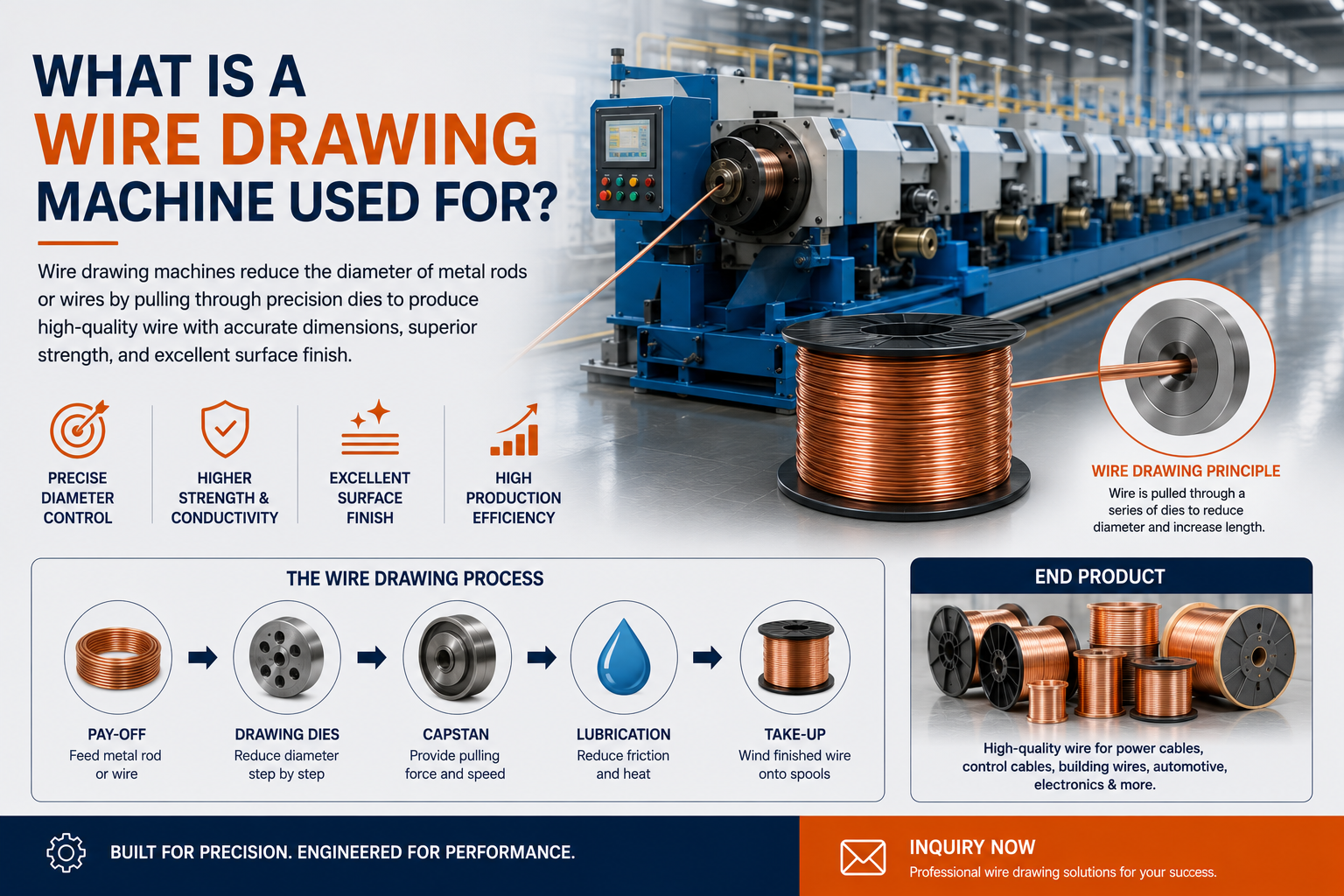
In the wire and cable industry, consistent diameter, high tensile strength, excellent surface finish, and reliable electrical performance are non-negotiable. A machine à tréfiler is the foundational equipment that transforms hot-rolled metal rods or thick wires into precise, high-quality fine wires used in power cables, control cables, building wires, automotive harnesses, and specialty conductors.

Whether you are producing copper or aluminum conductors for infrastructure projects, data centers, or renewable energy installations, understanding wire drawing technology helps ensure product quality, production efficiency, and long-term operational reliability.

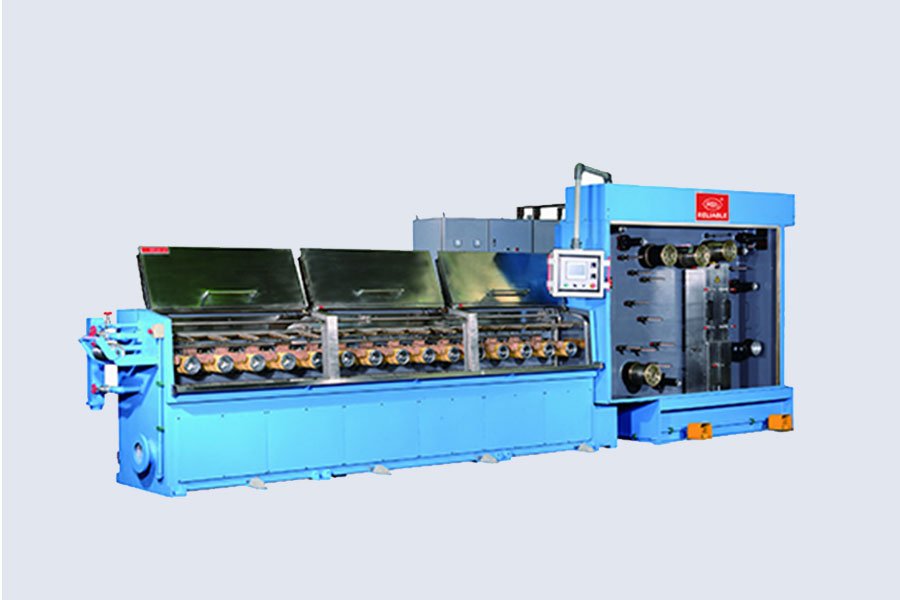
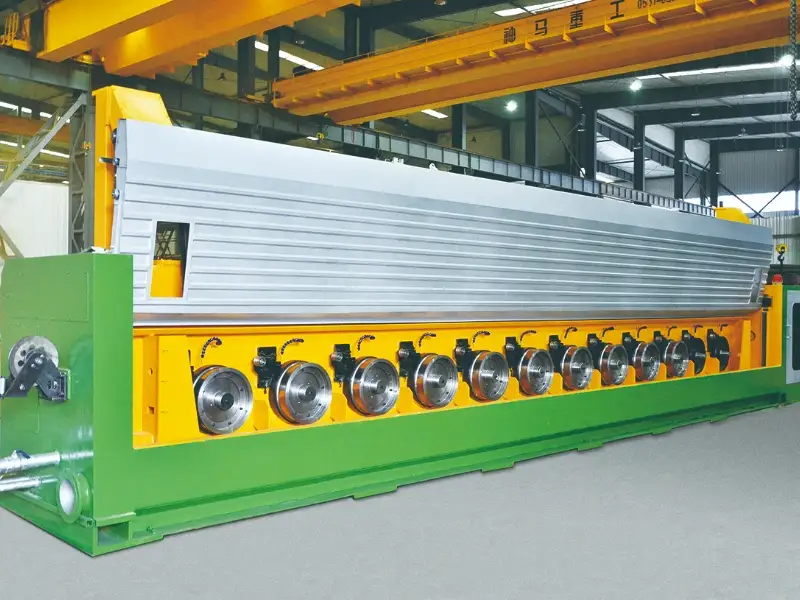
Typical high-performance multi-head wire drawing and continuous annealing line used in modern cable plants (example from reliable industrial supplier).

What is a Wire Drawing Machine?

A wire drawing machine is an industrial apparatus used in metalworking and manufacturing to reduce the cross-sectional diameter of metal rods or thick wires by pulling them through a series of progressively smaller calibrated dies. This simultaneously increases their length, tensile strength (through cold working/strain hardening), and surface smoothness.

The process maintains constant volume: A1L1=A2L2

where A is cross-sectional area and L is length. As diameter decreases, length increases proportionally.

Typical area reduction per pass ranges from 15–25% for fine wires and up to 20–45% for larger diameters. Excessive reduction (>50% total without annealing) requires intermediate annealing to restore ductility.

Dies are made from ultra-hard materials such as tungsten carbide (standard for most industrial applications) or diamond (for ultra-fine wires). Proper lubrication and cooling are critical to minimize friction, heat generation (often 150–400°C), die wear, and surface defects.

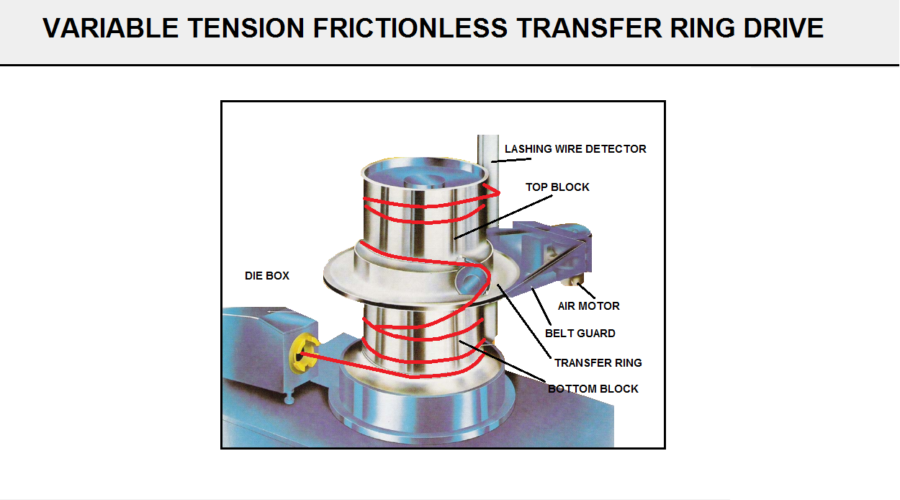
Process schematic illustrating capstan, die box, and wire path in a professional wire drawing setup.

How Does a Wire Drawing Machine Work? (Step-by-Step)

  1. Pay-off / Supply Unit — Feeds the cleaned and descaled metal coil or rod into the system at controlled tension.
  2. Drawing Dies — The wire is pulled through a series of dies with progressively smaller calibrated holes. Each die reduces diameter while work-hardening the material.
  3. Capstans / Drawing Blocks — Motorized rotating drums grip the wire and provide the pulling force. In continuous machines, multiple blocks operate at increasing speeds to accommodate the lengthening wire.
  4. Lubrication & Cooling System — Wet drawing (emulsions or soap solutions) or dry drawing (powder lubricants) reduces friction and heat. Advanced systems use high-pressure lubrication and water-cooled dies.
  5. Take-up Unit — Winds the finished precise wire onto spools or coils, often with automatic tension control and layering for uniform winding.

Modern lines integrate PLC control, servo drives, and zero-slip capstan technology for stable tension and minimal surface damage — essential for high-conductivity copper used in power cables.

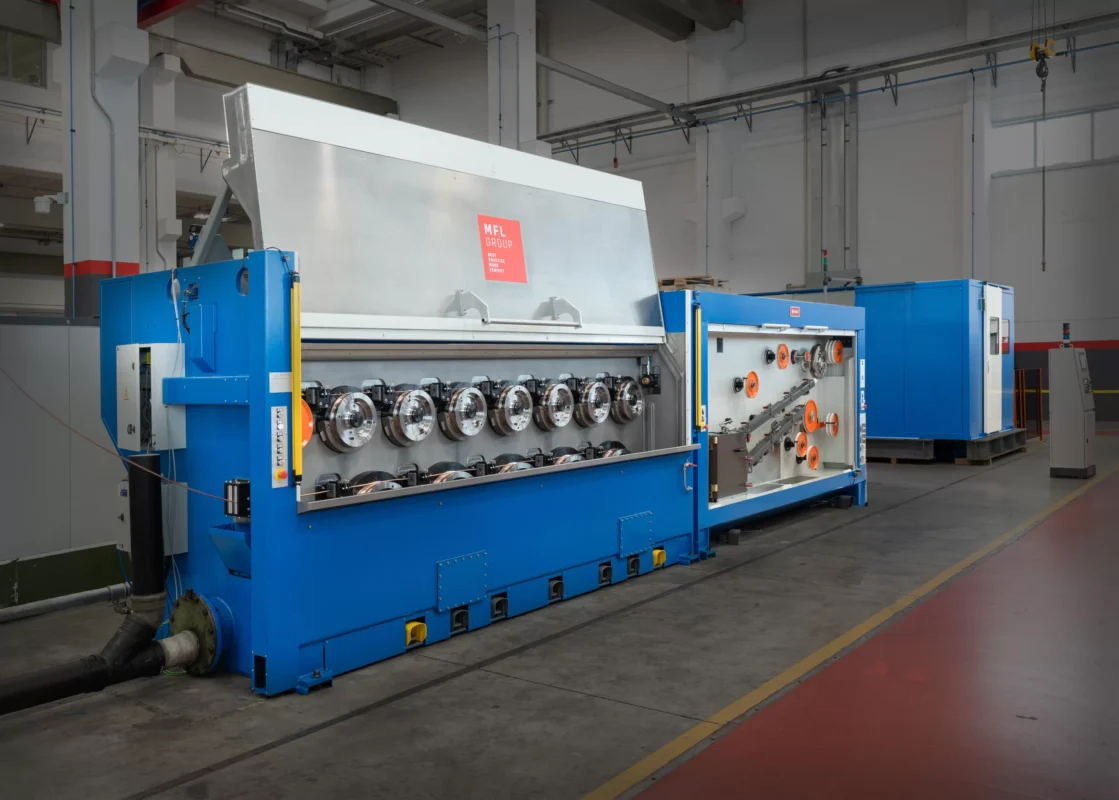
High-speed rod breakdown line — the first critical stage in copper/aluminum wire production for cable manufacturing.

Key Applications in the Cable & Wire Industry

  • Electrical & Power Cables: Drawing copper and aluminum into conductors for low-, medium-, and high-voltage cables, building wires, and magnet wire.
  • Câbles de commande et d'instrumentation: Fine, uniform wires with tight tolerances for signal integrity.
  • Automotive & Mechanical: High-strength spring wire, wire ropes, and spokes.
  • Construction et infrastructures: Low-carbon steel wire for nails, welded mesh, and reinforcement (often integrated with cable plant hardware lines).
  • Specialty: OPGW optical ground wires, ACSR/AW conductors, galvanized steel wire, and enameled wire.

In cable production, wire drawing is typically followed by continuous annealing (to restore conductivity and ductility) before stranding and extrusion.

Types of Wire Drawing Machines for Cable Production

TaperIdéal pourTypical Inlet/OutletKey FeaturesIdeal Production Scale
Rod Breakdown MachineCoarse copper/aluminum rod8–12 mm → 1–3 mmHigh power, robust capstansHigh-volume cable plants
Multi-Head / ContinuousIntermediate to fine wire2.5–3.5 mm → 0.3–1.5 mmMultiple wires simultaneously, annealing integrationMedium to large plants
Fine Wire Drawing (Wet)Ultra-fine, high-surface quality<1 mm → 0.05–0.3 mmExcellent cooling & lubricationMagnet wire, fine conductors
Straight-Line / DryLarger diameters, steel wireVariousHigh speed, robust for heavy reductionNail wire, mesh, hardware

Wet drawing excels for copper and fine wires (better finish, cooling). Dry drawing suits larger steel wires.

Technical Benefits & Quality Advantages

  • Enhanced Mechanical Properties: Cold working significantly increases tensile strength and hardness.
  • Superior Surface Finish: Reduces friction in subsequent stranding and extrusion processes.
  • Precise Dimensional Control: Tolerances critical for consistent stranding and meeting IEC 60228, ASTM, and BS standards.
  • Improved Conductivity: Proper drawing + annealing achieves >99% IACS for copper conductors.
  • Material Efficiency: Near-net-shape processing with minimal waste.

Wire Drawing Machine Price Considerations (2026)

Prices vary significantly based on capacity, automation, number of passes, wire material, and brand origin:

  • Basic fine wire or small single-block machines: approx. $5,000 – $25,000
  • Industrial rod breakdown or multi-head continuous lines: $80,000 – $300,000+ (common range for capable Chinese/European-spec equipment)
  • Full custom cable production lines (drawing + annealing + take-up): Quoted per project, often starting from $150,000+

Key price factors:

  • Inlet/outlet diameter range and reduction schedule
  • Production speed (m/min) and annual throughput (tons)
  • Automation level (PLC, HMI, auto die changing, tension control)
  • Lubrication/cooling system sophistication
  • After-sales support, spare parts availability, and integration capability

For most cable manufacturers targeting global/Middle East infrastructure projects, custom-configured, reliable equipment with strong technical support delivers the best long-term ROI through reduced downtime and consistent wire quality.

Why Choose a Reliable, Experienced Supplier?

Selecting the right wire drawing equipment is a strategic decision that impacts your entire cable production line. Partnering with a technically driven supplier ensures:

  • Machines engineered for qualité fiable and long service life
  • Customized solutions tailored to your specific conductor sizes, materials (copper/aluminum), and standards
  • Seamless integration with downstream processes (annealing, stranding, extrusion)
  • Comprehensive technical support, training, and spare parts availability
  • Focus on long-term cooperation and measurable production improvements

Whether you are expanding capacity for NEOM, Aramco-related projects, data center cabling, or renewable energy conductors, professional-grade wire drawing technology is essential.

Frequently Asked Questions (FAQ)

What materials can be processed?

Primarily ductile metals: copper, aluminum, low/medium/high-carbon steel, stainless steel, and some alloys. Copper and aluminum are dominant in cable production.

How many drawing passes are typically required?

Depends on total reduction. Rod breakdown may use 7–13 passes; fine wire drawing can involve 20+ passes. Intermediate annealing is applied when needed.

Wet vs dry drawing — which is better for cables?

Wet drawing is preferred for copper and fine wires due to superior cooling, lubrication, and surface quality. Dry drawing suits larger steel wires.

What causes wire breakage and how to prevent it?

Common causes: excessive reduction ratio, poor lubrication, worn dies, unstable tension, or material defects. Prevention: proper process design, quality lubricants, regular maintenance, and precise tension control.

What is the typical maintenance requirement?

Regular die inspection/replacement, lubricant management, capstan cleaning, and electrical/mechanical checks. Well-designed machines from experienced suppliers minimize downtime.

Conclusion & Call to Action

A wire drawing machine is far more than simple diameter reduction equipment — it is a precision engineering solution that directly determines the quality, performance, and reliability of the cables you produce. From rod breakdown to fine wire drawing with integrated annealing, choosing the right technology and supplier partnership is critical for competitive, high-quality cable manufacturing.

For reliable, technically advanced wire drawing solutions tailored to your cable production requirements — including custom rod breakdown lines, multi-head drawing & annealing systems, and full process integration — Inquiry Now.

Our team of experienced engineers is ready to discuss your specific inlet/outlet diameters, throughput targets, material specifications, and project timeline. Let us help you build a more efficient, reliable, and future-ready wire production capability.

Demande d'informations | Contact our cable equipment specialists for a detailed technical proposal and quotation.

Laisser un commentaire

Votre adresse e-mail ne sera pas publiée. Les champs obligatoires sont indiqués avec *