Uncategorized

What Is a Rigid Stranding Machine Used For?

What Is a Rigid Stranding Machine Used For

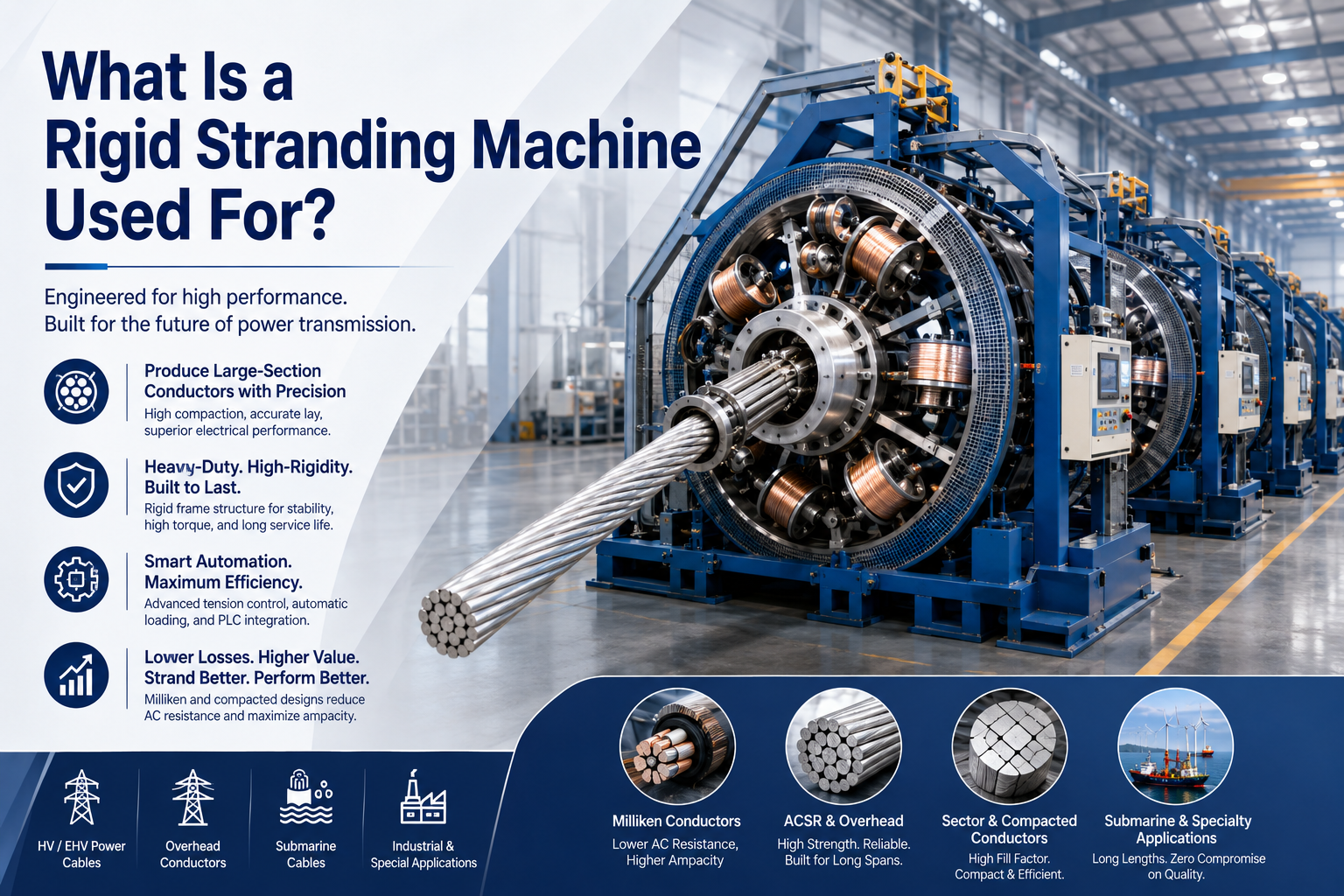
Rigid stranding machines are the backbone of modern high-voltage cable and overhead conductor production. These heavy-duty industrial systems twist multiple copper, aluminum, or steel wires into large cross-section stranded conductors with exceptional structural integrity, geometric precision, and electrical performance.

In an era of expanding power grids, renewable energy integration, data center growth, and massive infrastructure projects (such as those driven by Saudi Vision 2030 and global HVDC/AC transmission upgrades), the demand for reliable large-section conductors has never been higher. A well-engineered rigid frame strander (also known as rigid cage strander) delivers the rigidity, torque capacity, and process control required to produce compacted round, sector-shaped, and Milliken conductors that meet stringent international standards while maximizing production efficiency and long-term cable reliability.

This comprehensive guide explains exactly what a rigid stranding machine is used for, how it works, its key technical features, real-world applications, and why choosing the right equipment partner is critical for manufacturers and EPC contractors alike.

Why Rigid Stranding Technology Matters in Today’s Cable Industry

Large-section conductors (typically above 500–1000 mm² and up to several thousand mm²) generate significant torsional forces and centrifugal loads during stranding. Only a rigid frame design can maintain stability at high rotational speeds while preserving precise lay geometry and enabling high compaction ratios.

Tubular stranders, while excellent for smaller flexible conductors, lack the structural rigidity needed for these demanding applications. Planetary or back-twist machines offer greater flexibility but cannot match the compaction quality or production economics of rigid stranders for HV power cables and overhead lines.

The result? Rigid stranding machines enable:

  • Higher fill factors and lower AC resistance (especially with Milliken construction)
  • Reduced material usage and smaller overall cable diameters
  • Improved mechanical strength and fatigue performance
  • Consistent quality across long production lengths — essential for submarine cables, underground HV lines, and long-span overhead conductors

How a Rigid Stranding Machine Works: Engineering Fundamentals

A rigid stranding machine operates on a non-backtwist principle using one or more precision-engineered rotating cages mounted on a robust central shaft and frame.

Each cage carries multiple pay-off bobbins (commonly PND 630 mm, 710 mm, or 800 mm). As the rigid cage rotates at controlled high speed, individual wires are paid off under precisely regulated tension. The linear forward movement of the central core (or previous layer) combined with the cage’s rotation creates a helical lay.

Key engineering aspects include:

  • Lay Length (Pitch) Control: Stepless adjustment via PLC and HMI (typically 40–500 mm range). Precise control directly influences conductor flexibility, compaction, and electrical characteristics.
  • Tension Management: Advanced pneumatic, hysteresis, or servo-braking systems maintain constant tension from full to empty bobbin. This prevents loose strands, bird-caging, or uneven compaction that would compromise dielectric performance or mechanical integrity.
  • Compaction and Pre-Spiraling: Motorized compaction heads and pre-formers shape wires into round compacted or sector/Milliken profiles. High compaction reduces voids, improves current distribution, and enhances surface smoothness for better insulation adhesion.
  • Synchronization: Individual AC motor drives (often Siemens) per cage, coordinated with dual-capstan hauling units (up to 15 tonnes pull force), ensure perfect synchronization and minimal vibration even at high speeds.

The finished conductor is then taken up on large drums, ready for insulation, screening, or armoring stages in the cable production line.

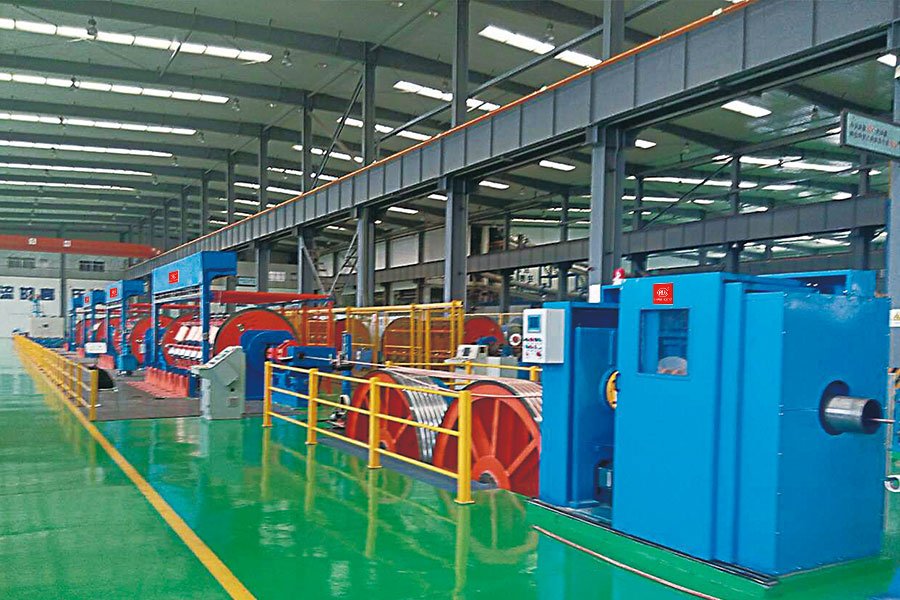
Typical rigid cage stranding line showing multiple high-capacity cages with automated features.

Core Components and Advanced Technical Features

Modern rigid stranding machines combine mechanical robustness with sophisticated automation:

1. High-Rigidity Frame Construction

Integrally welded and precision-bored steel frames resist deformation under high torque and speed. This is fundamental for maintaining conductor roundness and lay consistency on large sections.

2. Independent Drive & Control Systems

Each cage uses its own AC motor with inverter control. This enables independent speed adjustment, recipe storage for different products, and rapid changeovers. PLC-based systems (Siemens or equivalent) provide infinite pitch adjustment, synchronization, fault diagnostics, and integration with plant MES/ERP systems.

3. Intelligent Tension Control

Closed-loop tension systems with individual bobbin monitoring dramatically reduce wire breakage and ensure uniform strand tension — directly translating to lower scrap rates and higher first-pass yield.

4. Automated Bobbin Loading & Unloading

Hydraulic or pneumatic side-loading, bottom-loading, or 45°/90° lumped loading systems can reduce bobbin change time by 70–80% compared to manual methods. Safety interlocks, mechanical locking, and limit switches protect both operators and equipment.

5. Compaction & Sector Forming Units

Motorized rotating compact heads with servo control deliver consistent compaction ratios. Pre-spiraling units are essential for high-quality Milliken and sector conductors.

6. Safety & Monitoring

Fully enclosed motor-driven safety covers, automatic emergency stops on wire break, online diameter measurement, length counters, and vibration monitoring ensure safe, reliable 24/7 operation.

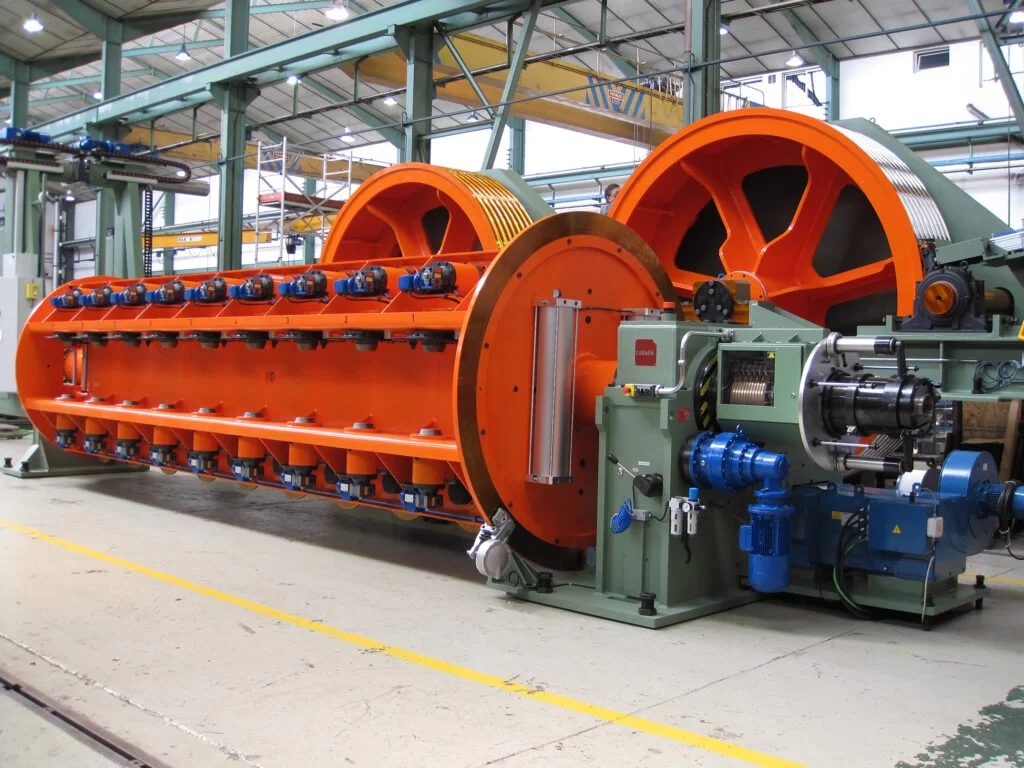
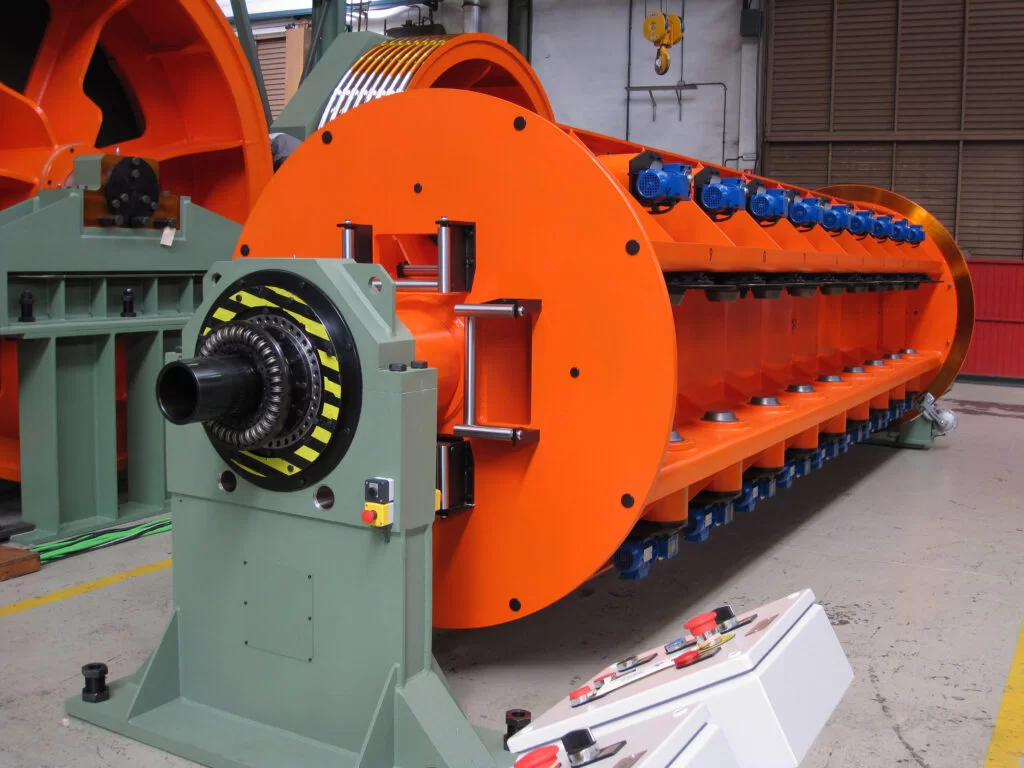
Close-up of rigid cage with bobbins and compaction area — the heart of precision stranding.

Technical Specifications (Typical & Customizable)

ParameterTypical Specification (JLK-630 / 710 Class)Notes / Customization Potential
Single Wire DiameterCu: 1.2–5.0 mm; Al/Alloy: 1.8–5.0 mmTailored to final conductor design
Bobbin Size (Cage)Φ500 / Φ630 / Φ710 / Φ800 mmLarger bobbins for longer production runs
Cage Configurations6B, 12B, 18B, 24B, 30B, 36B per cageMulti-cage lines: 1+6+12+18+24+30 or custom
Max Rotating Speed200–500 rpm (model & cage size dependent)Higher speeds on smaller/lighter cages
Lay LengthStepless 40–500 mm (or wider on request)Recipe-based for different products
Max Line Speed80–150 m/minDependent on conductor size and compaction
Max Conductor ODUp to Φ55 mm+ (custom higher)Designed around target cross-section
Haul ForceUp to 15 tonnesDual-wheel capstan systems
Tension ControlPneumatic / Hysteresis / Intelligent servoClosed-loop with individual bobbin monitoring
Drive SystemIndependent AC motor per cage + dual capstanSiemens/Schneider components standard
Loading SystemAutomatic hydraulic side or bottom loadingDramatically reduces downtime
ControlSiemens PLC + HMI touchscreenFull recipe management & remote diagnostics

All parameters are engineered to your specific production requirements, wire materials, and target conductor designs.

Primary Applications

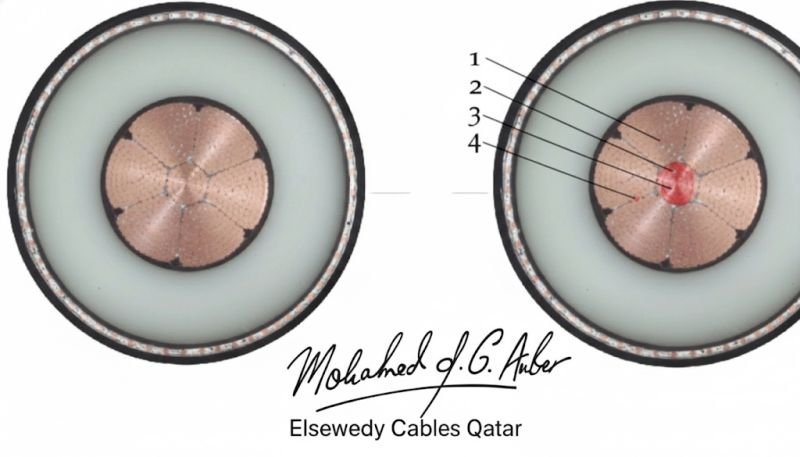
HV/EHV Power Cable Conductors & Milliken Cores Rigid stranders are the preferred equipment for producing phase conductors in 66 kV to 500 kV+ XLPE and submarine cables. Milliken (segmented) construction equalizes current distribution across the conductor cross-section, significantly reducing skin and proximity effects. This lowers AC resistance, reduces I²R losses, and allows higher ampacity or smaller cable diameters — critical advantages in congested urban circuits, offshore wind export cables, and long-distance transmission.

Milliken conductor cross-section — segmented design produced on rigid stranding lines with pre-spiraling technology.

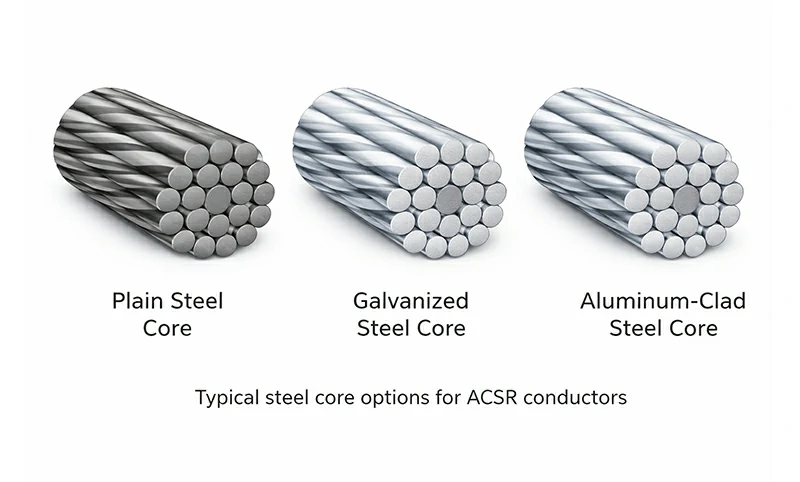
Overhead Transmission & Distribution Conductors Ideal for ACSR (Aluminum Conductor Steel Reinforced), AAAC, ACAR, ACCC, and ACSS conductors. The rigid design handles steel core layering with aluminum strands while achieving excellent compaction and surface quality required for long-span, high-tension applications.

Typical ACSR conductor constructions — rigid stranders excel at precise multi-layer stranding over steel cores.

Sector-Shaped and Compacted Round Conductors Used extensively in medium-voltage distribution cables where compact design and high fill factor improve overall cable performance and installation economics.

Submarine Power Cables & Special Applications High-capacity rigid lines support the long continuous lengths and stringent quality requirements of submarine projects.

Rigid vs. Alternative Stranding Technologies

CriteriaRigid Frame StranderTubular StranderPlanetary / Double-Twist
Max Practical Conductor SizeExcellent (large sections)LimitedMedium
Compaction & Shape RetentionExcellentGoodLimited
Production Speed (large size)HighMediumLower
Milliken / Sector CapabilityExcellentLimitedLimited
Flexibility of Final ProductLower (rigid focus)HigherHighest
Downtime (bobbin changes)Very Low (auto loading)HigherMedium
Best Suited ForHV power, overhead, MillikenSmaller flexible conductorsHighly flexible Class 5

Operational Benefits and Business Value

  • Higher Productivity: Automated loading systems and high line speeds reduce cost per meter produced.
  • Superior Quality & Yield: Consistent geometry, lower scrap, and higher first-pass acceptance rates on critical HV projects.
  • Long-Term Reliability: Robust construction designed for decades of service with proper maintenance.
  • Process Flexibility: Quick product changeovers via recipe management support both high-volume standard conductors and specialized custom orders.
  • Reduced Total Cost of Ownership: Lower energy consumption per ton with modern drives, reduced labor, and minimized unplanned downtime.

Why Choose a Proven Cable Equipment Partner

Selecting the right rigid stranding machine is not just about hardware — it is about securing a reliable technical solution that integrates seamlessly into your production environment and delivers measurable ROI over many years.

We bring extensive experience in wire and cable machinery, including close technical collaboration with leading manufacturers. Our approach emphasizes:

  • Customized engineering based on your exact wire specifications, conductor designs, and production targets
  • Robust, reliable quality built for demanding industrial environments
  • Comprehensive support — from initial consultation and line layout design through manufacturing, installation, commissioning, operator training, and long-term after-sales service (spares, upgrades, and process optimization)

Whether you are expanding capacity for HV power cables, modernizing overhead conductor production, or entering new markets for large-section Milliken conductors, we deliver tailored solutions focused on long-term partnership and operational excellence.

Inquiry Now to discuss your specific requirements. Our technical team will provide a detailed proposal including recommended configuration, layout options, performance data, and integration considerations.

Frequently Asked Questions

What conductor cross-sections are best suited to rigid stranding machines?

Rigid stranders excel with medium to very large sections (typically from several hundred mm² up to several thousand mm²), especially where high compaction or Milliken construction is required.

How does Milliken construction improve cable performance?

By segmenting the conductor, Milliken design reduces skin and proximity effects, lowering AC resistance and allowing higher current carrying capacity or reduced cable size for the same rating.

What automation level is recommended?

For most modern HV cable plants, automatic hydraulic bobbin loading combined with PLC recipe management and individual tension control offers the best balance of productivity, quality, and operator safety.

Can one machine produce both round compacted and sector/Milliken conductors?

Yes. With interchangeable or adjustable compaction and pre-spiraling tooling, most rigid lines offer excellent flexibility across multiple conductor types.

What standards do these machines support?

Properly specified rigid stranding equipment produces conductors compliant with IEC 60228, ASTM B231/B232/B399, BS, DIN, and customer-specific specifications.

How important is tension control?

Critical. Inconsistent tension leads to uneven lay, poor compaction, increased breakage, and ultimately lower electrical and mechanical performance of the finished cable.

What maintenance is typically required?

Regular inspection of bearings, drives, tension systems, and safety devices. Modern machines with quality components and predictive monitoring capabilities achieve very high uptime when properly maintained.

What is the typical service life?

Well-built rigid stranding lines from reputable suppliers routinely deliver 15–25+ years of reliable service with appropriate maintenance and occasional upgrades.

Conclusion

Rigid stranding machines are not commodity equipment — they are precision industrial systems that directly impact the quality, cost, and reliability of the power cables and overhead conductors your customers depend on.

By combining robust mechanical design, advanced automation, and deep process knowledge, these machines enable manufacturers to meet the growing technical demands of modern power infrastructure while maintaining competitive production economics.

Ready to optimize or expand your large-section conductor production capabilities?

Inquiry Now — Contact our experienced cable equipment specialists today. We are committed to delivering reliable quality, customized technical solutions, and long-term partnership value.

Leave a Reply

Your email address will not be published. Required fields are marked *