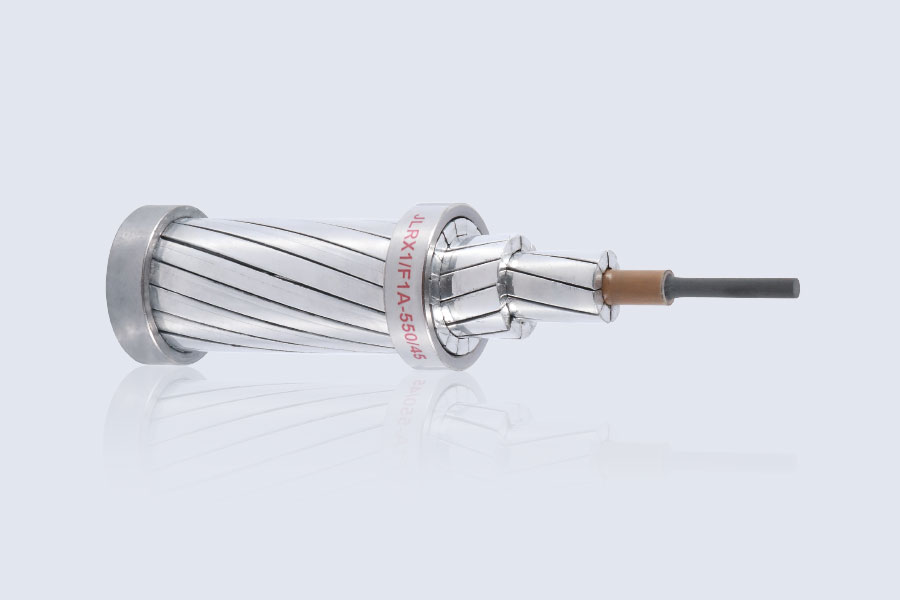
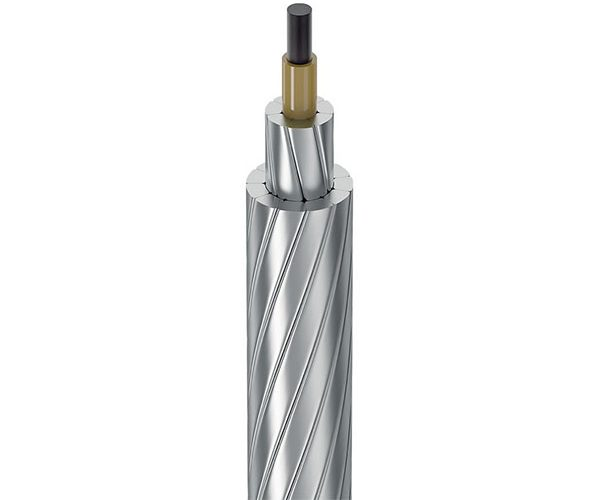
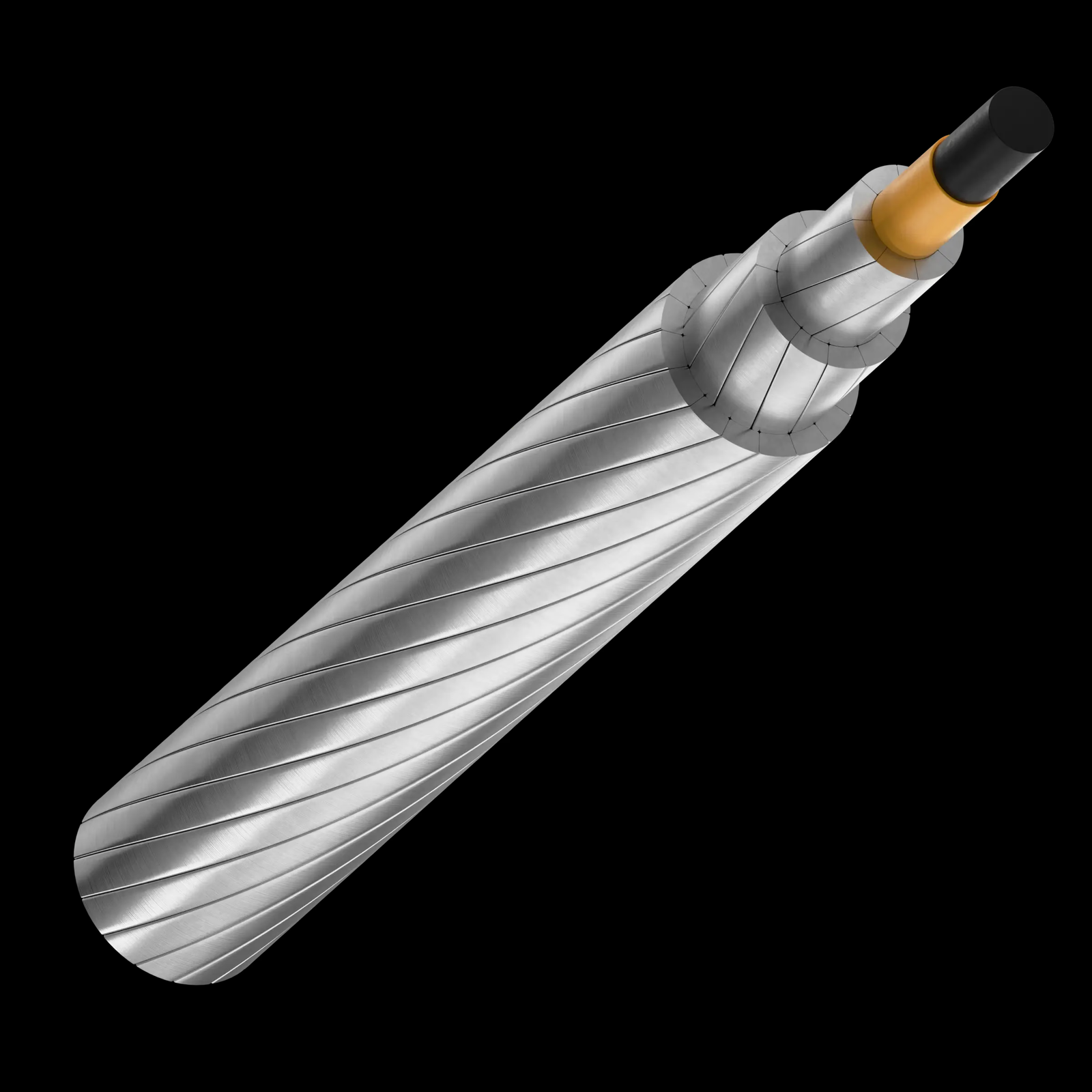
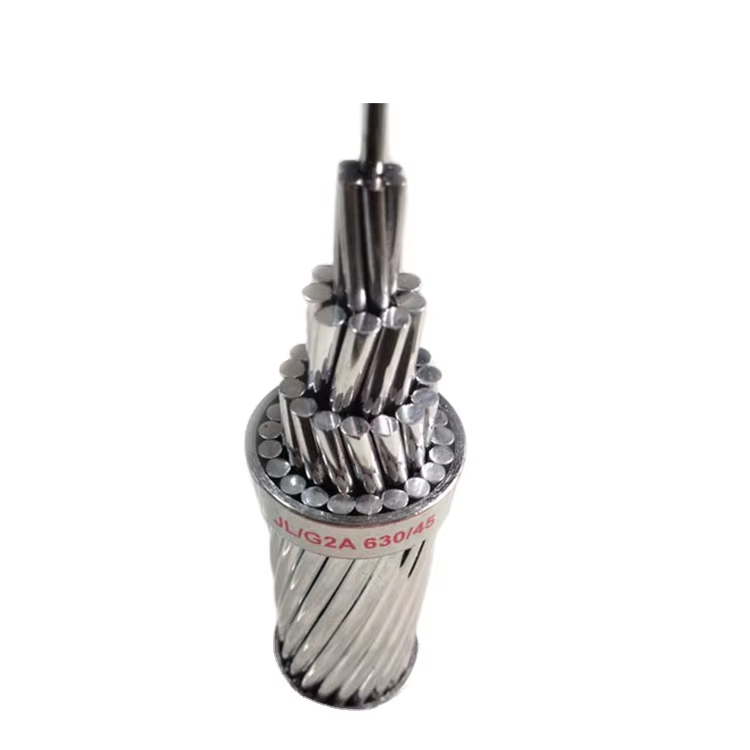
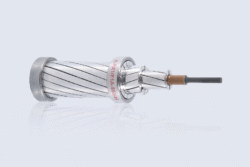
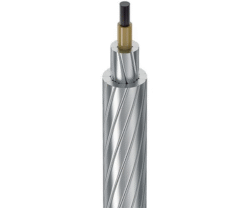
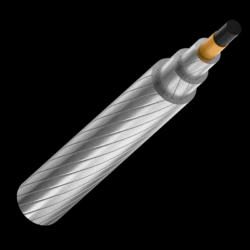
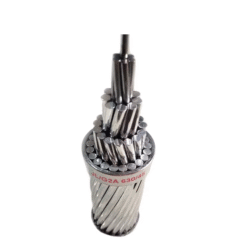
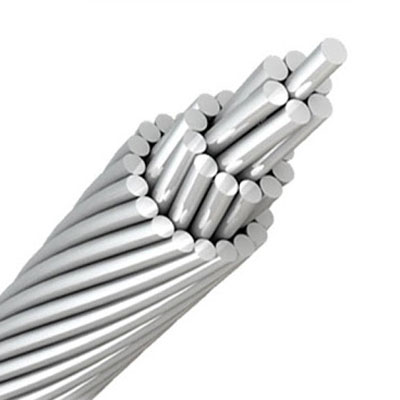
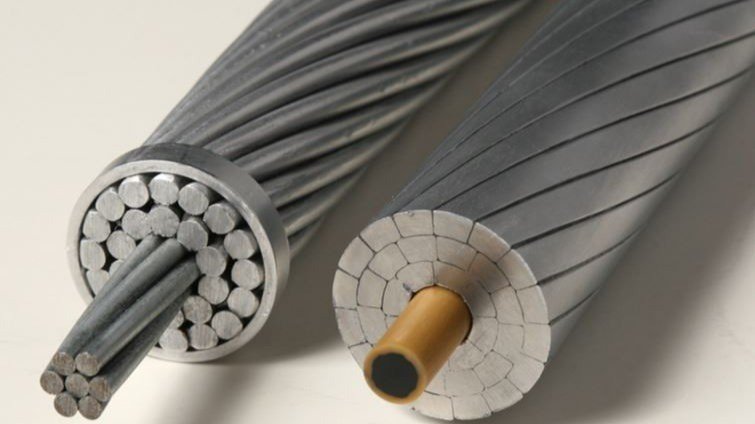
Noyau composite conducteur en aluminium (ACCC) Il s'agit d'un conducteur de transport d'énergie aérien haute température à faible flèche (HTLS) de nouvelle génération. Il est constitué d'une âme composite en fibre de carbone haute résistance, protégée par une gaine en fibre de verre et enroulée en hélice avec des brins d'aluminium trapézoïdaux ou ronds de haute pureté. Cette conception innovante offre une ampacité nettement supérieure, une flèche réduite, des pertes en ligne diminuées et une résistance à la corrosion exceptionnelle par rapport aux conducteurs ACSR ou AAC traditionnels, ce qui en fait la solution idéale pour les mises à niveau de capacité et les nouveaux projets de transport d'énergie à haute tension.

Construction and Material Properties
The structural core is a single hybrid rod of unidirectional carbon fibers surrounded by a protective glass-fiber shell, both embedded in a high-temperature thermoset epoxy matrix. Typical core properties (ASTM B987):
- Density: ~1.9 g/cm³ (versus ~7.8 g/cm³ for steel)
- Tensile strength: 2 158–2 585 MPa (standard 310 ksi; ULS variant 375 ksi)
- Modulus of elasticity: 112–147 GPa
- Coefficient of thermal expansion: ~1.6 × 10⁻⁶ /°C
Outer layers consist of fully annealed 1350-O temper aluminum wires formed into trapezoidal (TW) cross-sections and concentrically stranded. The compact packing raises aluminum cross-section by ~27–30 % compared with round-wire ACSR of identical outer diameter and approximate weight. Conductivity reaches ≥61.8–63 % IACS. The non-metallic core eliminates magnetic hysteresis losses and galvanic corrosion between core and aluminum.
Performance Comparison: ACCC vs ACSR vs ACSS
Laboratory and field data (including 2025 comparative testing of ACCC, ACSS and ACSR under CIGRE and IEC protocols) confirm ACCC superiority in sag-tension-temperature stability, creep resistance and long-term cost.
| Paramètre | ACSR (typical Drake equivalent) | ACSS (annealed Al / steel) | ACCC (composite core) |
|---|
| Core material | Galvanized or Al-clad steel | High-strength steel | Carbon/glass fiber epoxy |
| Continuous operating temperature | 75–90 °C | up to 200–250 °C | 180 °C (200 °C emergency) |
| Aluminum content (same diameter) | Baseline | Similar or slightly higher | +27–30 % |
| Ampacity (same diameter) | 1.0× | 1.6–2.0× | ~2.0× |
| Thermal sag at high load | High (steel CTE dominant after knee point) | Moderate–high | Lowest (core CTE ~1/10 of steel) |
| 10-year creep strain (core) | ~0.047 % | 0.041–0.060 % | ~0.035 % |
| Tension loss at max temperature | ~74 % | 58–60 % | ~50 % |
| Corrosion risk | High (steel) | High (steel) | None (non-metallic core) |
| Line-loss reduction vs ACSR | Baseline | Modéré | 25–40 % |
Real-world deployments show that reconductoring an existing line with ACCC can more than double transfer capacity without tower replacement or right-of-way expansion. Thirty-year total-cost analyses position ACCC as the lowest lifecycle option when loss savings, avoided structure work and reduced maintenance are included.
What is Aluminum Conductor Composite Core (ACCC)?
ACCC is a High-Temperature Low-Sag (HTLS) overhead conductor that replaces the traditional steel core with a lightweight, high-tensile carbon fiber composite core. The core is encapsulated in a fiberglass/epoxy sheath for added protection and is surrounded by trapezoidal or round strands of fully annealed, high-purity aluminum (up to 62.5% IACS conductivity).
This design allows continuous operation at 180–200°C with minimal thermal expansion, enabling utilities to double power transfer capacity on existing rights-of-way without major tower modifications.
Principaux avantages techniques
- Higher Capacity: Same overall diameter as conventional ACSR delivers roughly double the continuous current rating. Ideal for reconductoring existing corridors without tower reinforcement or new rights-of-way.
- Low Thermal Expansion & Sag Control: Composite core CTE ≈1.6 × 10⁻⁶/°C (≈10× lower than steel). Thermal sag remains minimal even at 180°C, preserving ground clearances and reducing outage risk.
- Reduced Line Losses & Efficiency: Extra aluminum + elimination of magnetic hysteresis losses (common in steel-core designs) cuts I²R losses 25–40% under equal load conditions. Verified CO₂ emission reductions of 27–31% versus ACSR in certified studies.
- Strength-to-Weight Ratio: Core is ~70% lighter and up to 50% stronger than steel equivalents (tensile strength typically 2,150–2,585 MPa). Supports longer spans, fewer/shorter structures, and lower foundation loads.
- Corrosion & Durability: Non-metallic core eliminates galvanic corrosion and steel-related degradation. Excellent resistance to cyclic fatigue, UV, and environmental stressors. Projected long service life with minimal maintenance.
- Installation Compatibility: Uses largely conventional tools and methods with specialized hardware (dead-ends, splices). Optional variants include ULS (ultra-low-sag) cores, AZR (aluminum-zirconium alloy strands for extreme ice/wind), and monitoring-enabled cores.
Principales applications
ACCC conductors are the preferred choice for:
- Augmentation de la capacité des lignes de transport existantes sans modification des pylônes
- Nouvelles lignes aériennes à haute tension de grande portée
- Régions côtières et à forte corrosion
- Heavy ice/wind load areas and major river crossings
- Smart grid modernization and renewable energy integration projects
Spécifications techniques (Tailles internationales représentatives)
| Nom du chef d'orchestre | Taille (kcmil) | Surface (mm²) | Diamètre du conducteur (mm) | Diamètre du noyau (mm) | Poids (kg/km) | Résistance nominale (kN) | Résistance CC (Ω/km) | Ampérage admissible 180 °C | Ampérage admissible 200 °C |
|---|
| Copenhague | 434 | 219.9 | 18.29 | 5.97 | 661 | 60.4 | 0.2094 | 1,017 | 1,070 |
| Lisbonne | 623 | 315.5 | 21.79 | 7.11 | 948 | 85.7 | 0.1460 | 1,284 | 1,353 |
| Bruxelles | 832 | 421.4 | 25.15 | 8.13 | 1,265 | 112.0 | 0.1097 | 1,549 | 1,632 |
| Hambourg | 1,078 | 546.4 | 28.63 | 8.76 | 1,627 | 130.2 | 0.0846 | 1,834 | 1,935 |
| Athènes | 2,782 | 1,409.6 | 44.75 | 10.54 | 4,066 | 188.3 | 0.0328 | 3,335 | 3,538 |
Ampacity values based on standard conditions (50 Hz, 25°C ambient, 0.5 solar absorptivity/emissivity, 0.61 m/s wind). Custom sizes and configurations available upon request.
Paramètres techniques typiques
| Propriété | Value |
|---|
| Nominal aluminum area | ~520 mm² (1026 kcmil class) |
| Overall diameter | ~28.1 mm |
| Mass | ~1 560–1 565 kg/km |
| Rated breaking strength | ~183–212 kN (standard / ULS) |
| DC resistance at 20 °C | ~0.0536–0.088 Ω/km (depending on exact size) |
| Continuous ampacity (IEEE 738 conditions, 180 °C) | ~1 780–1 880 A |
| Emergency ampacity (200 °C) | ~1 880–1 995 A |
| CTE (composite core) | ~1.6 × 10⁻⁶ /°C |
| Core tensile strength | 2 158–2 585 MPa |
Values vary by exact code word (Drake, Lisbon, Hamburg, Galveston, etc.) and core grade (standard or ULS). Manufacturers supply full sag-tension tables and PLS-CADD models for project-specific calculation.
Selection Logic and Application Guidelines
Specify ACCC when any of the following apply:
- Existing line is thermally limited by sag or clearance rather than structure strength.
- New line design prioritizes longer spans, fewer towers or lower capital cost.
- High renewable penetration or load growth requires rapid capacity uplift without multi-year permitting.
- Corrosive environments (coastal, industrial, agricultural fertilizer exposure) where steel-core longevity is compromised.
- Projects targeting measurable reduction in I²R losses and associated CO₂ emissions (SCS-verified 27–31 % reduction under defined conditions).
Variants:
- Standard ACCC: fully annealed 1350-O aluminum for maximum conductivity and efficiency.
- ACCC AZR: aluminum-zirconium alloy outer strands for higher overall tensile strength and extreme ice/wind loading.
- ACCC ULS: higher-modulus, higher-strength core (375 ksi) for the longest spans or heaviest mechanical loads.
Installation follows IEEE 524 practices with specialized hardware (dead-ends, splices and suspension clamps rated for the composite core). Pre-tensioning and controlled stringing tensions are critical to seat the aluminum strands properly and achieve the designed knee-point behavior. The ACCC InfoCore system (embedded optical fibers) allows post-installation integrity verification of the core.
Standards and Qualification
- Core: ASTM B987 / B987M
- Aluminum wires: ASTM B609 (1350-O) or equivalent
- Overall conductor: manufacturer specifications aligned with IEC 61395 (creep), IEC 61089, CIGRE Technical Brochures, IEEE 738 (ampacity)
- Extensive third-party testing (EPRI, universities, utility laboratories) covers tensile, fatigue, creep, thermal cycling, compression and long-term outdoor exposure.
Practical Considerations and Failure Prevention
The composite core is elastic and recovers fully under cyclic loading; it does not exhibit the plastic yielding or progressive creep of steel. Principal risks arise from improper installation (excessive bending radius, incorrect hardware compression, or uncontrolled tension) rather than material degradation. Manufacturer-trained crews and Master Installer support reduce these risks. Once correctly installed, ACCC has demonstrated multi-decade service with no reported core corrosion or fatigue failures in the global fleet (>1 650 projects, >70 countries, cumulative length exceeding 200 000 km as of 2025–2026 data).
Key Technical Takeaways
ACCC delivers higher ampacity at cooler operating temperatures, lower electrical losses, superior sag control and corrosion immunity compared with both ACSR and ACSS of equivalent diameter. The combination of ~28 % additional aluminum, ultra-low CTE composite core and proven field record makes it the preferred solution for capacity upgrades and new high-efficiency transmission corridors.
For project-specific sizing, sag-tension calculations, hardware compatibility or sample data sheets, contact our engineering team. Demande d'informations






Avis
Il n’y a pas encore d’avis.