Uncategorized

How much does an Aluminum Extrusion Machine cost?

How much does an aluminum extrusion machine cost-doingcable

Aluminum Extrusion for Profiles and Cable Sheath

An aluminum extrusion machine is either a hydraulic press that pushes a heated billet through a die, or a Conform / continuous rotary extruder that converts Ø9.5–15 mm aluminum rod into seamless tube or sheath. Press cost tracks tonnage and origin. Cable-sheath cost tracks wheel diameter, tube OD and whether corrugating + Ø4500 take-up are in the line. Mixing the two in one RFQ produces a number that cannot be commissioned.

2025–2026 equipment bands (FOB, order-of-magnitude)

EquipmentTypical specificationIndicative new price
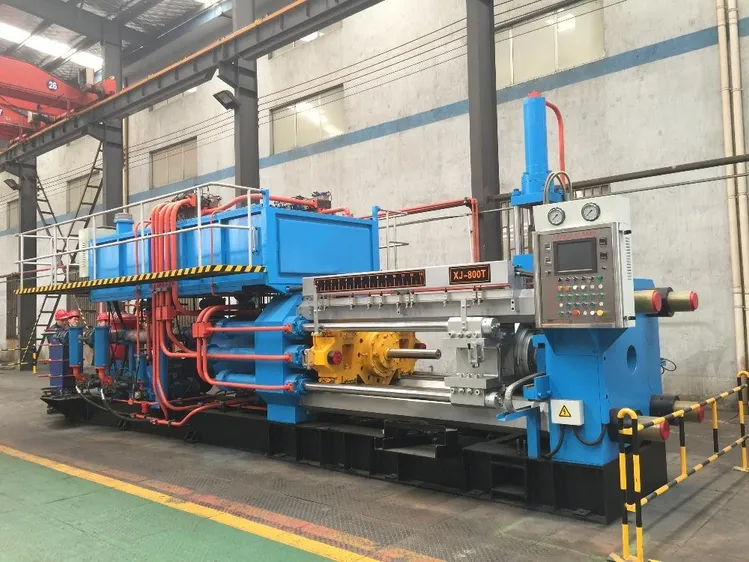
Hydraulic press only, CN 600–800 TØ80–110 mm billetUSD 85,000–160,000
Hydraulic press only, CN 1,000–1,250 TØ120–135 mm billetUSD 150,000–300,000
Hydraulic press only, CN 1,800–2,500 TØ178–228 mm billetUSD 300,000–550,000
Hydraulic press only, CN / EU 3,000–5,500 Tlarge structuralUSD 0.5–2.0 M+ (EU higher)
Full small profile plant 600–1,250 Tpress + furnace + puller + saw + agingUSD 0.5–1.5 M installed
Medium profile plant 1,600–3,500 Tas above, larger civilUSD 1.5–5 M installed
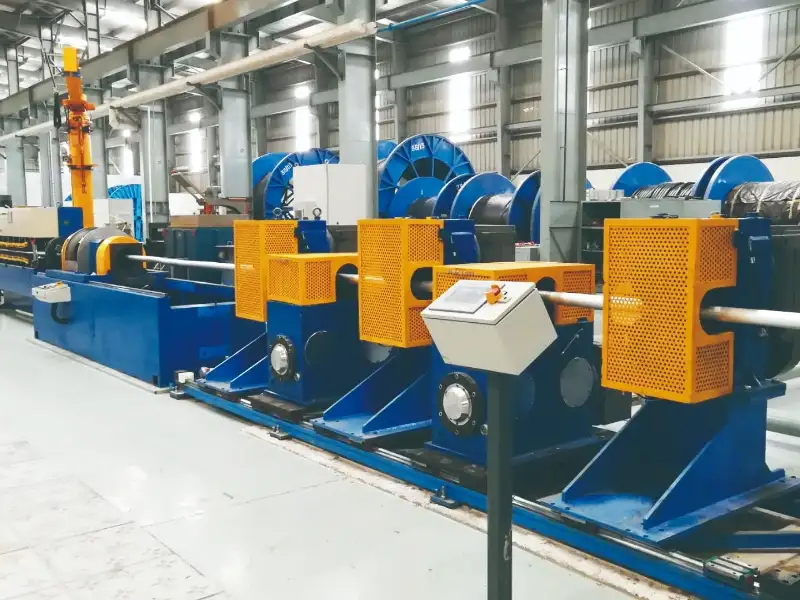
Conform cable Al sheath LBF350–420 classtube Ø60–170 mmquote by wheel + corrugator
Conform HV sheath SSLB / LBF540 classtube to Ø180 mm, 4-rod feedoften USD 0.18–1.8 M by scope

Global press market average in 2025 sat near USD 2.4 million per unit across all tonnages — that average is pulled up by 5,000 T+ European frames and is not the price of a 1,000 T Chinese press.

Send alloy, profile circumscribed circle or sheath OD/wall, annual tonnes, and whether the quote is press-only or turnkey. Inquiry Now

How Much Does an Aluminum Extrusion Machine Cost?

A new aluminum extrusion machine in 2025–2026 costs from about USD 85,000 for a Chinese 600 T press body to USD 1–25 million for a high-tonnage automated European line; a cable aluminum-sheath continuous extruder is a different machine and is priced by wheel size and tube range, commonly from the mid-six figures to about USD 1.6–1.8 million for a full HV sheathing line.

The published “average press” of ~USD 2.4 million in 2025 describes the global mix of ~300 units/year, not the machine a window-profile plant or a 132 kV cable plant should put on a purchase order. Tonnage, origin, auxiliaries and Conform versus billet-press architecture move the number by a factor of ten.

Why do two plants asking for an “aluminum extrusion machine” get quotes that differ by 10×?

They are buying different architectures. A hydraulic press extrudes finite billets into profiles. A Conform continuous extruder plasticizes aluminum rod on a rotating wheel and forms endless tube or sheath — the machine used for corrugated aluminum cable sheath to IEC 60840 / IEC 62067.

Hydraulic presses are specified in tonne-force and billet diameter. 600 T takes ~Ø80–90 × 500 mm; 1,250 T ~Ø130–135 × 800 mm; 2,500 T ~Ø228 × 1,100 mm; 4,000 T ~Ø320 mm class. Extrusion speed on these frames is on the order of 10–15 mm/s ram speed, not line metres per minute of cable. Chinese 600–1,250 T press bodies list in the USD 85,000–300,000 band; 1,800–2,500 T in the USD 300,000–550,000 band on current factory cards. German/Italian equivalents of the same force run 30–50% higher. A 1,250 T Chinese press at USD 180,000–300,000 versus USD 400,000–600,000 for a comparable EU machine is the split procurement sees repeatedly.

Conform cable lines are specified by wheel Ø (350 / 400 / 420 / 540 mm), rod count and diameter (2ר12 or 4ר9.5 / Ø12 / Ø15 mm, GB/T 3954), and tube OD × wall (typically Ø60–180 mm × 1.5–5.0 mm). Corrugation pitch 10–50 mm and depth 2–8 mm sit after the tube die. One published HV sheathing line (SSLB500 class) lists USD 1.65–1.80 million FOB. Smaller cladding/sheath Conform units and used Conform busbar machines sit well below that. Do not compare that number to a 1,000 T window-profile press.

ItemHydraulic profile pressConform cable Al sheath line
FeedstockHeated billet 6063 / 6061 etc.EC / electrical rod Ø9.5–15 mm
ProductFinite bars, tubes, profilesEndless seamless Al tube / sheath
Key sizeTonnage + container ØWheel Ø + tube OD × wall
Typical new CN price600 T ~USD 87–94k; 1,250 T ~USD 160–300k; 2,500 T ~USD 0.5 MLBF / LB / SSLB: mid-six figures to ~USD 1.8 M full HV line
Auxiliaries that dominate costBillet furnace, die oven, puller, stretcher, aging ovenRod clean, corrugator, Ø4500 pay-off/take-up, cooling
Cable relevanceBusbar, tray, enclosureMV/HV/EHV corrugated Al sheath, IEC 60840 / 62067
Weld in productDie seams on hollows; billet jointsNo longitudinal weld if Conform is correct

A cable factory that buys a 1,800 T profile press “to make aluminum sheath” still needs a welder, a corrugator and a 4.5 m drum — and still has a weld. That is the wrong machine.

What does the press or Conform line actually include in a usable price?

The press body is 40–65% of a small plant and much less of a turnkey HV sheath line. Furnace, puller, aging, dies — or rod-clean, corrugator and 4.5 m drums — are what turn a brochure price into a running plant.

Hydraulic line stack (small / medium plant)

BlockSmall plant 600–1,250 TMedium 1,600–3,500 T
PressUSD 150,000–550,000USD 500,000–1,800,000
Billet furnace30,000–120,000higher with log length
Die oven10,000–40,000
Cooling bed + puller25,000–80,000
Stretcher + saw30,000–100,000
Aging oven (T5/T6)20,000–80,000
First die set30,000–80,00080,000–200,000
Land / building / 3-month WCoften USD 160,000–500,000+450,000–1.4 M
Plant total often citedUSD 0.5–1.5 MUSD 1.5–5 M

Energy is 15–25% of later opex; metal is 50–60%. Payback on a utilized press is commonly quoted 3–7 years; that assumes the press is not waiting on dies or aging capacity.

Conform cable sheath stack

  • Wheel + tooling (350/420/540 class)
  • 2- or 4-rod pay-off and surface clean
  • Tube die + optional corrugator (pitch 10–50 mm, depth 2–8 mm)
  • Cooling, spark / diameter gauges
  • Portal pay-off and take-up PN4500 on HV lines
  • Main motor on the order of 315–600 kW on mid-to-large sheath machines

LBF420×2: rod Ø9.5 mm, wheel 420 mm, tube Ø60–170 × 1.5–5.0 mm. LBF540×2: rod Ø12 mm, wheel 540 mm, tube to Ø180 mm. Those two frames cover most 66–220 kV corrugated aluminum sheath constructions.

Used hydraulic presses and used Conform units cut capex 30–60%. Lead time on new large presses is 12–18 months in 2026 demand cycles; used is the only way some plants start inside a year. Inspect container, stem, wheel groove and gearbox hours — not paint.

How should a buyer choose tonnage or wheel size instead of chasing the lowest FOB number?

Choose press tonnage from the circumscribed circle and wall of the heaviest profile, and Conform wheel size from the largest sheath OD and wall on the cable construction sheet. Under-tonnage and under-wheel are the two capital mistakes that show up as cracked dies and thin spots, not as a cheap PO.

Profile press. 600–800 T: small 6063 architectural. 1,100–1,250 T: general industrial, Ø5 inch class billet. 1,800–2,500 T: Ø7–9 inch, larger hollows. 3,000 T+: structural and thick wall. Specific pressure in the container, not the nameplate tonne figure, is what fills a thin-wall hollow. Short-stroke front-load presses cost more than long-stroke equivalents of the same force and cut dead-cycle time.

Cable Conform. Tube Ø60–120 mm / wall 1.5–3 mm → LBF350 class. Tube to Ø170 mm / wall to 4–5 mm → LBF420. Tube to Ø180 mm and heavier HV/EHV → LBF540 / SSLB500 class. IEC 60840 (30–150 kV) and IEC 62067 (>150 kV) require a radial moisture barrier; seamless Conform sheath removes the longitudinal weld that argon-arc welded tape still carries. Wall minimums on published Conform cards are about 1.5 mm below ~Ø80 mm tube and 1.8 mm above.

Do not buy 2,500 T “for future 220 kV sheath.” The press cannot form a 4.5 m drum of corrugated tube around an XLPE core.

Which standards and FAT items belong on the purchase contract?

Profile presses are accepted on force, billet size, ram speed and first-article profile tolerance (EN 755 / GB/T 5237 family). Cable Conform lines are accepted on tube OD, wall, corrugation geometry and a moisture-barrier construction that can sit under IEC 60840 / IEC 62067 sheath clauses.

Metal and product

  • Billet alloys 6063 / 6061 / 6082 and temper after aging (T5/T6).
  • Electrical rod GB/T 3954 (A2/A4/A8) or equivalent EC rod for Conform.
  • IEC 60840:2020 and IEC 62067 for HV/EHV cable with metallic sheath.
  • EN 755 series dimensional tolerances on profiles.

FAT that prevents a cheap press from failing in month three

  • Nameplate force verified on a load cell or calculated from main-cylinder area × 21 MPa (typical CN card pressure).
  • First die: wall thickness and gap on the heaviest hollow in the PO.
  • Conform: continuous 200 m tube at specified OD × wall; no groove-mark crack; corrugation pitch/depth within drawing.
  • Motor kW and oil temperature at rated cycle.
  • Used machines: container liner ID, stem wear, wheel-groove depth, gearbox vibration.

A 1,000 T press listed at USD 35,000–130,000 on a trading portal is not the same object as a 1,000 T short-stroke line with furnace and puller. Read the scope line by line.

What fails after a low-price extrusion machine is installed?

Under-force, missing aging, welded sheath sold as seamless, and used containers that have lost liner interference are the four defects that convert a cheap PO into scrap metal.

  1. Profile will not fill. Tonnage sized on solid bar, then used on a thin-wall hollow. Recalculate specific pressure or step up a frame.
  2. T6 properties fail. Press bought, aging oven omitted. 6061-T6 is a furnace problem, not a ram problem.
  3. HV cable fails a moisture test. Welded aluminum tape specified as “extruded sheath.” Conform or a qualified weld + corrugation procedure — not a 1,250 T window press.
  4. Tube wall ±0.3 mm. Wheel groove worn or rod oxide not cleaned. Conform FAT must include rod-clean current and groove inspection.
  5. Used 2,500 T arrives with cracked platen. Price was 40% of new; remaining life was not. Borescope the container before the LC is released.
  6. Energy bill eats the capex gap. Old hydraulics versus new short-stroke / variable pumps. Energy is 15–25% of opex; model kWh/kg before celebrating a used bargain.

2024–2026: Chinese 600–1,250 T remains the volume entry; 1,800–2,500 T is the industrial workhorse; Conform LBF420/540 is the cable-sheath specification that belongs next to IEC 60840 on an HV RFQ; used equipment demand is up because new large-press lead times run 12–18 months.

Leave a Reply

Your email address will not be published. Required fields are marked *