Ürün Bilgi Bankası, Teknik Kılavuzlar ve Bilgiler

Maleik Anhidrit Aşılanmış Polipropilen

Maleik Anhidrit Aşılanmış Polipropilen

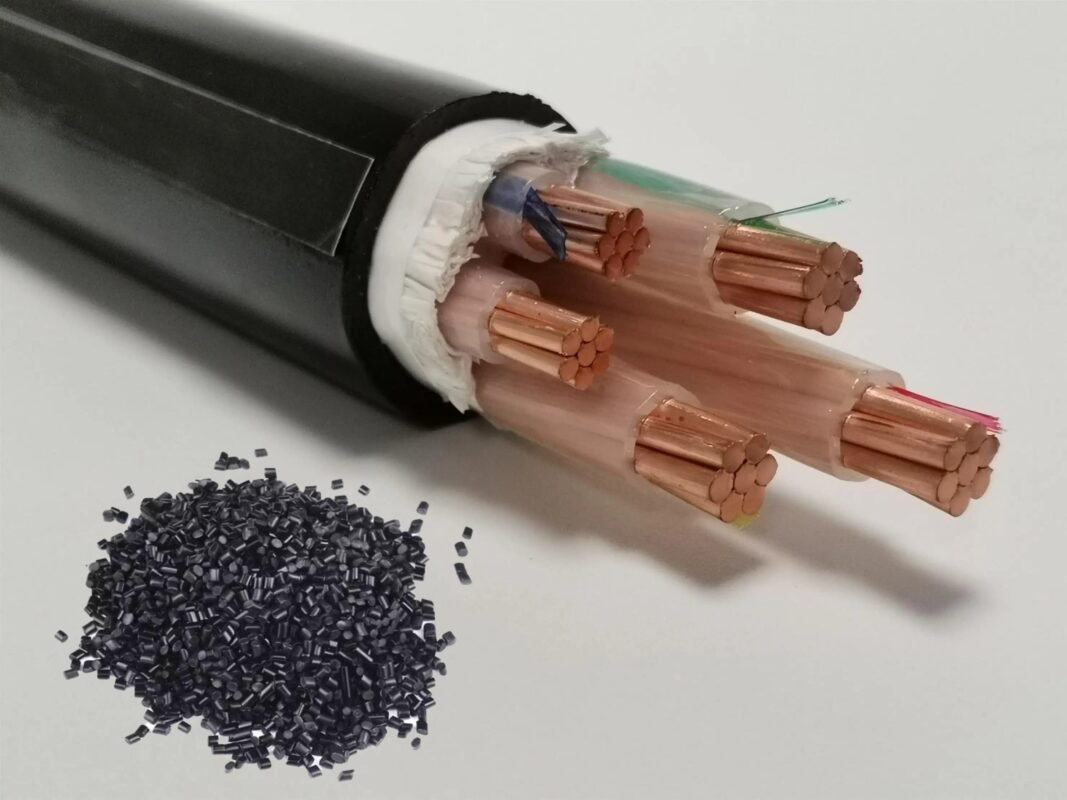
In the production of medium-voltage (MV), high-voltage (HV), and communication cables, polymer compound performance directly determines electrical integrity, mechanical durability, flame retardancy, and long-term reliability under demanding installation and operating conditions. Non-polar base polymers such as polypropylene (PP) and polyethylene (PE) struggle to wet and bond with polar fillers and reinforcements. This leads to agglomeration, weak interfaces, processing difficulties, and potential failure points.

Maleic Anhydride Grafted Polypropylene (MAPP) has become an indispensable functional additive. By introducing reactive polar groups onto the PP backbone, MAPP acts as both a compatibilizer and coupling agent, delivering measurable improvements in dispersion, adhesion, and compound performance. Cable manufacturers targeting infrastructure projects in the Middle East and global markets (NEOM, Aramco, data centers, renewables) increasingly rely on MAPP-enhanced formulations to meet stringent IEC, ASTM, and regional safety standards.

How MAPP Addresses Core Challenges in Cable Compounds

Cable compound formulators face two recurring issues:

  1. Poor dispersion of polar fillers — Carbon black (semi-conductive), aluminum hydroxide (ATH), and magnesium hydroxide (MDH) tend to agglomerate in non-polar matrices, creating resistivity hotspots or weak mechanical zones.
  2. Weak interfacial adhesion — Poor bonding between semi-conductive layers and insulation, or between polymer and high loadings of flame retardant fillers, leads to delamination, voids, partial discharge, and reduced mechanical properties.

MAPP resolves both by lowering interfacial tension, improving wetting, and creating chemical bridges at the interface.

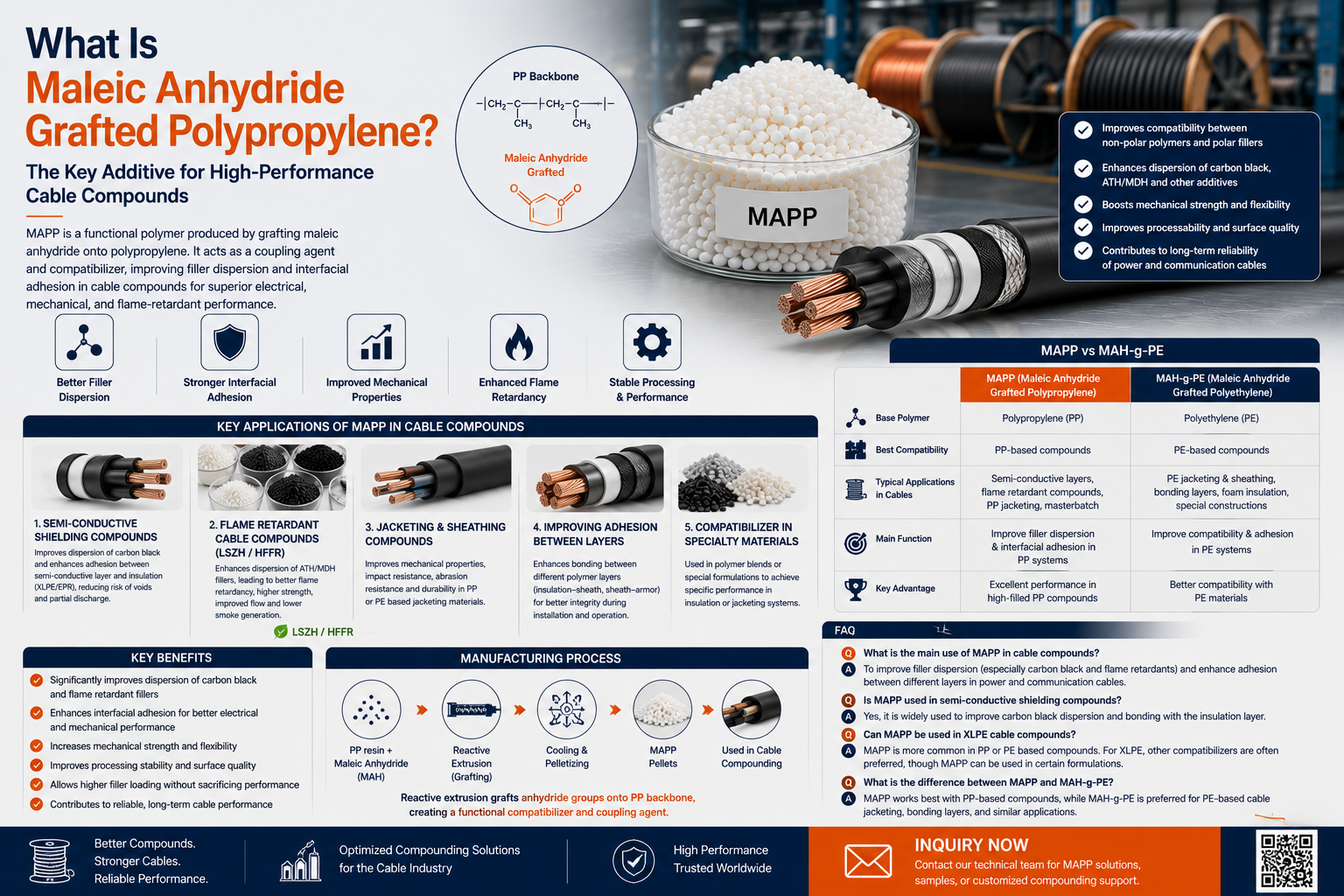
What is Maleic Anhydride Grafted Polypropylene?

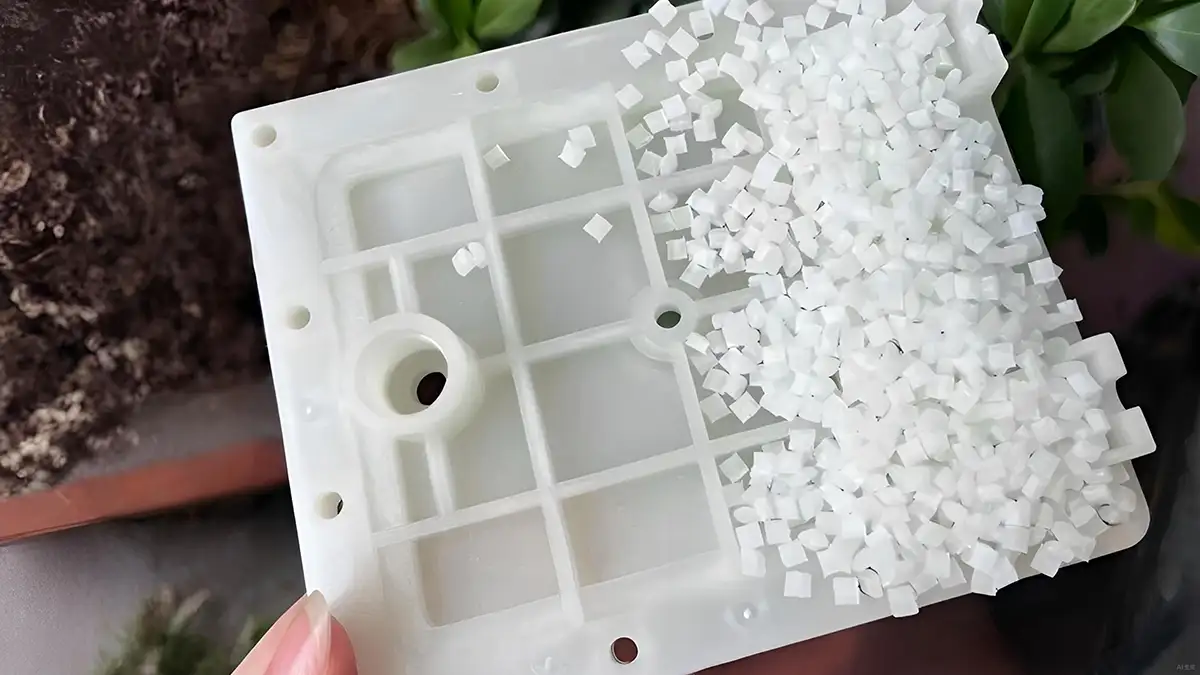
MAPP is produced by grafting maleic anhydride (MAH) onto polypropylene through reactive extrusion. The grafted anhydride groups give the material polar characteristics and chemical reactivity, allowing it to act as an effective coupling agent Ve uyumlayıcı.

In cable applications, MAPP helps solve two common challenges:

  • Poor dispersion of polar fillers (such as carbon black, aluminum hydroxide, or magnesium hydroxide)
  • Weak interfacial adhesion between different polymer layers or between polymer and filler

Key Applications of MAPP in Cable Production

1. Semi-Conductive Shielding Compounds (Conductor Screen & Insulation Screen)

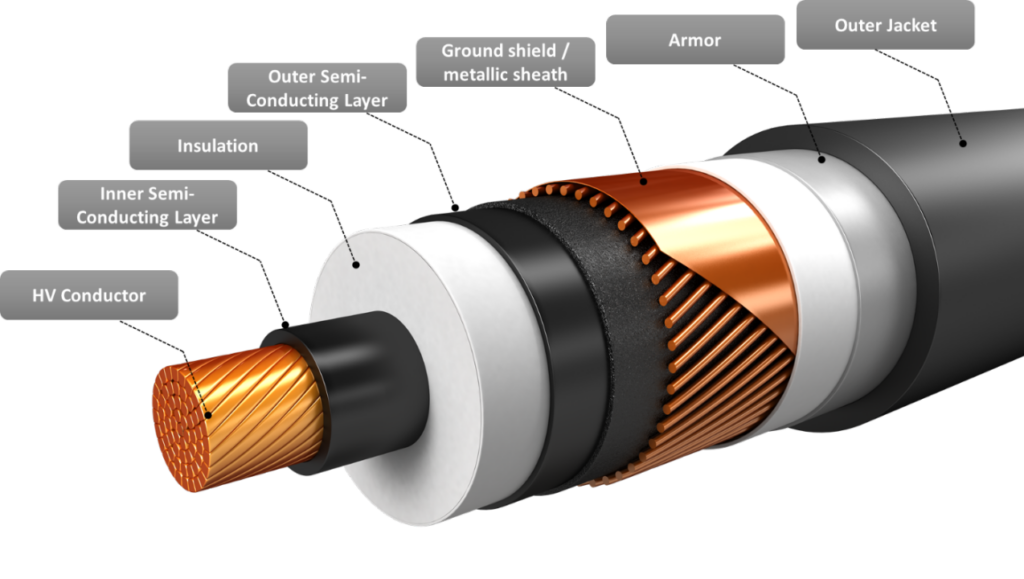
In MV and HV power cables, semi-conductive layers must provide uniform conductivity while forming an intimate, void-free bond with the XLPE or EPR insulation. High loadings of conductive carbon black are required.

MAPP dramatically improves carbon black dispersion and promotes strong adhesion between the semi-conductive layer and insulation. The result: reduced risk of partial discharge, smoother interfaces, and enhanced long-term electrical reliability — critical for cables operating at 66 kV and above.

2. LSZH / HFFR Flame Retardant Cable Compounds

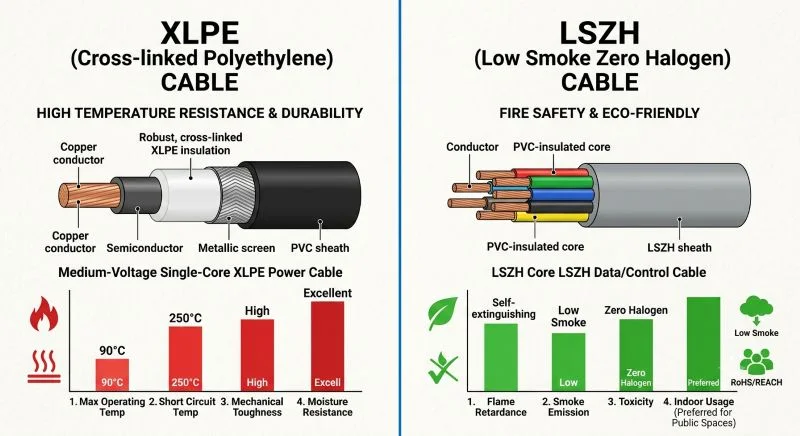
Low Smoke Zero Halogen (LSZH) and Halogen-Free Flame Retardant (HFFR) compounds often contain 50–70% ATH or MDH. These high filler levels are essential for meeting flame retardancy, low smoke, and toxicity requirements (IEC 60332, BS EN 60332, etc.), yet they severely compromise processability and mechanical properties without proper compatibilization.

MAPP enables:

  • Superior dispersion of ATH/MDH
  • Higher achievable filler loadings without embrittlement
  • Improved tensile strength and elongation
  • Better melt flow and surface quality during extrusion
  • Reduced smoke generation and enhanced char formation

These benefits are particularly valuable for building wires, power distribution cables, and communication cables installed in public infrastructure, tunnels, and high-rise projects.

3. Cable Jacketing and Sheathing Compounds

Whether based on polypropylene or filled polyethylene, jacketing compounds benefit from MAPP through enhanced filler compatibility, impact resistance, abrasion resistance, and long-term environmental durability. This is especially relevant for cables exposed to harsh conditions — direct burial, outdoor exposure, or industrial environments common in energy and infrastructure projects.

4. Improving Adhesion Between Cable Layers

In complex multilayer constructions (e.g., insulation + outer sheath, or different polymer blends), MAPP functions as a tie-layer additive or compatibilizer, ensuring integrity during installation bending, thermal cycling, and long-term operation.

5. Compatibilizer in Specialty Cable Materials

MAPP facilitates blending of PP with PE, elastomers, or other polymers to achieve tailored balance of flexibility, toughness, and processing characteristics in insulation or jacketing formulations.

Benefits of Using MAPP in Cable Production

  • Significantly improves dispersion of carbon black and flame retardant fillers
  • Enhances interfacial adhesion between semi-conductive layers and insulation
  • Increases mechanical strength and flexibility of cable compounds
  • Improves processing stability and surface quality
  • Helps achieve higher filler loading without sacrificing performance
  • Contributes to better long-term electrical and mechanical reliability of cables

MAPP vs. Maleic Anhydride Grafted Polyethylene (MAH-g-PE)

While both are valuable grafted polyolefins:

  • MAPP is the preferred choice for polypropylene-based compounds and systems requiring strong coupling with polar fillers in PP matrices.
  • MAH-g-PE offers better compatibility in polyethylene-based jacketing, sheathing, and bonding layers.

Cable compound developers select based on the primary polymer matrix and specific performance targets. Many advanced formulations combine both for optimized multilayer performance.

Maleic Anhydride Grafted Polyethylene (MAH-g-PE) in Cables

Similar to MAPP, Maleic Anhydride Grafted Polyethylene (MAH-g-PE) is also used in the cable industry, particularly in polyethylene-based compounds. It is commonly applied in:

  • PE-based jacketing and sheathing
  • Bonding layers in multilayer cables
  • Improving adhesion in foam insulation or special constructions

While MAPP is more commonly used in polypropylene systems, MAH-g-PE offers better compatibility when the base polymer is polyethylene.

Selection and Processing Considerations

En iyi sonuçlar için:

  • Choose grades with appropriate grafting level and melt flow index (MFI) matched to your base polymer and processing equipment.
  • Typical addition levels range from 1–5% depending on filler type/loading and target properties (exact dosage should be optimized via compounding trials).
  • MAPP is generally added during the compounding stage (internal mixer or twin-screw extruder) to ensure uniform distribution.
  • Processing temperatures should be controlled to preserve grafting functionality while achieving good dispersion.

As a reliable partner to cable manufacturers worldwide, we recommend close collaboration between compound formulators and equipment suppliers to fine-tune both formulation and extrusion parameters.

Sonuç

Maleic Anhydride Grafted Polypropylene (MAPP) has evolved from a specialty additive into a strategic enabler for high-performance, reliable cable compounds. Its ability to deliver superior filler dispersion and robust interfacial bonding makes it indispensable in semi-conductive shielding and high-filled flame-retardant formulations — directly supporting the electrical integrity, safety, and durability demanded by modern power and communication infrastructure.

For cable manufacturers and compound producers aiming to elevate product performance, reduce defects, and meet increasingly stringent global specifications, MAPP represents a proven, cost-effective technical solution.

Şimdi bilgi isteyin to discuss your specific compound requirements, request technical data, or explore how our cable extrusion and compounding equipment can help you integrate MAPP-enhanced formulations into efficient, high-quality production lines. Our team is ready to support your next project with reliable quality, customized technical solutions, and long-term partnership.

Sıkça Sorulan Sorular

What is the main use of MAPP in cable compounds?

MAPP primarily improves dispersion of polar fillers (carbon black, ATH, MDH) and enhances adhesion between layers or between polymer and filler in power and communication cables.

Is MAPP used in semi-conductive shielding compounds?

Yes. It is widely used to achieve uniform carbon black dispersion and strong bonding with XLPE/EPR insulation, critical for reducing partial discharge in MV/HV cables.

Can MAPP be used in XLPE cable compounds?

MAPP is most commonly applied in PP or filled PE compounds. In pure XLPE systems, other compatibilizers may be preferred, though MAPP can be effective in specific hybrid formulations.

What is the difference between MAPP and MAH-g-PE?

MAPP excels in polypropylene-based systems. MAH-g-PE is generally preferred for polyethylene-based jacketing and bonding layers due to better matrix compatibility.

How does MAPP improve flame retardant performance in LSZH cables?

By dramatically improving ATH/MDH dispersion, MAPP enables higher filler loadings, better mechanical properties, improved processability, and more effective flame retardancy with lower smoke generation.

Ready to optimize your cable compounds with MAPP technology?

Şimdi bilgi isteyin — we provide both the materials insight and the production equipment expertise to help you succeed.

Bir yanıt yazın

E-posta adresiniz yayınlanmayacak. Gerekli alanlar * ile işaretlenmişlerdir