Uncategorized

What Is a Copper Wire Annealing and Tinning Machine?

What Is a Copper Wire Annealing and Tinning Machine-doingcable

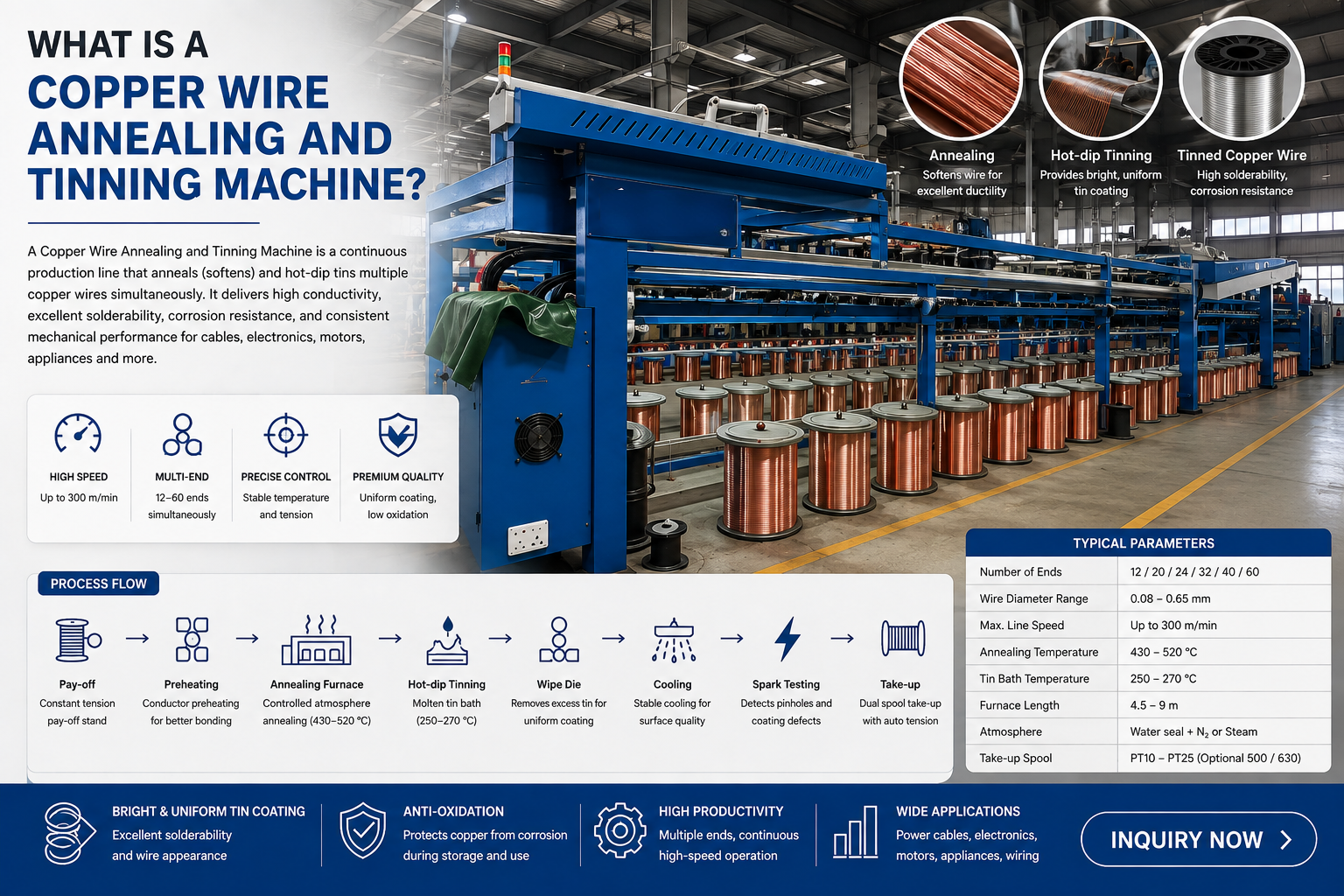
A copper wire annealing and tinning machine is a continuous industrial line that does two jobs in one pass: it anneals hard-drawn copper wire so the conductor becomes soft and ductile, and it hot-dip tins the same wire so the surface is solderable and protected against oxidation.

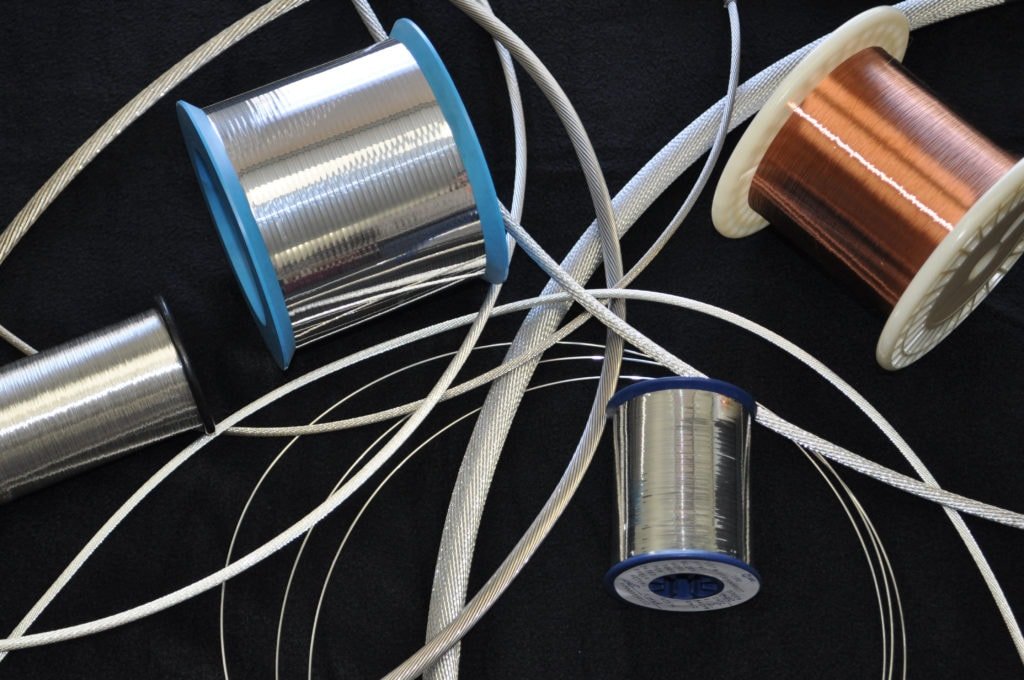
It is not a drawing machine and it is not an electroplating line. After multi-wire drawing, copper is work-hardened and oxidizes quickly. Cable plants therefore put a tubular annealing–tinning line between drawing and bunching / extrusion. The output is bright, soft, tinned monofilament wound on PT10–PT25 plastic bobbins or larger process spools, ready for Class 5 / Class 6 flexible conductors.

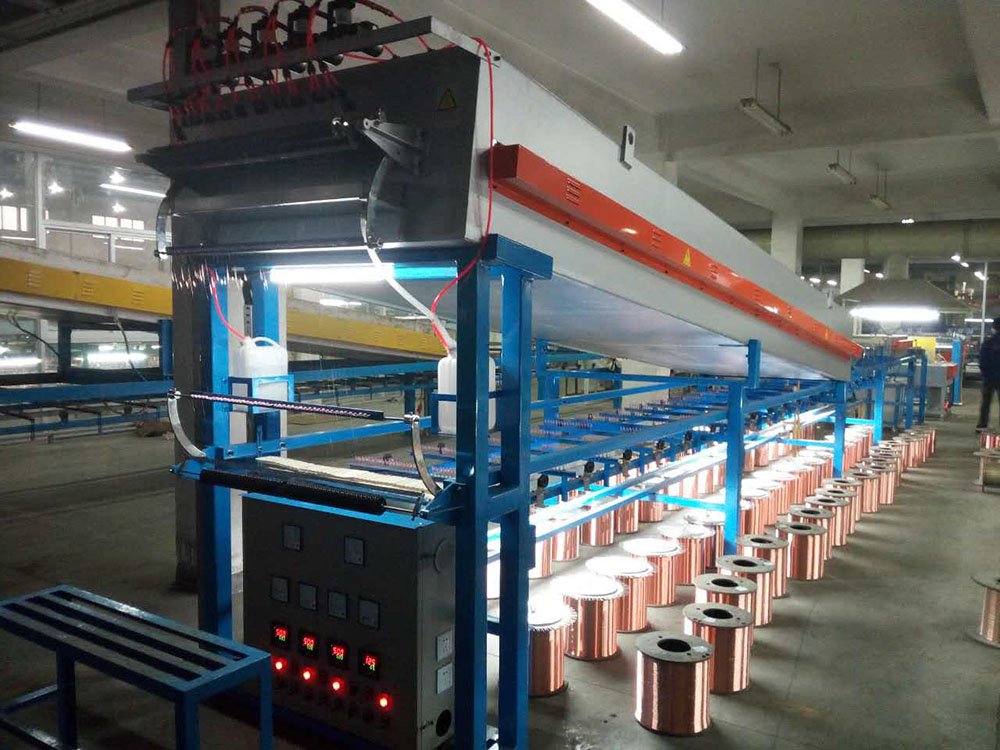
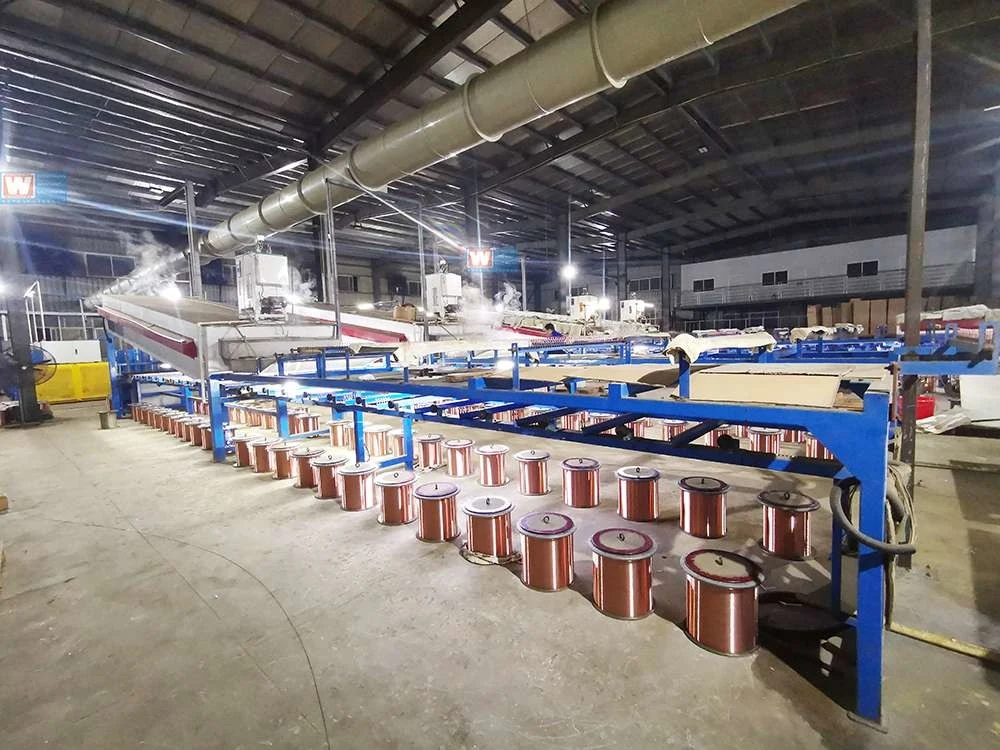
Typical commercial configurations run 12, 16, 24, 32, 40 or 60 heads at once, cover about 0.08–0.65 mm, and reach up to 300 m/min on fine gauges. Furnace length is usually 4.5–9 m. Tin is applied by single or dual hot-dip baths with wipe dies—not by electrolytic plating.

Inquiry Now if you need a 24 / 40 / 60-head line sized to your inlet diameter, elongation target and take-up bobbin.

Why cable plants combine annealing and tinning

Drawn copper is strong but brittle. Annealing recrystallizes the grain structure, restores elongation and keeps conductivity close to the IACS reference used for electrical copper.

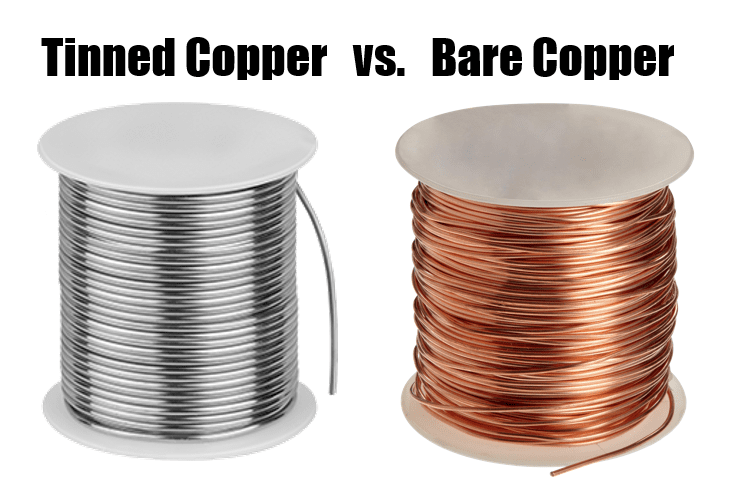
Bare annealed copper still tarnishes. A continuous tin envelope:

  • Blocks atmospheric oxidation and green copper salts that later stain insulation
  • Improves solderability for terminations and harness work
  • Raises practical service temperature of the conductor surface (tin coatings are commonly used up to about 150 °C in coated-conductor practice)
  • Reduces rubber / PVC adhesion problems and conductor blackening inside some insulation systems

Hot-dip tin also forms a copper–tin intermetallic at the interface. That bond is why ASTM B33 tests adherence by wrap-and-immersion as well as continuity by hydrochloric acid–sodium polysulfide.

How the machine works (process chain)

A production annealing and tinning line is a straight, multi-station process: pay-off → tubular anneal → water seal / dry → pickle or flux → hot-dip tin → wipe die → cool → take-up.

1. Pay-off. Hard-drawn fine wire comes from Ø300 mm (or specified) bobbins. Brush pay-off, curl-flyer or constant-tension pay-off keeps each of the 12–60 ends from slapping or stretching. Surface must already be round and free of drawing-soap films; residual lubricant oxidizes fast and must be tinned promptly.

2. Tubular annealing. Each wire runs inside its own heat-resistant tube (commonly 321 stainless process tubes, 2520-grade heater tubes on many Chinese-built lines). Electric radiation heating, multi-zone PID and K-type thermocouples hold a stable profile. Protection is a water seal at the furnace mouth plus steam or nitrogen inside the tubes so the copper does not scale. Effective furnace length is typically 5 m, 6 m, 7 m or 9 m; longer tubes give more dwell at a given speed and are used on heavier gauges.

Annealing set-point is kept slightly below a stand-alone annealer, because the wire is reheated in the tin bath. Too hot + too slow → over-soft or color shift later; too cold + too fast → low elongation and breaks.

3. Water seal, wipe and dry. The water trough isolates air from the hot tubes, quenches scale risk and strips loose oxide. A blower / small drying oven removes moisture before flux.

4. Pickling / flux. A controlled acid or flux pad removes remaining oxide so molten tin wets the copper. Poor pickling is the most common cause of bare spots and failed continuity tests.

5. Hot-dip tin bath. Commercially pure tin is melted in a one-piece cast pot (often HT200) heated by immersion tubes. Industrial practice for copper wire is a bath in the approximately 250–270 °C window; related hot-dip tin studies on copper cluster around 260–280 °C to keep flowability without runaway intermetallic growth. Too low → dull, rough coat and breaks; too high → discoloration and thick Cu–Sn alloy that raises resistivity. Dual-pot layouts let one bath run while the other is skimmed or alloy-adjusted.

6. Wipe / scrape dies. Diamond or tungsten-carbide dies meter the liquid tin. Undersize dies break wire; oversize dies waste tin and leave a heavy, uneven coat. Diamond is preferred on fine wire for surface finish. Some lines add an air knife after the die.

7. Cooling. Combined air + water cooling locks the coat before take-up. Incomplete cooling makes adjacent wires stick on the bobbin.

8. Capstan and torque take-up. An inverter-driven haul-off sets line speed. Torque-motor take-up on PT5–PT25 (or mixed sizes on single-side traverse) winds each end with controlled tension. Line speed must match dwell in both the annealer and the tin pot.

Hot-dip tin vs electroplating

ItemHot-dip on this machineElectroplating
Coating methodWire through molten tin + wipe dieElectrolytic cell
BondInstant Cu–Sn intermetallicMechanical / electrolytic deposit
ResiduesNo plating-bath chemistry on the wireRisk of chemical residues if rinse is poor
WhiskersGenerally not associated with hot-dip pure tin on wireMore often discussed on electrodeposits
Typical plant useFine multi-end cable conductors after drawingSelected electronics / thickness-critical parts

For multi-end 0.08–0.65 mm cable wire, hot-dip on a tubular line is the standard factory method. Electroplating is a different capital line and a different process window.

What the finished wire must pass

Buyers should specify the wire standard, not only the machine model.

  • ASTM B33 — tin-coated soft or annealed copper wire for electrical purposes: tensile/elongation, resistivity, diameter tolerance, continuous coating (HCl–sodium polysulfide), adherent coating (wrap and immersion). Tin shall be commercially pure (other elements excluding copper typically ≤ 1 %).
  • GB/T 4910-2022 — tinned round copper wire for cables and electronic hook-up: models, diameter deviation, mechanical/electrical values, coating appearance, solderability, restricted substances. Covers tinned soft, solderable tinned soft, and tinned hard round copper. Example designation: TXR 0.500 GB/T 4910-2022.
  • IEC 60228:2023 — when the monofilament is stranded into an insulated-cable conductor: allows plain or metal-coated annealed copper, including tin or tin-alloy coating.

A correctly set line produces a bright, continuous tin envelope over a Cu–Sn alloy layer. That alloy slightly increases resistivity versus bare annealed copper; process control (bath temperature, speed, die size) keeps the increase inside the specified max resistance.

Typical technical envelope (reference, customizable)

ParameterCommon industrial range
ApplicationSoftening + hot-dip tinning of round copper (some lines also run selected copper alloys)
Number of heads12 / 16 / 24 / 32 / 40 / 60
Wire diameterFine: ~0.08–0.32 mm; standard: ~0.10–0.65 mm (model-dependent)
Max. line speedUp to ~300 m/min (finer wire, shorter dwell)
Annealing typeMulti-tube electric radiation furnace, water-seal + steam/N₂
Furnace length4.5 / 5 / 6 / 7 / 9 m
TinningSingle or dual horizontal hot-dip pot + diamond/tungsten wipe dies
Tin bathMolten commercially pure tin, typically ~250–270 °C process window
Pay-offBrush, curl-flyer or constant tension; Ø300 mm common
Take-upTorque motor, PT10–PT25 or mixed; single- or double-layer traverse
Installed powerRoughly 45–75 kW depending on heads and furnace length (example 40-head / 6 m ≈ 65 kW class)
Line lengthAbout 14–22 m × 1.5–2.2 m × 1.9–2.4 m
Supply380–400 V, 50/60 Hz three-phase

Figures above synthesize published OEM ranges (QDX-40, WM-40, SY-40H/6, JCJX-40H, FC-T series). Final guarantee must be written on the order: inlet/outlet diameter, number of ends, elongation %, tin coat continuity, bobbin and voltage.

Where the output wire is used

Tinned annealed monofilament is the feedstock for:

  • Flexible power cords and appliance leads
  • Automotive and industrial control cables
  • Data / communication hook-up and braid wires
  • Transformer leads and connector pigtails
  • Marine, humid and outdoor constructions where bare copper would oxidize
  • Subsequent bunching, stranding and extrusion on IEC 60228 Class 5 / Class 6 conductors

What fails in production, and how is it prevented?

FailurePhysical causePrevention
Discontinuous tin / red copper spotsOxide film, wet wire, dirty tube, low bath °CSteam/N₂ seal, dry-out zone, pot temperature PID, tube clean-out
Poor adherence / flaking on wrapResidual lubricant, intermetallic too thick, overheated bathDegrease / steam clean, keep pot 250–270 °C, limit copper in tin
Low elongationUnder-anneal (speed too high or furnace too short)Longer furnace or lower speed; verify 430–520 °C on the metal
Over-soft / breaks on take-upOver-anneal or excessive take-up tensionZone control; torque-motor recipe per diameter
Oval coat / lumpsWorn wipe die, unstable tension, dross on pot surfaceDie life log, skimming schedule, matched pay-off tension
Wire breaks in furnaceGuide scratch, tension spike, already-nicked inletCeramic guides, dancer control, incoming ovality check
Yellow / dull coat after storageThin coat + residual moisture, poor dryAir wipe, dry bobbin store, verify continuity before packing

Tin and copper form intermetallics over time even at room temperature; the rate rises with storage temperature. That is a metallurgical fact of the Cu–Sn system, not a machine defect. Plants that ship to electronics customers should define maximum storage time and steam-age solderability if required.

Inlet quality remains the first filter. Drawn copper with die lines or residual emulsion will not become a B33 wire because a tinning line cannot repair a damaged surface — it only coats it.

Buying checklist for a reliable line

  1. Confirm hot-dip, not “tin plating” language that hides an electroplating cell.
  2. Match furnace length and head count to your heaviest gauge and elongation.
  3. Require steam or nitrogen protection, not air-only tubes.
  4. Specify diamond wipe dies for ≤0.20 mm.
  5. Dual tin pot if you cannot stop the line for dross skimming.
  6. Ask for a process window: anneal zones, tin temperature, speed vs diameter, expected elongation.
  7. Witness ASTM B33 continuity + adherence or GB/T 4910 coating + solderability on trial bobbins.
  8. Lock spare-parts list: tubes, heaters, thermocouples, wipe dies, torque motors.
  9. Plan layout: 20 m straight run, fume extraction over the tin pot, deionized or low-ion water for the seal tank.

Custom engineering—head count, furnace length, take-up size, 50/60 Hz electrics—is the normal B2B path. Long-term cooperation is built on stable elongation, stable tin color and low break rate, not on a catalogue model number alone.

Inquiry Now with: inlet diameter, number of ends, target elongation, tin standard (ASTM B33 / GB/T 4910), bobbin size and plant voltage.

Leave a Reply

Your email address will not be published. Required fields are marked *