Uncategorized

What is the Meaning of XLPE Cable?

What is XLPE Cable

XLPE cable — short for Cross-Linked Polyethylene cable — represents one of the most significant advancements in power cable technology since the mid-20th century. Today it is the dominant insulation choice for low-, medium-, and high-voltage power transmission and distribution systems worldwide. Engineers, utilities, EPC contractors, and industrial facility owners specify XLPE cables when they require higher current-carrying capacity, superior electrical reliability, excellent thermal performance, and long-term operational dependability in demanding environments.

This comprehensive technical guide explains the XLPE cable full meaning, the science behind its molecular structure, modern manufacturing processes, detailed specifications, construction diagrams, real-world applications, performance data versus PVC and other materials, and critical engineering considerations. As a long-established manufacturer with state-of-the-art production capabilities, we provide not only high-quality XLPE cables but also deep technical expertise and customised solutions tailored to your project requirements.

XLPE Cable Full Meaning and Technical Definition

XLPE is the acronym for Cross-Linked Polyethylene (also written Crosslinked Polyethylene). It is a thermosetting polymer created when linear polyethylene (PE) molecules are chemically or physically bonded in three dimensions during a controlled curing process (peroxide, silane or electron-beam methods).

Unlike thermoplastic materials that soften and melt when reheated, the cross-linked molecular network in XLPE forms a stable three-dimensional matrix. This structure delivers:

  • Significantly higher continuous operating temperature (90 °C conductor temperature)
  • Superior short-circuit withstand capability (up to 250 °C for 5 seconds)
  • Enhanced mechanical strength, abrasion resistance and resistance to environmental stress cracking
  • Excellent dielectric properties with low loss and high breakdown strength

The original polyethylene base provides outstanding electrical insulation; the cross-linking process transforms it into a high-performance thermoset material trusted in the most demanding power infrastructure projects.

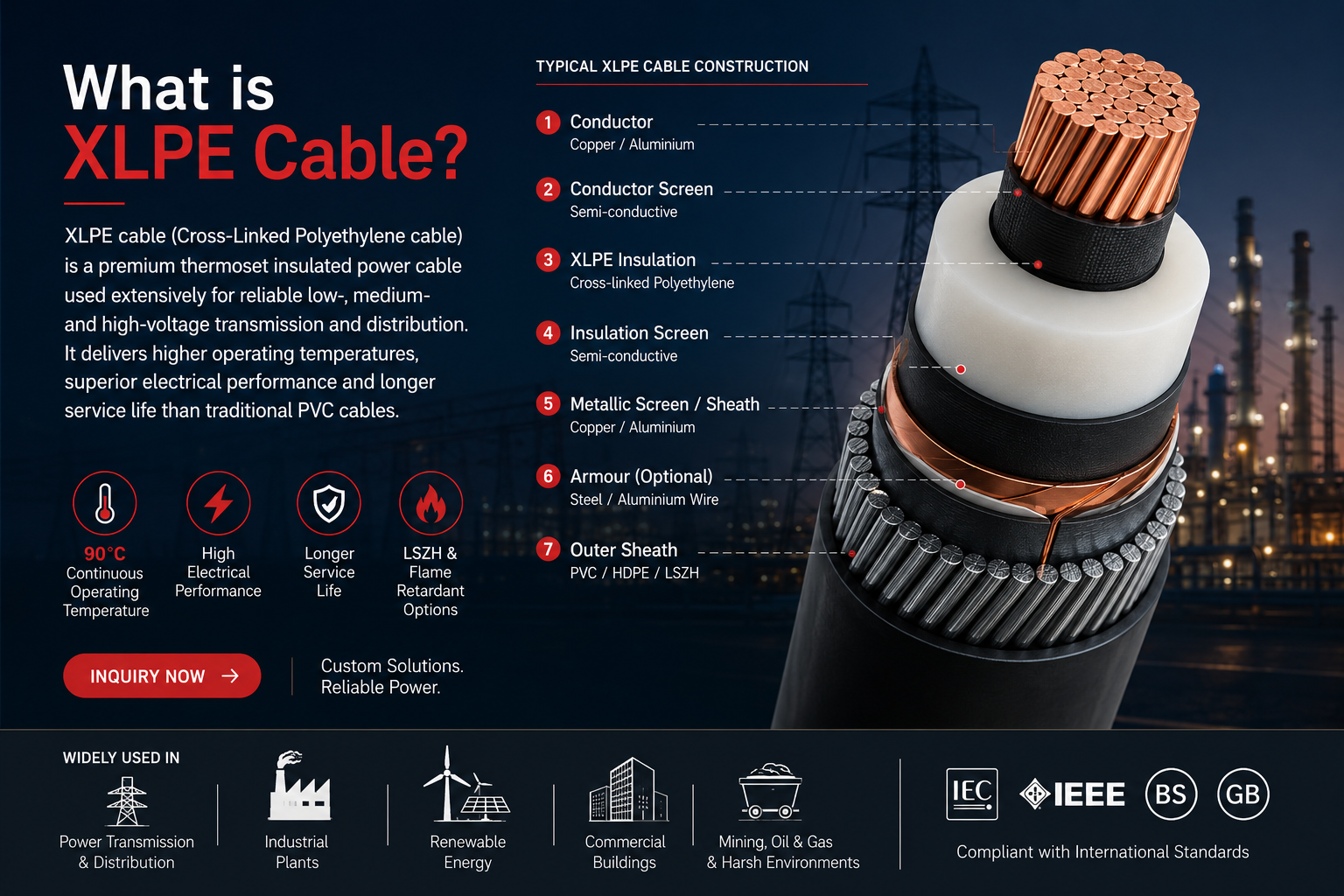
XLPE Cable Diagram – Typical Construction Layers

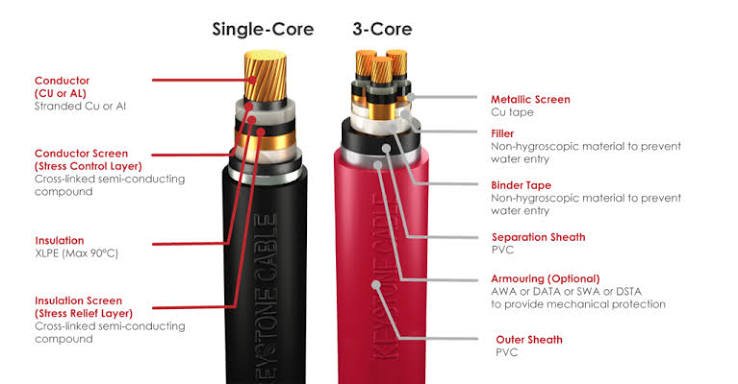
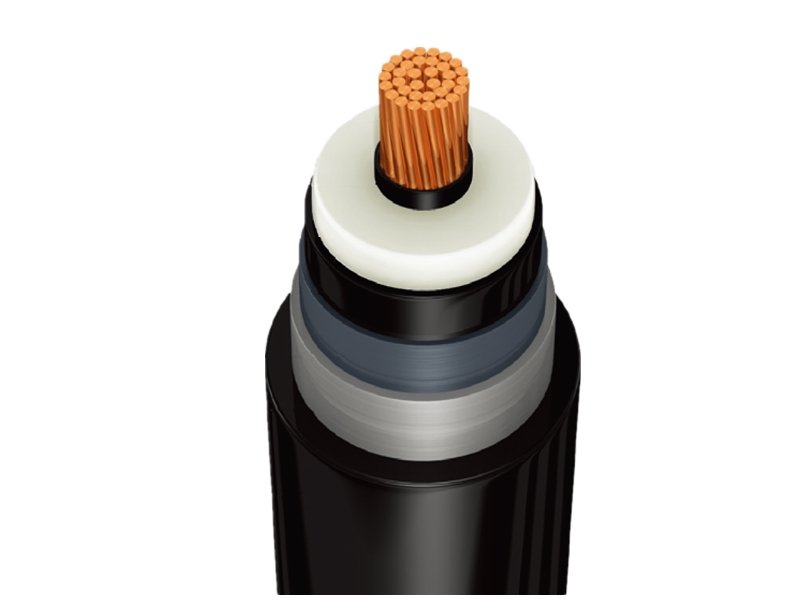
A typical XLPE power cable (especially medium- and high-voltage) comprises multiple precisely engineered layers. The diagram above and the labeled examples below illustrate standard construction:

Core Layers (from inside out):

  1. Conductor – Stranded plain annealed copper or aluminium (Class 2 per IEC 60228)
  2. Conductor Screen – Extruded semi-conductive compound (stress control)
  3. XLPE Insulation – High-purity cross-linked polyethylene (main dielectric)
  4. Insulation Screen – Extruded semi-conductive compound (stress relief)
  5. Metallic Screen / Sheath – Copper tape, copper wire screen or aluminium laminated foil (earth fault path + moisture barrier)
  6. Bedding / Filler – Non-hygroscopic material
  7. Armour (optional) – Galvanised steel wire (SWA), aluminium wire (AWA) or steel tape for mechanical protection
  8. Outer Sheath – PVC, HDPE, MDPE or LSZH compound (UV, chemical, flame and rodent resistant options available)

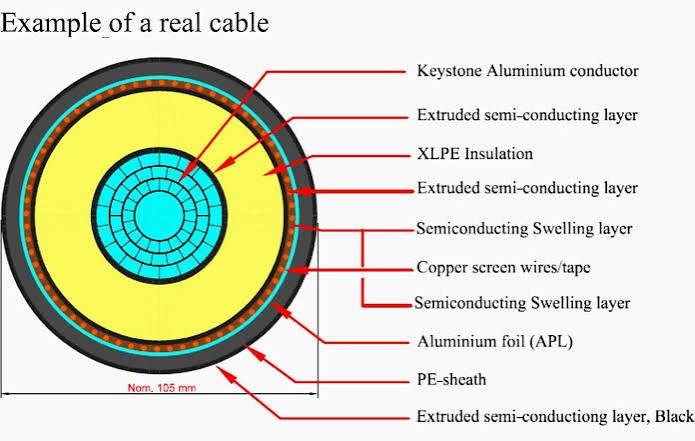
Low-voltage XLPE cables are often simpler (conductor + XLPE insulation + optional bedding + outer sheath), while HV/EHV cables (66 kV–500 kV) incorporate additional swelling tapes, buffer layers and sophisticated metallic sheaths for longitudinal water blocking.

High-voltage XLPE cable cross-section (above) showing advanced features including swelling layers, copper screen wires, aluminium foil (APL) moisture barrier, and PE outer sheath.

Detailed Layer Functions:

  • Conductor: Provides the current path. Copper offers superior conductivity; aluminium provides cost and weight advantages. Stranded construction improves flexibility and reduces skin effect at higher frequencies.
  • Conductor Screen: Extruded semi-conductive compound that equalises the electric field around the conductor, preventing high-stress points that could initiate partial discharge.
  • XLPE Insulation: The primary dielectric. Thickness is precisely controlled according to voltage rating and standard (e.g., IEC 60502). Modern compounds include antioxidants and, for underground use, tree-retardant additives.
  • Insulation Screen: Another semi-conductive layer that defines the outer boundary of the electric field and provides a smooth surface for the metallic screen.
  • Metallic Screen / Sheath: Copper tape or wires for earth fault current return and electromagnetic screening; often combined with aluminium laminated foil for radial moisture blocking.
  • Water-Blocking Elements: Swelling tapes or powders that expand on contact with moisture to prevent longitudinal water migration.
  • Armour (optional but common): Galvanised steel wire (SWA) for high tensile strength and impact protection; aluminium wire (AWA) for single-core cables to avoid magnetic losses; steel tape (STA) for lighter-duty applications.
  • Outer Sheath: Provides overall mechanical, chemical, UV, and flame protection. Options include PVC, HDPE/MDPE (excellent moisture barrier), or LSZH (low smoke zero halogen) for fire-performance-critical installations.

Key XLPE Cable Specifications

When specifying or procuring XLPE cables, engineers should verify the following critical parameters:

ParameterTypical Values / StandardsWhy It Matters
Voltage Rating0.6/1 kV (LV), 3.6/6–26/35 kV (MV), 66–500 kV (HV)Determines insulation thickness and stress control design
ConductorCopper or Aluminium, Class 2 strandedConductivity, weight, cost and termination method
Continuous Temp90 °C (conductor)Directly impacts current-carrying capacity
Short-Circuit Temp250 °C for max. 5 sCritical for protection coordination
StandardsIEC 60502-1/2, IEC 60840, BS 5467, IEEE 635, GB/T 12706, UL 1072Compliance ensures safety, performance and interoperability
Insulation ThicknessPer voltage & standard (e.g. ~3.4 mm min at 11 kV)Electrical stress control and partial discharge performance
Sheath & ArmourPVC ST2, HDPE, LSZH; SWA / AWA / TapeEnvironmental protection and mechanical robustness
Special CompoundsTR-XLPE (tree-retardant), LSZH, flame-retardantExtended life in wet conditions or enhanced fire safety

Our technical team performs full value engineering on every enquiry to optimise conductor size, insulation design and armouring against your actual load profile, installation method and environmental conditions.

What is XLPE Cable Used For? Primary Applications

XLPE cables are deployed across the entire voltage spectrum:

  • Low Voltage (≤1 kV): Commercial buildings, data centres, industrial plants, renewable energy inverters, EV charging infrastructure
  • Medium Voltage (1–35 kV): Utility distribution networks, factory substations, wind and solar farm collection systems, underground urban feeders, mining and oil & gas installations
  • High & Extra High Voltage (66–500 kV): Grid interconnectors, power plant step-up connections, long-distance transmission (often with cross-bonding or sheath voltage limiters)

Key advantages in real-world use include direct burial without conduit in many cases (when armoured), excellent performance in ducts or tunnels, resistance to moisture ingress (especially with modern TR-XLPE and longitudinal water-blocking), and compatibility with both indoor and outdoor terminations.

XLPE Cable Advantages and Disadvantages

Major Advantages

  • Higher continuous and short-circuit temperature ratings → higher ampacity or smaller conductor cross-section for the same load (typical 15–30 % gain vs PVC depending on installation)
  • Superior dielectric performance and lower losses at medium/high voltage
  • Excellent long-term reliability — modern formulations routinely achieve 40+ year design life
  • Strong resistance to chemicals, abrasion and environmental stress cracking
  • Halogen-free and low-smoke options available for fire-sensitive environments
  • Reduced maintenance and lower total cost of ownership over the cable lifecycle

Considerations / Disadvantages

  • Higher initial material and processing cost compared with PVC
  • Requires skilled jointing and termination techniques (especially MV/HV)
  • Thermoset nature makes end-of-life recycling more challenging than thermoplastics
  • Historical water-treeing risk in wet environments — fully mitigated in current-generation TR-XLPE and dry-cured production

XLPE Cable vs Armoured Cable

“Armoured cable” describes mechanical protection (usually SWA or AWA), while XLPE describes the insulation material. In practice, the highest-performing underground and industrial cables combine both: XLPE insulation + metallic screen + steel wire armour + robust outer sheath.

XLPE-insulated armoured cables (compliant with BS 5467 or IEC 60502-2) deliver the best of both worlds — outstanding electrical characteristics from the XLPE dielectric plus excellent resistance to impact, crushing and rodent attack. Non-armoured XLPE cables are preferred for tray, ladder or clipped installations where mechanical risk is low.

XLPE vs HDPE

XLPE excels as primary insulation because of its thermoset cross-linked structure and 90 °C rating. HDPE (High-Density Polyethylene) is a thermoplastic commonly used as an outer sheath on XLPE cables. It offers:

  • Superior moisture barrier and abrasion resistance
  • Excellent UV stability for exposed installations
  • Lower cost and easier processing than some XLPE sheathing compounds

Many of our medium- and high-voltage XLPE cables are supplied with HDPE outer sheaths precisely because the combination provides optimal electrical performance (XLPE) plus mechanical and environmental protection (HDPE). For pure insulation duty, XLPE remains the clear technical leader.

XLPE Cable Price Considerations

XLPE cable pricing depends on multiple variables: conductor material and size, voltage rating, armour type, sheath compound, length, certification requirements and current metal market prices.

As a long-established manufacturer, we focus on total cost of ownership. While XLPE cables carry a premium versus basic PVC constructions, the ability to use smaller conductors, longer maintenance-free service life and higher reliability frequently delivers measurable project savings. Volume contracts, framework agreements and technical optimisation further improve commercial outcomes.

For current pricing and technical proposals tailored to your project, please Inquiry Now. Our engineering and commercial teams respond promptly with detailed quotations, cable data sheets and installation guidance.

Why Partner with Us for Your XLPE Cable Requirements?

With decades of specialised experience in power cable design and manufacturing, we deliver:

  • Reliable quality — rigorous in-process testing, partial discharge monitoring on MV/HV lines and full traceability
  • Custom technical solutions — tree-retardant compounds, LSZH sheathing, special armouring, hybrid constructions and project-specific voltage-drop or short-circuit calculations
  • Long-term partnership — consistent supply, technical training for your teams, responsive after-sales support and collaborative value engineering
  • Global compliance — cables certified to IEC, BS, IEEE, UL and regional standards as required

Whether you need standard LV/MV distribution cables or engineered high-voltage solutions, we are committed to providing the most dependable and technically appropriate XLPE cable for your application.

Ready to move forward?

Inquiry Now — speak with our cable specialists today for expert specification support, competitive quotations and reliable long-term supply.

Leave a Reply

Your email address will not be published. Required fields are marked *