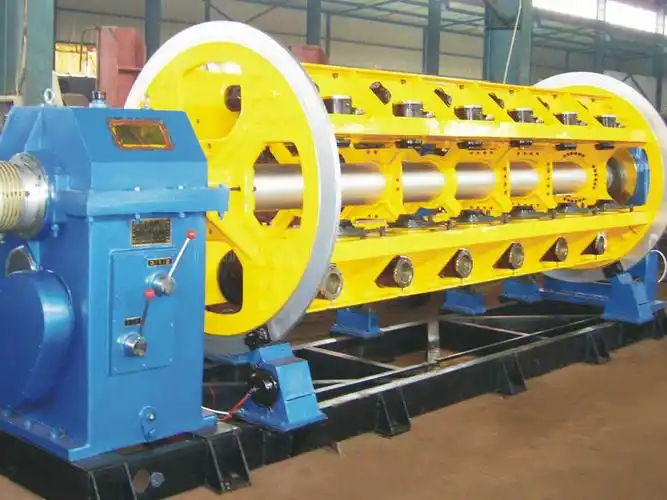
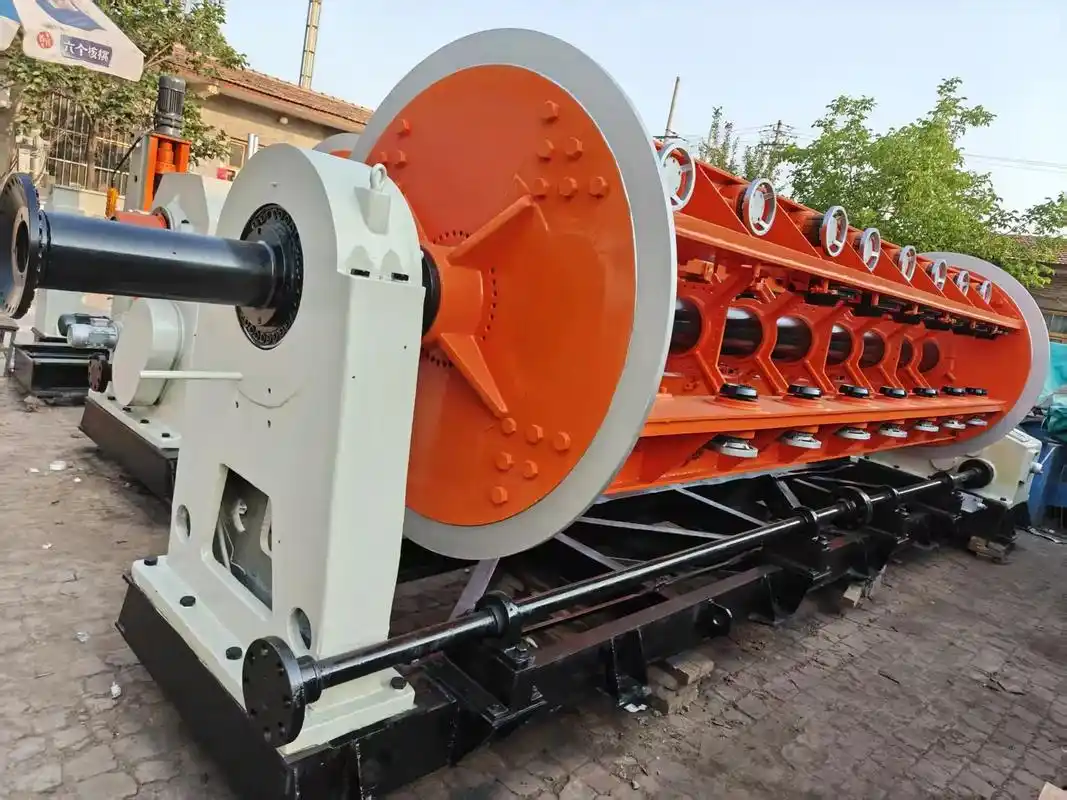
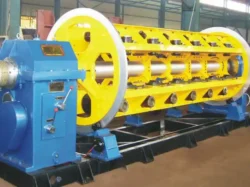
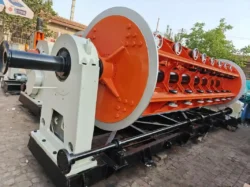
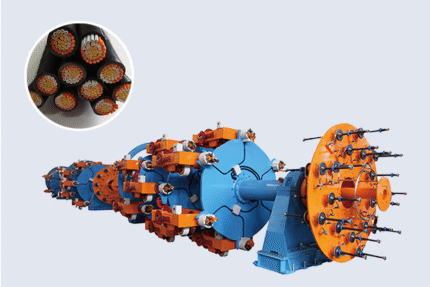
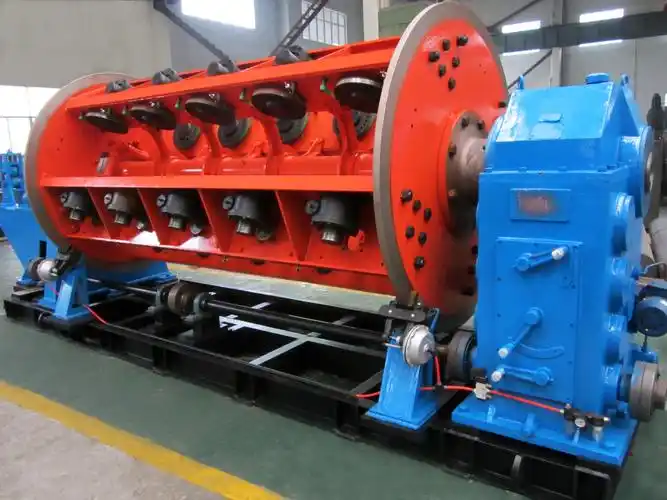
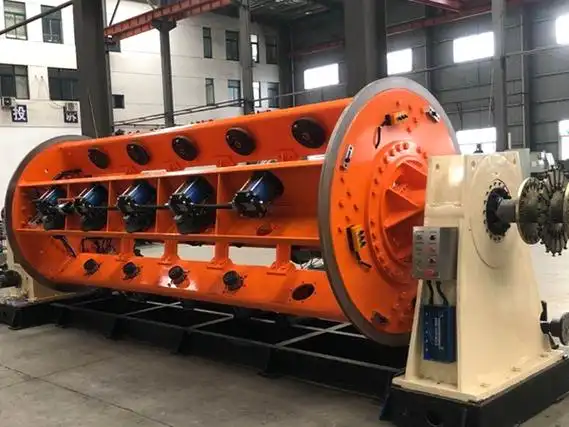
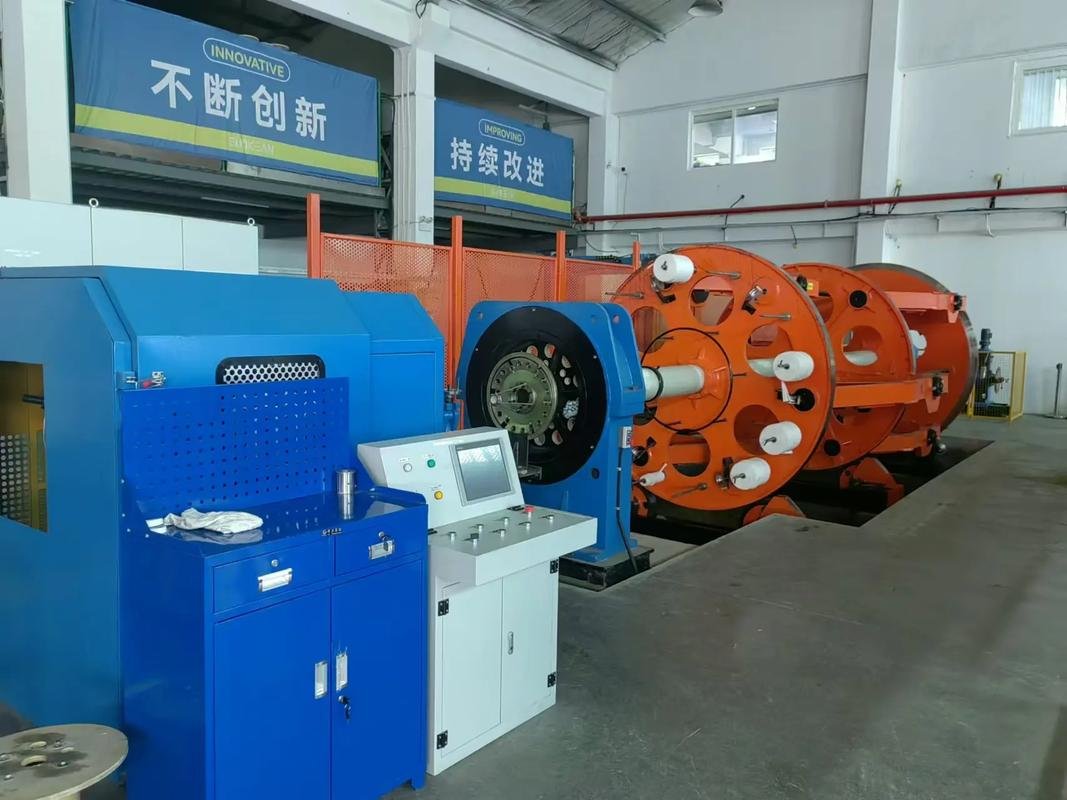
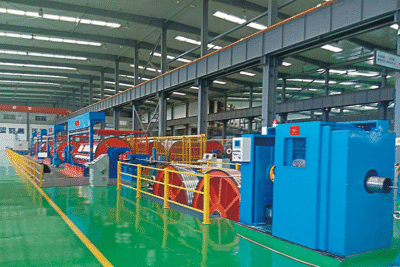
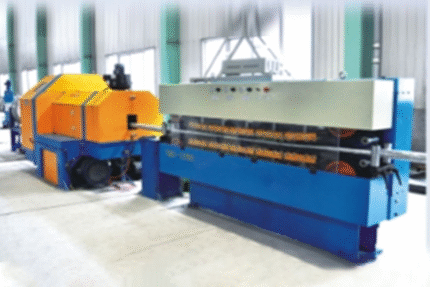
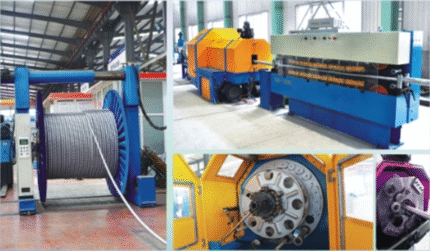
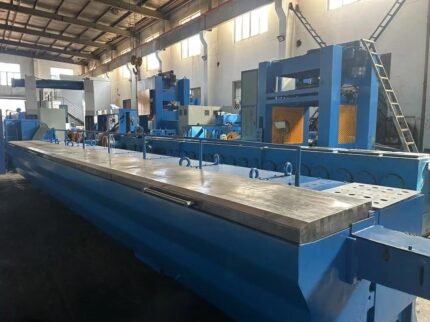
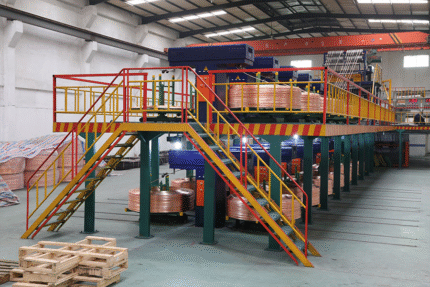
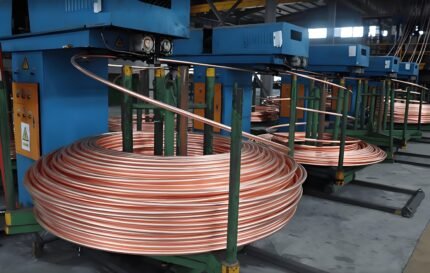
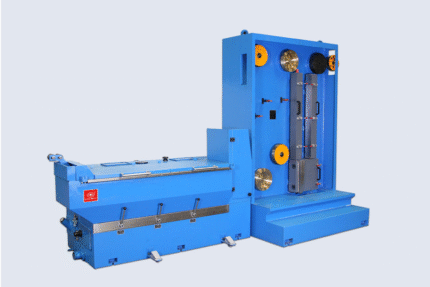
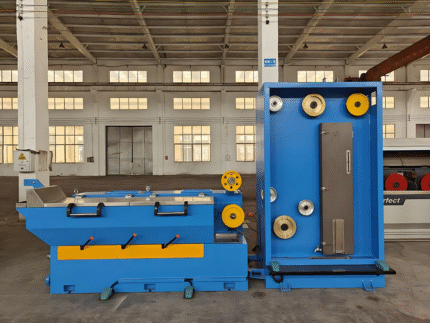
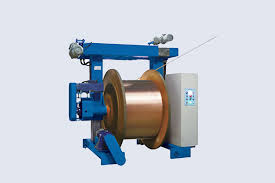
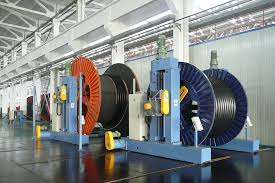
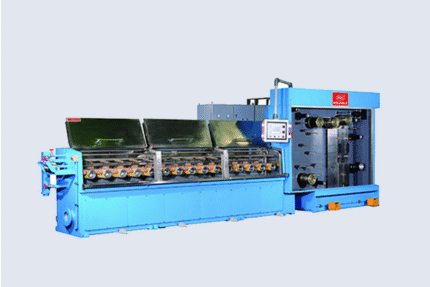
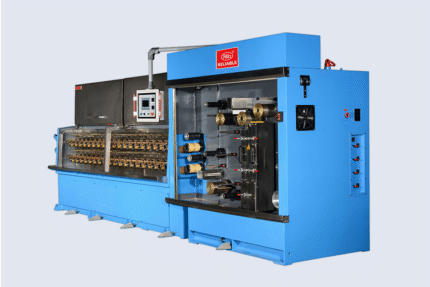
A Machine de câblage rigide (also called rigid frame strander or rigid cage strander) is a heavy-duty, non-back-twist conductor stranding system designed to produce large-cross-section round, compacted, or sector-shaped conductors for medium-voltage, high-voltage, and extra-high-voltage power cables. It uses multiple rigid rotating cages that hold bobbins of copper or aluminum wire and applies precise helical stranding without reversing the twist of individual wires. This configuration delivers the mechanical stability, lay uniformity, and compaction density required by IEC 60228 Class 2 conductors and modern XLPE-insulated power cables.
The machine is the preferred solution when manufacturers need long continuous lengths, high tensile strength, and consistent electrical performance for underground and overhead power transmission lines.
Grâce à son système d'entraînement robuste par arbre au sol, son chargement automatique de bobines et son contrôle intelligent de tension constante, cette machine offre une production constante de haute qualité avec une excellente productivité, ce qui en fait un choix privilégié pour les fabricants de câbles en Arabie saoudite et dans le CCG.
How Does a Rigid Stranding Machine Work?
A rigid stranding machine works by mounting individual wire bobbins directly onto rigid rotating cages arranged in successive layers (commonly 6 + 12 + 18 + 24 + 30). As the cages rotate at controlled speeds, the wires are pulled forward by a dual-wheel or single-wheel capstan and formed through dies or rollers into a tightly stranded conductor. Because the bobbins do not rotate on their own axes relative to the cage, the process is defined as non-back-twist stranding. This eliminates residual torsional stress in the finished conductor and produces superior compaction compared with many tubular designs.
Modern systems use independent AC servo or variable-frequency motors for each cage section, synchronized by Siemens or equivalent PLC + HMI control. Pitch is set digitally and remains constant even when line speed changes. Pre-forming devices and compacting dies can be added for sector or Milliken conductors used in EHV XLPE cables up to 500 kV.
Typical wire diameters handled are 1.5–5.0 mm for copper and 1.7–5.0 mm for aluminum and aluminum alloy. Maximum finished conductor diameters commonly reach 45–80 mm depending on configuration.
Processus technologique
Pay-off reels (automatic side-lower or front loading) → Multi-bobbin rigid cage → High-speed non-back-twist stranding → Precision die holder for round or sector compaction → Meter counter and dual-wheel capstan → Automatic take-up bobbin.
The concentric rigid-cage architecture ensures a smooth wire path with reduced contact points and friction. This design, combined with precise electrical and mechanical synchronization, enables stable high-speed operation with minimal vibration and uniform product geometry from the first meter to the last.

Rigid Frame vs Tubular vs Planetary Stranding – Which Is Best for Power Cables?
Rigid frame stranders outperform tubular and planetary machines when the primary requirement is large-section power conductors with high mechanical integrity.
| Fonctionnalité | Rigid Frame Strander | Tubular Strander | Planetary Strander |
|---|
| Back-twist | No (non-back-twist) | Yes | Partial |
| Typical max conductor OD | 45–80 mm | ≤35 mm | 30–60 mm |
| Preferred application | MV/HV/EHV power cables, ACSR, sector | Control & instrumentation cables | Flexible or special constructions |
| Cage speed range | 80–300 rpm | 800–3000 rpm | 100–400 rpm |
| Line speed (typical) | 40–80 m/min | 80–180 m/min | 50–120 m/min |
| Compaction capability | Excellent (die/roll) | Modéré | Bien |
| Bobbin capacity | High (PND 500–800) | Lower | Medium |
| Suitability for XLPE MV/HV | Preferred | Limité | Limited for large sections |
What Are the Key Technical Parameters of a Modern Rigid Stranding Machine?
The following table summarizes typical performance data for current-generation rigid stranders:
| Paramètre | 500-Series | 630-Series | 710/800-Series |
|---|
| Pay-off bobbin size | PND 500 | PND 630 | PND 710–800 |
| Copper wire diameter | 1.5–4.6 mm | 1.5–5.0 mm | 1.5–5.0 mm |
| Aluminum wire diameter | 1.7–5.0 mm | 1.8–5.0 mm | 1.8–5.0 mm |
| Max. finished conductor OD | 35–55 mm | 45–80 mm | 55–80 mm |
| Cage speed (6-bobbin) | up to 230–300 rpm | up to 175–240 rpm | up to 120–200 rpm |
| Cage speed (24-bobbin) | up to 130–175 rpm | up to 110–160 rpm | up to 90–140 rpm |
| Line speed | 40–70 m/min | 50–80 m/min | 40–75 m/min |
| Capstan diameter | 1600–2000 mm | 2000–2500 mm | 2000–3500 mm |
| Main drive type | Individual motor / shaft | Individual motor preferred | Individual motor |
| Typical installed power | 150–250 kW | 200–350 kW | 250–450 kW |
These parameters support continuous production of Class 2 conductors complying with IEC 60228 and GB/T 3956. Individual-motor designs reduce mechanical complexity, lower noise, and improve energy efficiency by 10–15 % compared with traditional ground-shaft systems.
Principaux avantages techniques et opérationnels
True Non-Back-Twist Rigid Stranding
The rigid cage structure delivers exceptional mechanical stability and high compaction force. This is essential for armoring layers and large-section conductors where dimensional accuracy, mechanical strength and long-term cable integrity are critical. Compared with planetary systems, the rigid design achieves better roundness and higher density with lower energy consumption.
Système de chargement automatique de bobine
Available with side-lower or front automatic loading mechanisms customized to your factory layout. This significantly reduces changeover time, lowers labor requirements and minimizes production downtime — a decisive advantage in continuous high-volume operations.
Intelligent Constant Tension Control
Aerodynamic resistance combined with electromagnetic brakes provides precise, automatic tension compensation from full to empty bobbin. Uniform lay length and consistent strand quality are maintained throughout the entire bobbin life, resulting in lower scrap rates and higher overall yield.
Robust Ground Shaft Drive with Independent AC Motors
Each cage is driven by its own AC motor under precise electrical synchronization. The system offers stable high-speed running, low noise, reduced mechanical complexity and markedly lower maintenance compared with traditional shared-drive or gearbox systems.
Advanced MMI + PLC Control
Operators can easily pre-set stranding pitch, direction, tension profiles and full line synchronization with the pulling capstan and take-up unit. Recipe storage for different cable constructions enables fast and repeatable product changeovers.
Manutention polyvalente
Handles copper wires (1.5–3.6 mm), aluminum and aluminum-alloy wires (1.75–5.0 mm), and steel wires. Bobbin loading capacity reaches up to 1 200 kg, supporting both continuous production runs and flexible manufacturing schedules.
These engineering features translate into higher line output, reduced energy consumption per meter of cable, lower scrap rates and consistently high-quality armored or shielded product — exactly the performance modern power-cable manufacturers require.
Spécifications techniques
| Modèle | Configuration | Bobine de paiement (mm) | Diam. Fil Cuivre (mm) | Fil d'aluminium Dia. (mm) | Max. OD échoué (mm) | Vitesse du rotor (tr/min) | Vitesse de ligne (m/min) | Puissance moteur principal (kW) |
|---|
| ST56 | 6B–30B | 560 | 1.5–3.6 | 1.75–5.0 | 80 | 45–220 (selon la configuration) | 90–320 (selon la configuration) | 45–75 après J.-C. |
| ST63 | 6B–30B | 630 | 1.5–3.6 | 1.75–5.0 | 80 | 45–210 (selon la configuration) | 80–300 (selon la configuration) | 55–75 apr. J.-C. |
Les valeurs de performance varient selon la configuration de la bobine (vitesse plus élevée avec moins de bobines). Configurations personnalisées disponibles.

Composants principaux et intégration du système
- Cage rigide avec bobines internes et ailes volantes
- Système de chargement automatique de bobines (côté ou avant)
- Porte-matrice de précision pour le compactage rond/sectoriel
- Transmission à arbre de masse avec moteurs CA indépendants
- Contrôle de tension constant (freins aérodynamiques + électromagnétiques)
- Armoire de commande intelligente MMI + PLC
- Compatible avec les systèmes de déroulement, de traction et de prise.
But: Tressage et blindage à haute vitesse et haute compaction pour câbles d'alimentation moyenne et haute tension avec une fiabilité maximale et une maintenance minimale.
Applications principales
- Armement de fils d'acier pour câbles d'alimentation
- Blindage de câbles par fil de cuivre et ruban de cuivre
- Blindage et torquage de fils en aluminium rond
- Toronnage et blindage de conducteur de secteur pré-tordu
- Production de câbles blindés et armés moyenne et haute tension
Why Choose Our Rigid Stranding Machine?
- Superior Rigidity & Compaction: Better mechanical strength and roundness than planetary stranders.
- High Productivity & Low Downtime: Automatic bobbin loading and constant tension control.
- Energy Efficient & Low Maintenance: Ground shaft drive system with independent motors.
- Full Local Support in Saudi Arabia: Turnkey installation, operator training, 24/7 remote diagnostics, and spare parts availability in the Eastern Province.
- Vision 2030 Aligned: Supports local manufacturing of high-quality armored cables for power grid expansion and industrial projects.

What Are the Common Failure Modes and How Can They Be Prevented?
Common operational issues include unstable stranding pitch, single-wire breakage, uneven tension, and motor overheating. Pitch variation usually results from loss of synchronization between cages and the haul-off capstan; the solution is proper PLC tuning and regular inspection of encoder feedback. Wire breaks are frequently caused by excessive pay-off tension, damaged bobbin flanges, or impurities in the incoming wire. Maintaining calibrated pneumatic or magnetic brakes and using high-quality drawn wire reduces this risk. Motor overheating is prevented by ensuring correct load distribution, adequate cooling, and avoidance of prolonged operation above the rated cage speed for a given bobbin fill level.
Regular lubrication of main bearings, inspection of die wear, and verification of safety interlocks are essential preventive measures for reliable long-term operation.
Key Takeaways for Cable Manufacturers
Rigid stranding machines remain the core technology for producing high-quality, large-section conductors required by modern XLPE power cables. Their non-back-twist design, high compaction capability, and compatibility with automatic loading systems deliver the dimensional accuracy and mechanical strength demanded by IEC and national standards. Selecting a machine with individual-motor drive, adequate bobbin capacity, and digital process control provides the most reliable path to consistent production quality and long-term operational efficiency.
For detailed technical proposals, configuration options, and capacity calculations tailored to your specific power-cable range, contact our engineering team.
Machine de câblage rigide
Tresseuse Rigide Haute Vitesse (Série ST56 / ST63) pour le blindage et la protection des câbles d'énergie moyenne et haute tension. Conception à cage rigide sans torsion négative avec chargement automatique des bobines et contrôle de tension constant.
SKU du produit:
ST56-24B / ST63-30B
Marque de produit:
Machines RLB
Devise:
USD
Prix du produit:
Contactez-nous pour un devis
Produit en stock:
En stock
Note de l’éditeur/éditrice :4.9 





Avis
Il n’y a pas encore d’avis.