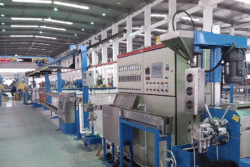
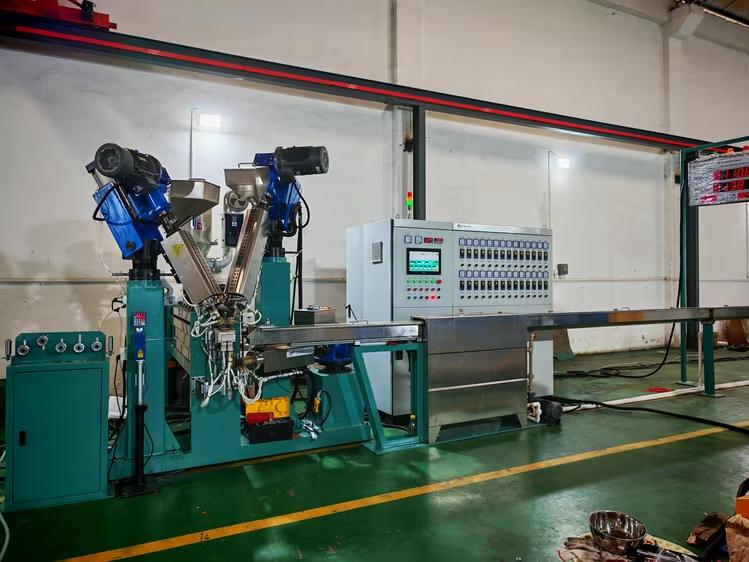
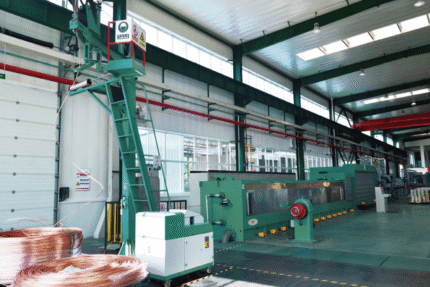
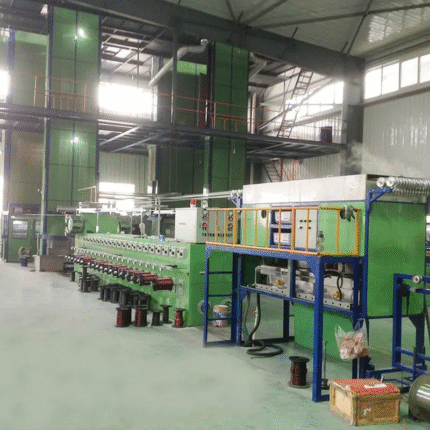
The Building Wire Extrusion Production Line is a complete, high-efficiency automated system designed for the continuous insulation (and optional sheathing) of single-core building wires used in residential, commercial and industrial electrical installations. These lines process copper or aluminum conductors typically ranging from 0.75 mm² to 240 mm², applying thermoplastic compounds such as PVC, PE, XLPE, Low Smoke Halogen-Free (LSHF/HFFR) and, for THHN/THWN constructions, a nylon (PA) outer jacket via tandem or co-extrusion.
Modern lines prioritize high line speed, consistent insulation thickness (±0.02 mm typical with closed-loop control), excellent concentricity (>90–95 %), and material versatility while meeting international standards including IEC 60227, UL (THHN/THWN), BS 6004, VDE and IS 694. Typical maximum speeds reach 600–1200 m/min on fine conductors (high-speed series) and 100–350 m/min on larger cross-sections, enabling high-volume, low-cost-per-meter production.
Whether you are producing standard residential building wires or premium nylon-jacketed THHN/THWN conductors for demanding commercial and industrial applications, RLB delivers reliable, data-driven performance backed by decades of cable machinery expertise.
Core Technology & Engineering Advantages of This Wire Extrusion Line
- Material Compatibility & Screw Optimization: Specialized screws and barrels (L/D ratios typically 25:1 or 26:1) optimized for heat-sensitive PVC (to avoid degradation) and higher-temperature XLPE/LSHF compounds. Multi-zone PID temperature control (usually 4–9 zones) maintains melt homogeneity at 120–220 °C depending on material.
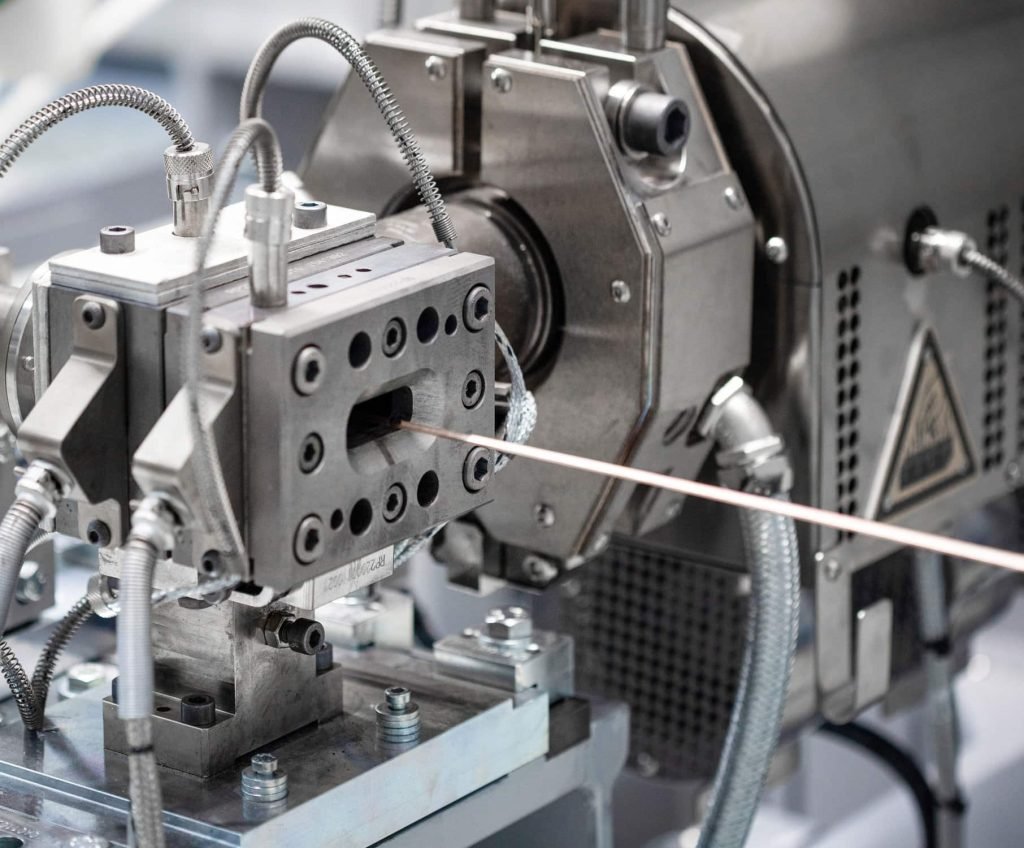
- Precision Crosshead & Tooling: Fixed-center or adjustable concentric crossheads with tungsten carbide dies/tips ensure uniform wall thickness and high concentricity. Optional co-extrusion for skin/stripe color or dual-layer constructions; tandem extruder configuration for nylon jacketing on THHN lines.
- Intelligent Control System: MMI + PLC (Mitsubishi or equivalent) with real-time laser diameter gauge feedback (closed-loop), recipe storage, line-speed synchronization, and process parameter logging for full traceability and rapid changeovers.
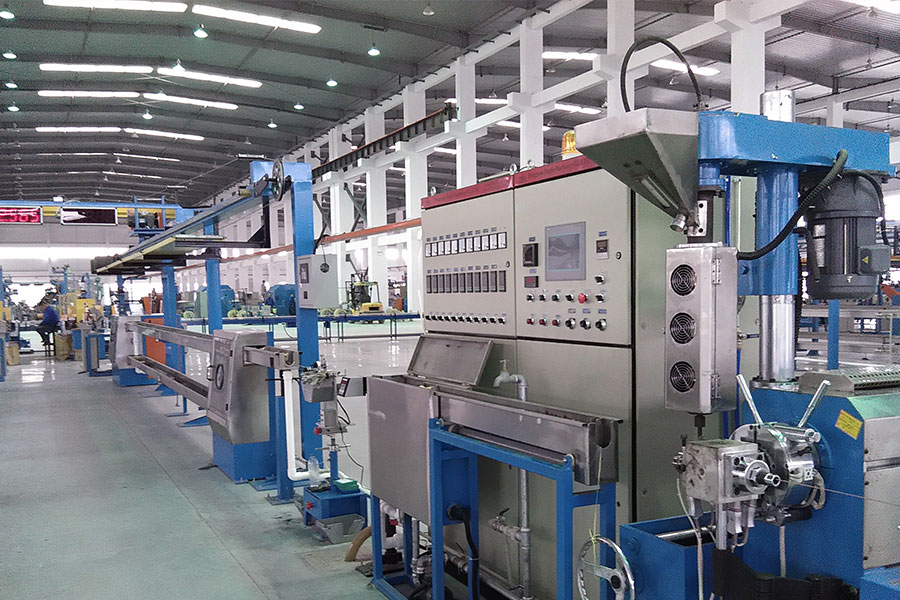
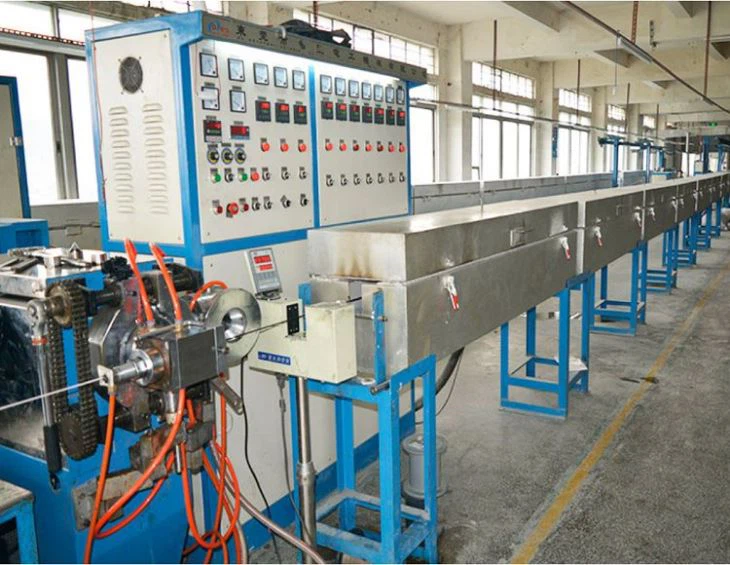
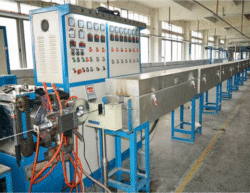
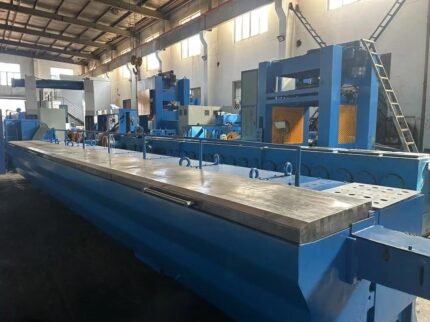
- Cooling & Downstream Quality Assurance: Extended multi-stage water cooling troughs (U-type or straight, stainless steel) sized for high speeds, followed by air wiping, spark tester (0–15/30 kV), inkjet/laser printer, and optional diameter/ovality monitoring.
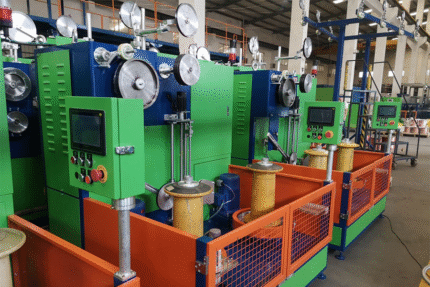
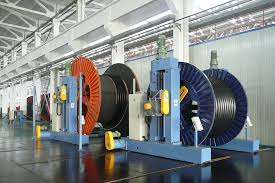
- Pay-off / Take-up Flexibility: Dual or shaftless pay-offs with automatic tension control; dual automatic or semi-automatic take-ups for continuous non-stop production. Optional integration with coiling, taping, shrink-wrapping or full factory material handling systems.
- Auxiliary Options: Automatic granule feeding & drying, gravimetric/volumetric color masterbatch dosing, pre-heater, high-speed inkjet/laser marking, and online quality inspection modules.
The result is cables with superior electrical properties, smooth surface finish, and repeatable quality — fully compliant with IEC, UL, GB, and other major standards.

What Is a Building Wire Extrusion Production Line and How Does It Work?
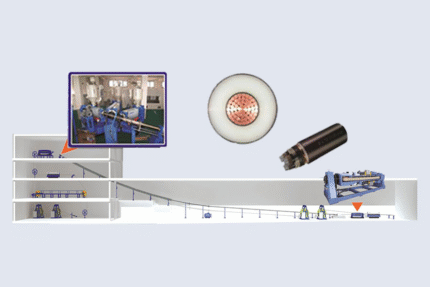
A building wire extrusion production line is an automated continuous process that melts polymer compounds, applies them concentrically around a bare conductor, cools and solidifies the insulation, performs online diameter and spark testing, and winds the finished wire—all under closed-loop PLC control.
The sequence is fixed and data-driven:
- Pay-off with automatic tension control (dancer or accumulator) unwinds the conductor without stretch or breakage.
- Optional pre-heater raises conductor surface temperature to improve adhesion.
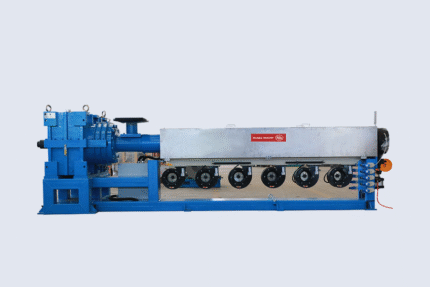
- Single or tandem extruder (screw diameter 45–150 mm, L/D 25:1 or 26:1) melts the compound at 120–220 °C depending on material.
- Precision cross-head and tungsten-carbide tooling form the insulation layer.
- Multi-stage water cooling trough solidifies the melt without voids or ovality.
- Online laser diameter gauge, spark tester (15 kV typical) and inkjet/laser marking provide real-time quality feedback.
- Dual automatic take-up or coiling/wrapping unit completes continuous production.

Technical Specifications
RLBEH High-Speed Series (Small Cross-Section Building Wires)
| Model | Cross Section (mm²) | Finished Diameter (mm) | Max. Line Speed (m/min) |
|---|
| RLBEH-75 | 1.5 – 6 | 6 | 600 |
| RLBEH-90 | 1.5 – 10 | 8 | 800 |
| RLBEH-100 | 1.5 – 16 | 10 | 900 |
| RLBEH-120 | 1.5 – 16 | 14 | 1200 |
RLBEW Series (Medium & Large Cross-Section Cables)
| Model | Cross Section (mm²) | Finished Diameter (mm) | Max. Line Speed (m/min) |
|---|
| RLBEW-90 | 10 – 50 | 15 | 100 |
| RLBEW-100 | 10 – 70 | 20 | 150 |
| RLBEW-120 | 16 – 150 | 25 | 250 |
| RLBEW-150 | 25 – 240 | 30 | 350 |
Note: Actual achievable speed depends on conductor material, insulation type/thickness, and cooling configuration. Custom configurations and higher-performance options available upon request.
Technical Comparison: High-Speed vs Medium/Large Cross-Section Lines
| Parameter | High-Speed Series (RLBEH / equivalent) | Medium & Large Series (RLBEW / equivalent) |
|---|
| Conductor cross-section | 1.5–16 mm² | 10–240 mm² |
| Finished diameter | 6–14 mm | 15–30 mm |
| Max line speed | 600–1,200 m/min | 100–350 m/min |
| Typical extruder size | 75–120 mm | 90–150 mm |
| Primary materials | PVC, LSHF, thin-wall XLPE | PVC, XLPE, PE, nylon (THHN tandem) |
| Concentricity | >92–95 % | >90–93 % |
| Wall tolerance | ±0.02 mm (closed-loop) | ±0.03–0.05 mm |
| Typical output capacity | 150–400 kg/h PVC | 220–550 kg/h PVC |
Production Process Flow
- Conductor pay-off with precision tension control and optional pre-heating.
- Extrusion through optimized screw/barrel and precision crosshead.
- Rapid multi-stage water cooling and air drying.
- Online diameter measurement, spark testing and product marking.
- Capstan/haul-off synchronized to line speed.
- Dual take-up or continuous coiling for uninterrupted operation.
Applications
- Residential and commercial internal wiring (BV, BVR, THHN/THWN).
- Lighting, power distribution and panel circuits.
- Flame-retardant (FR) and low-smoke (FRLS/LSHF) installations for public buildings, tunnels and industrial facilities.
- Compliance with global safety and performance standards.
Primary Applications in Building Wire & Low-Voltage Cable Industry
- Building & Installation Wires: BV, BVV, NYY, H07V-U/R, THHN/THWN, and other single/multi-core cables
- Power & Control Cables up to 240 mm²
- Flame-Retardant & Low-Smoke Halogen-Free Cables for public buildings and infrastructure
- Nylon-Jacketed THHN/THWN Conductors for conduit and industrial wiring
This building wire extrusion line is the smart choice for manufacturers seeking consistent, high-quality output with minimal scrap and maximum ROI.
Why Partner with RLB for Your Building Wire Extrusion Needs?
As a specialized cable and wire machinery supplier with extensive turnkey project experience, RLB focuses on delivering not just equipment, but complete technical solutions that drive long-term productivity and quality. Our lines are designed for reliability, ease of operation, and future expansion. We provide layout design, installation supervision, operator training, spare parts support, and ongoing technical partnership — the foundation of lasting cooperation with manufacturers worldwide.
Applicable Standards and Performance Data
Compliant finished wires meet:
- IEC 60227 (PVC insulated cables for fixed wiring)
- UL 83 / UL 1063 (THHN/THWN)
- BS 6004, VDE 0281, IS 694, GB/T 5023
Key measurable results from modern lines:
- Insulation thickness uniformity ±0.02 mm
- Concentricity ≥90–95 %
- Spark-test pass rate >99.8 % at rated voltage
- Surface finish free of pinholes, orange-peel or burn marks when temperature and tension are correctly controlled
Common Failure Modes and Preventive Engineering Measures
Diameter fluctuation or bamboo effect is caused by unstable tension or incorrect barrel temperature in the feed zone; closed-loop diameter control and precise dancer systems eliminate it. Surface pinholes or cracks arise from moisture in the compound or low melt temperature; pre-drying to <0.05 % moisture and multi-zone heating resolve the issue. Poor concentricity results from worn tooling or misaligned cross-head; tungsten-carbide dies and self-centering heads maintain >92 % concentricity over long runs. Burnt particles appear when residence time is excessive or screw geometry is mismatched to the material; dedicated screws and optimized L/D ratios prevent degradation.
Routine preventive actions include weekly tooling inspection, monthly screw wear measurement, and continuous monitoring of melt pressure and temperature profiles.
Key Takeaways for Cable Manufacturers
A correctly specified building wire extrusion production line delivers high line speed, tight dimensional control and full standards compliance while minimizing scrap and energy use. Material-specific screw design, closed-loop diameter feedback and robust cooling troughs are the engineering factors that determine long-term reliability and cost per meter.
For custom configuration of high-speed or large-section building wire extrusion lines, detailed capacity calculation or technical validation against your exact conductor and compound requirements, Inquiry Now.





Reviews
There are no reviews yet.